
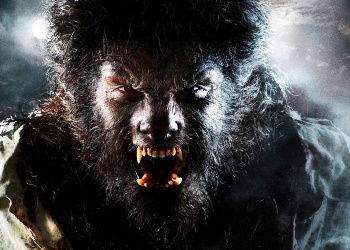
This time of year, all you see are countless shows and movies featuring vampires and zombies. True Blood, The Vampire Diaries, Twilight, Dawn of the Dead and The Walking Dead for example. They’re very popular so why isn’t there a craving for werewolves?
Sure they pop up as supporting characters or villains in vampire productions (see True Blood, Being Human, Underworld and Twilight) but it seems like any attempt to have werewolves as the main draw falls flat.
The most recent example was last year’s film The Wolfman that came and went without much notice. In fact, I believe the last breakout films about them were The Howling and An American Werewolf in London (and their sequels were awful). That was back in the ’80s when their makeup was revolutionary. Maybe it has to do with the way they are usually shown nowadays. Often they use obvious CGI or actual wolves whereas vamps and zombies are done with makeup that still carries the day. Filmmakers need to perfect a new way of presenting werewolves that doesn’t look like CGI.
The Undead Reach New Heights
Some may argue that since the ’90s vampires have been portrayed as very sexual and alluring hence their popularity. That take on vampires actually began with Bela Lugosi’s portrayal of Dracula back in the ’30s. But it wasn’t until Anne Rice’s vampire books that the concept of sensual, tortured vampires truly took off then went to an entire different level of popularity when the Twilight phenomenon started. The result was that the vampire became the superstar of the monster world leaving werewolves and others biting the dust. In terms of novels, there are many werewolf romance novel but they have yet to capture the public’s eye like Twilight has.
For zombies, they appealed to those wanting pure horror soaked with blood and guts and a dash of the apocalypse.  When it comes to gore, werewolves can’t compete with cannibalistic zombies in the ick factor. As everyone knows the modern zombie genre started with George Romero’s classic Night of the Living Dead film and its sequels. Zombies also gained a strong presence with other media like Max Brooks’ World War Z novel, Robert Kirkman’s comic book The Walking Dead and numerous video games such as Resident Evil and House of the Dead. How can a poor werewolf compete with hordes of the undead rampaging through the streets? It’s gotten so bad that a recent episode of Spike TV’s show Deadliest Warrior featured a matchup of vampires against zombies with hardly a mention of lycanthropes.
Sign Of The Times
Many say that the public’s fascination with creatures of the underworld has to do with the times. Modern zombies are seen as a statement about modern materialistic society. IOW we are the undead; mindless drones who only consume. They’re also the great equalizer in the so-called social class struggle. As they feed on the rich and poor alike without regard, zombies have shown that we are all equal when it comes to food. Werewolves aren’t associated with the end of civilization and the one thing they had over zombies, being fast and savage, has been co-opted by recent zombie films.
Vampires not only explore themes of forbidden sexuality but of adapting to the new age while lamenting the old world and its more dignified culture. But the werewolf theme of man losing his humanity and giving in to his bestial nature is a compelling subject. Being Human explored this very well to the point that the werewolf protagonist is a well developed and sympathetic character. Other examples include The Wolfman, Marvel Comics’ Werewolf By Night and the American Werewolf films. There have been attempts to explore the sexual aspects of werewolves, most notably Neil Jordan’s film In The Company Of Wolves and Mike Nichols’ Wolf with mixed results. The gist of werewolf sexuality is the attraction to the rough, bestial nature of someone cursed as a werewolf. The ultimate good girl likes bad boy concept.

Nice Werewolves Finish Last?
Sookie Stackhouse in True Blood has a fascination with the werewolf Alcide that goes beyond her love for Bill and Eric. The attraction could be because Alcide comes off as more human and kinder than the vampires in the show and books. In many of these incarnations, the main character is shown to be a really nice, meek middle class person who uncontrollably releases the primal side. The film Wolf embraces this theme as Jack Nicholson’s character succeeds in life when he embraces his bestial side and stops letting others step all over him. Or take David Naughton’s character in An American Werewolf In London who is a comical, everyday kind of guy who transforms into a murderous lycanthrope with tragic results. The entire concept can be interpreted as an examination of how humanity is cut off from their true bestial selves that need expression.
It’s difficult to pinpoint why werewolves haven’t quite captured the general public’s eye like all the apocalyptic zombies and emo vampires. Perhaps it’s because werewolves aren’t the undead just specialized shape-shifters. Everyone is fascinated with death and the afterlife and zombies and vamps give us a glimpse of this in a way that werewolves cannot. Maybe it has to do with timing and frankly I wonder how much longer the vampire and zombie fascination will continue. To me it seems we’re oversaturated and the public’s attention will eventually shift to something else.
But the real reason for the lack of popularity probably has to do with the story itself. Recently there isn’t a truly captivating character or storyline that grabs the current zeitgeist.  It can happen out of the blue; times and taste will change and the lycanthropes will capture the public eye with a crossover novel, game or film. They’ll get their moment in the moon before long.
Waldermann Rivera



 Starloggers