Season Three Of The Walking Dead Concludes, Part I

Editor’s Note: For those of you who haven’t visited our other site Deadloggers, here’s a brief recap of the second half of the third season of The Walking Dead

daryl-merle

Brothers In Arms

Episode Nine: The pre-credits scene of episode nine of The Walking Dead, “The Suicide King”, opens in the fights arena as the bandaged Governor (David Morrisey) leaves Merle Dixon (Michael Rooker) and his captured brother Daryl (Norman Reedus) to slug it out to the death. The crowd, hungry for action, spurs them on. The Governor’s thugs hover around the arena with harnessed walkers –part of the sport – as Merle pulverizes his younger brother, calling out his declarations of loyalty to Woodbury. Unbeknownst to the crowd, Merle instructs Daryl to follow his lead in escaping as the two turn on the surrounding walkers. Suddenly, Rick Grimes (Andrew Lincoln) and the rescue team raid the arena, throwing smoke bombs and firing shots as they enable Daryl and Merle to slip out …

governorPost-credits, Merle leads the rescue team out of Woodbury, curiously leaving an open hole in the fence. They meet up with Glenn (Steven Yeun), Maggie (Lauren Cohan), and Michonne (Danai Gurira) on the outskirts. Both Michonne and Glenn are incensed that Merle has joined them and both need to be restrained due to their anger. Merle, however, seizes the opportunity to jibe Michonne, sneering a variety of politically incorrect taunts until Rick knocks him unconscious. Heading back to the prison, an argument ensues. Daryl vehemently wants his brother in the group – claiming they need the muscle against the Governor  – but is against Michonne’s presence.  Glenn – his face still red and bruised from Merle’s beating – is opposed to Merle but wants Michonne to stay. Rick, meanwhile opposes the presence of both. Daryl understands Rick’s thinking, and declares that Merle and him will leave the group and fend for themselves. Grabbing his gear, he joins his brother – now awake – and they disappear into the forest. Rick, meanwhile, snaps at Michonne, warning her that the moment she is patched up she is on her own…

Please click on the link to Deadloggers to continue reading about Episode Nine.
rick-walkers

Increasing Tensions

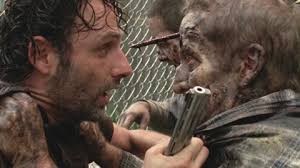
Episode Ten: In the pre-credits scene of the episode “Home”, former sheriff’s deputy Rick Grimes takes a break from manning the prison barricades in order to scope the perimeter. Using his binoculars, he spots a few stray walkers, but then discovers an odd sight: his dead wife Lori (Sarah Wayne Callies), her back turned, standing over hers and T-Dog’s graves in the prison yard. Dressed in white, she stands erect, radiating a spectral, ethereal beauty. Rick grabs his rifle and feverishly heads out to confront her only to find her gone, having re-appeared outside the prison gates. Drenched in sweat and consumed with longing, he finally reaches her. Lori strokes his cheek as they gaze at one another, face-to-face. Michonne, alerted to this curiosity, closes the gate behind him and watches, shocked, as she realizes Rick is deep inside a powerful hallucination…

Post-credits, Andrea (Laurie Holden) visits the Governor in his Woodbury apartment and finds him apologetic and insecure over his eroding leadership skills. Complimenting her over her impromptu speech to the citizens (in the previous episode, “Made to Suffer”), he declares his plans to abdicate and offers to make her his successor. Andrea, stunned at the revelation, is speechless…

Outside the prison, the now-independent Merle and Daryl Dixon are hiking through the forest. Unsuccessful at finding food, there is growing tension and a general lack of agreement between the brothers. Daryl wants to return to the prison, although Merle assures him that the Governor has already annihilated the survivors, leaving Daryl in somewhat of a funk…

merle-daryl

Continuing on, sweaty and gasping for air in the thick humidity, Merle continues taking shots at Daryl, this time over what he perceives are his poor navigational skills. Alerted by noises that shatter the morning calm, Merle laughs it off as animals getting intimate although Daryl recognizes it as a baby crying. Hurrying in the noise’s direction, they spot a horrifying sight: a desperate Hispanic family is trapped on a bridge, surrounded by a herd of walkers moving in for the kill. Daryl races in to help, while Merle remains behind, mocking his brother’s valiant tendencies and yelling after him to “stay put”…

Please click on the link to Deadloggers to continue reading about Episode Ten. Continue reading
Gravity Won’t Let You Go

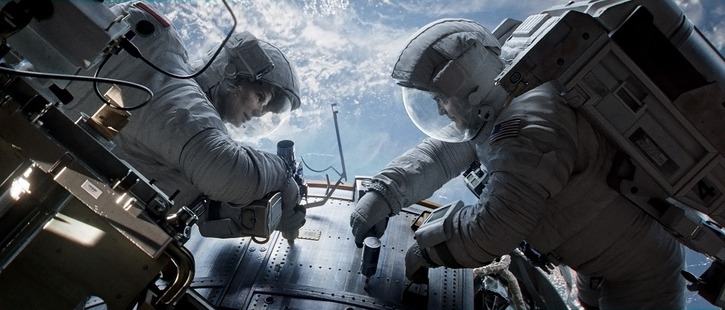
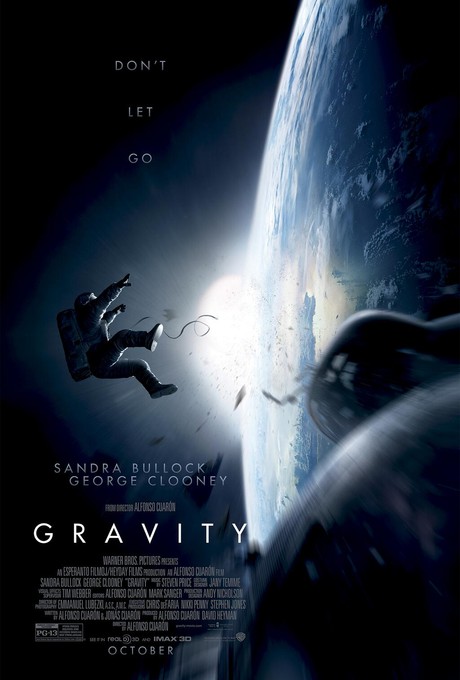
gpWhat Alfonso Cuarón, Sandra Bullock and George Clooney pull off with the film Gravity is nearly miraculous. It’s astonishingly accurate in its depiction of being in outer space, as we experience its dangerous but beautiful aspects.

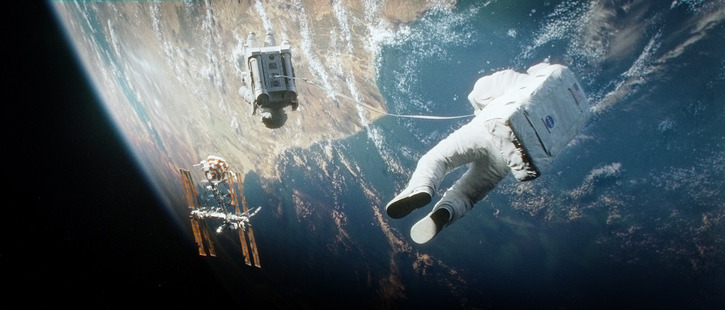
Director Alfonso Cuarón triumphantly filmed this unforgettable movie experience starting with the very first shot. It’s one of his signature minutes-long takes that begins with the majestic vista of the Earth seen from orbit as a space shuttle slowly appears, seemingly out of nowhere. The spacecraft gradually fills the screen as we are introduced to Gravity’s main characters. Darting around the shuttle are Dr. Ryan Stone (Sandra Bullock), a rookie astronaut, who is repairing the Hubble telescope that is docked to the shuttle’s main bay. Darting around her and the ship, almost playfully, is retiring veteran astronaut Matt Kowalski (George Clooney), who still can’t get enough of the space experience. Stone, on the other hand, seems unimpressed with the magnitude of where she is and is somewhat withdrawn. Later in the film, we learn why.

GRAVITY

Before Gravity can turn into another one of those pleasantly relaxing IMAX films about space travel, the astronauts are abruptly warned about an approaching debris field from a destroyed satellite. Then the chilling terror begins as metal debris showers the shuttle. The astronauts are thrown about like rag dolls and the shuttle is damaged beyond use. These pulse-pounding scenes create a sense of terror since we see early on how fragile our heroes are and realize the enormity of their life-and-death situation. Despite the turmoil, Kowalski stays cool and collected, while Stone, like most of us, is in panic mode and for good reason. Somehow, she has to fight her terror and find a way to safely return to Earth.

Bullock gives one of her very best performances in this film. Through minimal dialogue and tension-filled sequences we feel an empathy for her. Stone is a rather nuanced person; GRAVITYwhen we first meet her she is passive and gives in to her feelings of helplessness. She almost seems innocent, and the moments when she is floating in a space station curled up like an infant drive this point home. But by the end of the film, she undergoes a rebirth of sorts as an intense, spiritual metamorphosis takes place. Stone develops an inner, steely resolve. She becomes a fighter, not in the screaming warrior sense, but as someone who can think clearly during a crisis, while displaying a indomitable fighting spirit.

The director uses a minimalist approach to express these themes. There aren’t any great mysteries or philosophical questions to ponder. It’s a movie about survival and finding that inner strength that most of us have to fight against the odds. In this case, Stone has to find a way to return to Earth despite overwhelming odds and her tenuous circumstances. That’s what is so inspiring about Gravity.

GRAVITYAlfonso Cuarón demonstrates why he is a filmmaker to be revered. His work drew me into the film and made me feel like I was there. There are so many little touches that sell the impression that the characters are in space. Things like the lack of sound, except what is heard inside the spacesuits, and the cramped interiors of the I.S.S. with all the floating objects. It’s so realistically rendered that a part of me wondered at times how he filmed all those scenes of weightlessness. It seems like Cuarón took a camera up to the I.S.S. and filmed segments in zero gravity. It’s needless to say that the special effects and cinematography are beyond flawless.

Are there flaws with Gravity? Of course, there are. But so does Star Wars, Avatar, 2001: A Space Odyssey and other groundbreaking movies. Without going into details, let’s just say that a careful observer can spot when dramatic licenses were taken during pivotal moments. But that’s just nitpicking, and such instances don’t approach the level of inaccuracies and plot flaws seen in other recent blockbuster films. Without sounding too hyperbolic, Gravity is a game changer. We see the majestic wonder of observing the Earth from above, but are made too aware of how precarious life is outside of the world’s protective influence. However, its core message was about the resiliency of the human spirit and the fragile but beauteous nature of life. That along with breathtaking visuals, auteur direction and bravura performances, is why Gravity won’t let you go long after seeing it.

José Soto

We3: A Killer Critters Comic Book Perfect For Film

Films based on comic books are the rage we3 coverin Hollywood these days, and not just those based on superheroes. Many are discovering that the printed medium is a breeding ground for terrific sci-fi, fantasy, horror and crime stories. One such comic book story is We3, which should be made into a film.

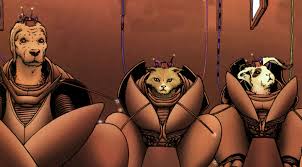
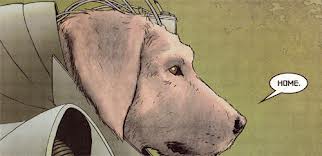
We3 was a comic book mini-series published in 2004 by DC Comics under their Vertigo imprint line. Written by Grant Morrison and drawn by Frank Quitely, the three-issue tale was about a trio of lab animals that were enhanced by the military with bionic implants. The animals were a dog, a cat and a rabbit named Bandit, Tinker and Pirate, respectively. They were fitted with high-tech armor that donned deadly weapons like razor claws and machine guns, and the animals were also had rudimentary speech thanks to skull implants.The animal trio escaped and throughout the series they frantically evaded the military, as they encountered the outside world and other people.

we3 animals

It was both very touching and disturbing since we felt for these abused animals, who didn’t quite understand what happened to them or why. Thanks to Morrison’s script and Quitely’s pencils, it was very easy to build a rapport with the trio and empathize with their plight as they stayed one step ahead of the military. Plus, they were deadly and effective war tools, hence why the military wanted them back at all costs. The story wasn’t just an allegory about the ethics of the military’s use of animals for warfare, but the controversy of animals being subjected to lab experiments. Seriously, look at the way these three animals were outfitted in their robotic armor, the process had to be painful for them. Your heart just goes out these critters whenever they spoke. Their fear and confusion pounded the message home that what was done to them was barbaric.

The mini-series was quite graphic, it clearly wasn’t for children. That could be a reason why film studios may be hesitant to adapt We3. New Line Cinema optioned a live-action film back in 2006 and Morrison even wrote a script for it. Also, Kung Fu Panda director John Stevenson was attached to the project in 2008. Unfortunately, the proposed film has been stuck in development hell and New Line Cinema isn’t involved anymore, so who knows when or if We3 will get made.

dogIt could be done as an animated film, but serious, adult-oriented animated films are a rarity from Hollywood. The subject matter may be too controversial and violent for a mainstream Hollywood movie. It’s easy to imagine parents protesting the film since they thought it was fine for their children to watch. This could happen despite the fact that in interviews, Morrison stated that the violence in the script was toned down to make the story more palatable. Still, such misperceptions would probably plagued a live-action version of We3. Even though Rise Of The Planet Of The Apes did well in theaters, studios might be hesitant to greenlight a non-family film about talking animals that is violent and sure to raise animal rights issues.

But the bottom line is that films based on comic books are everywhere these days. The studios are always looking for something new to adapt and have made successful adaptations like 30 Days Of Night and Red. In the right hands, We3 would make an unforgettable film if adapted correctly.

José Soto

                                                For Laika


The Avengers Assemble to Celebrate Fifty Years Of Teaming Up


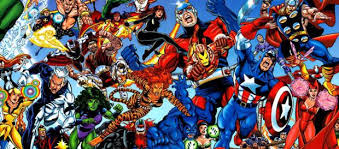
perez avengers

“And there came a day, a day unlike any other, when Earth’s mightiest heroes and heroines found themselves united against a common threat. On that day, the Avengers were bornto fight the foes no single super hero could withstand! Through the years, their roster has prospered, changing many times, their glory has never been denied! Heed the call, thenfor now, the Avengers Assemble!”– Monthly prologue inserted in every issue of The Avengers

Most fans know the story behind Marvel Comics’ famous group of superheroes, the Avengers. In the early ’60s Marvel’s rival DC Comics had a huge hit with their own superhero team the Justice League of America (JLA). In a desire to compete with JLA’s strong sales, Marvel publisher Martin Goodman directed editor Stan Lee to put out their own brand of superhero comics like The Fantastic Four, The Amazing Spider-Man, The Incredible Hulk and The X-Men. Thus, the creation of what general readers know as The Marvel Comic Book Universe was in progress. The popular storylines readers love about Marvel hadn’t been written yet, but the Marvel characters were just created and began their journey of adventures while inhabiting a shared Marvel universe. As successful as these comic books were, the company didn’t have an equivalent to the JLA. In other words, a comic book that featured their most popular heroes teaming up against a huge threat.

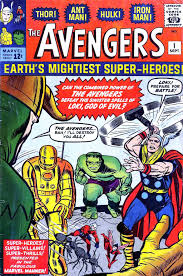
avengers issue 1To remedy this, Stan worked with his long-time collaborator, co-plotter and penciller Jack Kirby to create the Avengers. When Marvel published the first issue of The Avengers Marvel found its equivalent to JLA. Right before the Avengers were created, Marvel had popular heroes like the Hulk, Thor and Iron Man and so it was feasible to do a team-up book since these core members would make a good fit as a team. The comic book was a huge hit with readers because of a formula it followed. The main characters, like the Fantastic Four, didn’t see eye-to-eye with each other. In fact, they fought each other, starting with the very first issue when the Hulk was attacked by the other founding members (it was all part of a ruse engineered by Thor’s wicked step brother Loki). But in the end, the heroes would put aside their differences to battle a force that each of them couldn’t handle alone. What’s more is that these heroes had character flaws, as all heroes from the original Silver Age roster of the Marvel Universe. This contrasted dramatically from the members of the JLA- who were viewed by readers as perfect personalities with no character flaws. Plus, it didn’t hurt that fans loved the famous battle cry “Avengers Assemble!” made by the team.

Enter Captain America

Still, as successful as the book was, Lee and Goodman knew something was missing. There wasn’t anyone who had the ability of keeping the team together; there was no strong leader. They needed someone who had a long-established history to be part of the team. Enter Captain America; co-created in the 1940’s by writer Joe Simon and artist Jack Kirby. Cap’s greatest run at that point, was in the 40’s, when he was popular as a patriotic superhero. But after WWII, sales dwindled for his comic books and he only appeared in comic books occasionally during the 1950s. His return to the Marvel Universe in issue 4 of The Avengers is not just a pivotal moment in Avengers history but in comic book history as well. This was because he is a pop icon who symbolized what was best about America and his heroics dated back to World War II.

His induction into the team changed the tone of The Avengers, too. The stories had more depth and introduced a fish-out-of-water element. What also became apparent is that Captain America was a natural leader and he helped usher in the next important change to the title.

Changing Lineup

Somewhat of a hallmark today for The Avengers is the title’s ever-changing lineup. Lee realized that it was difficult to have so many popular characters in The Avengers while they had their own adventures in their own titles. It was hard to keep up with the continuity and in the end might dilute their popularity. So it was decided to remove the popular characters except for Captain America. The question was who would replace the superstars? In The Avengers #16, photo3Captain America needed to bring in new recruits after the core members left the team. They ended up being Quicksilver, Scarlet Witch and Hawkeye. These choices were out of the ordinary because at that time, they were more known for being villains. Adding to that dilemma was that Hawkeye’s abrasive attitude served as a perfect foil to true-blue, all-American Captain America. Previously, he would give out orders and no one would question him, but now Hawkeye would do so, which added conflict. This element was a big hit with readers and made the book even more successful and reinforced the winning formula: likeable heroes who bicker, but in the end use teamwork to defeat a common foe. Continue reading

The Star Trek Movies Ranked, Part II

Continuing this ranking of Star Trek films, we go from the undeniable classics to the lesser entries in the Star Trek film series. They range from being just okay to junk best seen on Mystery Science Theater 3000. As explained in the previous article, tier three films have their flaws but also boast some admirable qualities about them. Meanwhile, the tier four flicks are absolute junk that should only be seen by hardcore fans or the morbidly curious who want sleep aids.

Tier Three

7. Star Trek III: The Search For Spock (1984): The second Star Trek sequel has so many elements going for it, but for some reason it doesn’t search for spocktake off. After the triumph of Star Trek II, this direct sequel is a huge letdown. Trying to follow up Star Trek II is a difficult task and try as it did, Star Trek III couldn’t equal it, much less top it. For me, it’s hard to pinpoint why this film is a misfire, but for all the important plot developments it doesn’t have much passion.

In this sequel, James T. Kirk (William Shatner) and his core Enterprise crew risk everything, including their careers, to retrieve Spock’s (Leonard Nimoy) body from the Genesis Planet. Once there, they discover that he’s resurrected and now have to save him. There are many pivotal events in this movie; the Enterprise is destroyed, someone close to Kirk is killed, while his best friend comes back to life, and careers are jeopardized. Yet, most of these events feel ho-hum. One thing will happen, the characters reflect about it, then it’s on to the next development.

enterprise blows up

On the other hand, Star Trek III is not to be missed, not just because of what happens in the movie, but for its merits. The character interactions are fantastic and the actors all turn in solid performances. The villain of Star Trek III, a Klingon commander (Christopher Lloyd) is quite menacing and Lloyd plays him more nuanced than your typical Klingon, which was refreshing. The final battle between him and Kirk was also satisfying to watch. Production wise, Star Trek III hits the right marks and this is the movie that introduces the ubiquitous and iconic Klingon bird-of-prey ship and the Excelsior-class starship. Compared to the other films, Star Trek III is a good, but not an outstanding entry in this series.

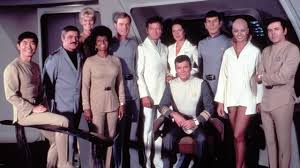
crew8. Star Trek: The Motion Picture (1979): I’ll be frank and say this movie is boring in many parts. Yet, there is so much that I like about it. It is the one film that stays truest to creator Gene Roddenberry’s vision for Star Trek and humanity in the future. Out of all the films, this one is the most cerebral and takes its influence from pre-Star Wars films like 2001: A Space Odyssey, and it does so to a fault.

In the first Star Trek movie, an enormous, destructive energy cloud is headed towards Earth and a newly refitted Enterprise is dispatched to confront it. The lead up to encountering the cloud was pretty good. Remember, when the film came out, we hadn’t seen the original crew in anything since the series ended in 1969. So, the film reveled in re-introducing Star Trek’s many iconic characters like James T. Kirk, Spock and McCoy (DeForest Kelley). That reunion aspect worked very well thanks to Jerry Goldsmith’s majestic and triumphant score, special effects that still hold up today and the cast’s acting prowess–they’re clearly comfortable in their familiar roles.

Well, we’re building up to when the Enterprise confronts the energy cloud. The movie is self-indulgent at parts, enterprise refitbut it’s moving along. Then midway through it, the film comes to a snoozing halt after the first encounter reveals that the cloud is hiding an immense artificial entity that is seeking its creator. Overly long scenes of people staring at special effects plague the movie. They’re pretty to look at, but after a few minutes, it becomes overkill and enough is enough! There is a lot of pondering throughout, in fact, there’s too much of it. But in spite of its faults, Star Trek: The Motion Picture has an ethereal, contemplative quality that is hard to dismiss.

9. Star Trek: Nemesis (2002): This is probably the most underrated Star Trek film in the batch, which is unfortunate. Due to its dismal reception at the box office and with fans, this would turn out to be the last film to feature The Next Generation crew. It does have major faults, such as its by-the-numbers execution and that it outright cannibalizes plot elements from the TV show Star Trek: The Next Generation and Star Trek II. At one point, it was the best ripoff of the first Star Trek sequel until Star Trek Into Darkness came along.

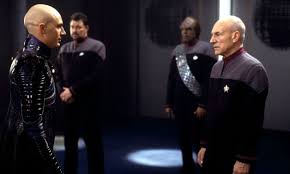
s3Captain Jean-Luc Picard (Patrick Stewart) is ordered to take the Enterprise-E to the enemy Romulan homeworld and meet that empire’s new leader in a peace initiative. This leader turns out to be Shinzon (Tom Hardy), a young clone of Picard and he has a major beef with Picard and the Federation. Shinzon’s unclear motives are one of the weakest elements about Star Trek: Nemesis and that is vital since this film’s premise hangs on the villain. He just lacks the gravitas to be an effective foil for Picard. What’s worse is his lack of reason for wanting to attack the Federation. All Shinzon does is spout corny lines about being Picard’s opposite. It’s probably the film’s clumsy attempt at addressing the theme of duality. Adding to that theme is a redundant sub plot involving the android Data (Brent Spiner) and his duplicate, which already happened n the TV series. The action is unexpectedly flaccid considering that the director (Stuart Baird) was known for helming action films.

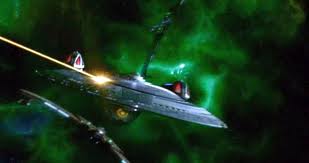
Still, this film has some merits. It features interesting character scenes and it exudes an atmosphere of impending change. The scene where the Enterprise-E is rammed enterprise fightsagainst Shinzon’s warship is pretty cool though, but a major character’s death doesn’t generate much of a reaction from me. It felt forced and trite since it tried to evoke Spock’s death in Star Trek II. With all that, somehow, it serves as a decent wrap up for films featuring The Next Generation crew.  At the very least, the film isn’t dull and has superb special effects and the last score done by composer Jerry Goldsmith. Continue reading