The Walking Dead March On, Part I

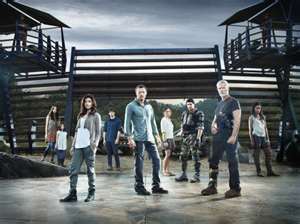
cast photo

The first season of AMC’s The Walking Dead, based on Robert Kirkman’s hit comic book gore fest of the same name, cleaned up in the ratings and kept fans biting their nails on the edge of their sofas.

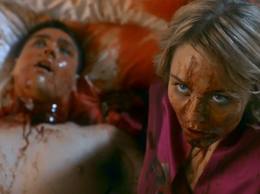
Developed by veteran director Frank Darabont, together with Kirkman, the highly anticipated first season premiered on AMC to universal acclaim in October 2010, setting a record audience for a cable show premiere. Albeit way too short (a paltry six episodes, eliciting a collective groan from fans and critics alike) the not-for-the-squeamish show jumped right into the action. Initially sticking close to the comic, it developed characters, themes, and storylines made only for the TV version. episode-1-rick-3[1]The show follows Rick Grimes, a lion-hearted sheriff’s deputy from Georgia, as he got shot in the line of duty, then awakened from a coma in an abandoned hospital. He found his family and then led them and a small band of survivors to safety through the aftermath of a zombie apocalypse. The Walking Dead delivered the goods: coming in the wake of Lost, the show helped satisfy fans’ craving for a diverse group (old, young, pre-teen, black, Asian, blonde, redneck, etc.), each with his or her own backdrop story to tell, struggling their way out of a helpless situation. The survivors dealt with infighting, romance, the daily grind of scrounging for food and weapons, and most of all, well…zombies.

male-walker-760[1]Where Lost had the villainous “Others,” The Walking Dead upped the ante and put forth the most horrifyingly evil and dangerous cast of villains ever shown on TV: shuffling masses of brainless, gut-chomping, intestine-ripping “walkers” (called so for their habit of endlessly wandering and being incapable of physically tiring). With outstretched arms seeking live flesh, they are slow, nameless, and deadly. As it seems, a bite from a walker turns a victim into a walker himself.  Over the six episodes, aired back-to-back, the show raised the bar for gore-splattering special effects and makeup as we watched the walkers, in varying stages of decay, feast, or get killed from head-bursting gunshots and blood-spraying decapitations.

By the last episode in season one (“TS-19”), the survivors’ ranks were thinning out due to walkers and suicide. Trapped in Atlanta’s Centers for Diseases Control and Prevention (CDC) – where they arrived in a futile attempt to find a cure for the zombie plague – the group used a grenade to blast their way out of the fortress-like government center before it self-destructed. They fled Atlanta to begin a nervous, uncertain pilgrimage to Fort Benning in the hopes of finding a safe zone.

Thankfully, for season two, the top-notch main cast signed on to continue. Among them are native Englishman Andrew Lincoln (who should win an award just doing such a marvelously convincing American accent) as the take-charge Rick; Sarah Wayne Callies as his pretty wife Lori; Jon Bernthal as his best friend and co-deputy Shane Walsh (who had an affair with Lori before Rick turned up alive); Steven Yeun as Glenn, the delivery boy turned resourceful street rat; Laurie Holden as despairing Andrea; Jeffrey DeMunn as the elderly and life-experienced Dale; IronE Singleton as T-Dog, an amiable, stocky black guy;  Melissa McBride and Madison Lintz as gentle widow Carol and her pre-teen daughter Sophia, Norman Reedus as Daryl Dixon, a redneck alpha male archer and already a fan favorite; plus Chandler Riggs as Rick and Lori’s pre-teen son Carl.

Please click on the following links to Deadloggers to read more on Episodes One and Two of the second season of The Walking Dead

Evan Rothfeld

The Thing Continues To Chill Audiences

The cinemas may be flooded with prequels, sequels, remakes and reboots, but The Thing is a worthy companion to John Carpenter’s 1982 classic film of the same name. Both films follow the source material (John W. Campbells novella Who Goes There?) more closely than Howard Hawks’ film from the ’50s.

The storyline is fairly simple, American  paleontologist Kate Lloyd (Mary Elizabeth Winstead) joins a Norwegian research team in Antarctica when the Norwegians uncover a crashed alien craft frozen in the ice. They excavate the ship and bring back the icy remains of an extra-terrestrial that thaws out and displays the ability to genetically mimic any life form, including humans. Much like Carpenter’s film, this one plays a suspenseful and paranoid case of cat and mouse as the humans are picked off one by one by the Thing.

It was a wise move to place the movie in the Norwegian station since it helps make this film a good companion piece to Carpenter’s version. And equally wise to hire Dutch film director Matthijs van Heijningen, since portions of the film were filmed in Norwegian, and someone with equal Proto-Germanic language and cultural background would understand Norwegian characters, the movie cast and culture.  There are some good nuances with the Norwegians by having them converse among themselves in their native language since it helps make this film different while adding to the paranoia that pervades the humans.

Both versions deal with two reactions to our human situation; 1) the group paranoia of who is the enemy and 2) infectious diseases. The paraonid theme from the ’82 version reflects aspects of the Cold War of not knowing who is the spy. With the 2011 version, today’s identity theft problem is similar to what the Thing does. The difference is the Thing is a biological ID thief. Regarding diseases, back in 1982, AIDS was just emerging and most of the world was uninformed about the disease. Today we know AIDS spreads through bodily fluid contact which is how the Thing replicates and takes over humans in the 2011 film version.

But the real highlight was Winstead’s performance who has the same inner strength that Sigourney Weaver had in Alien. Much like Ripley, Lloyd at first doesn’t seem like a natural leader, but over the course of the film, her expertise helps the team to survive and more and more the leadership role is entrusted upon her. Her cleverness helps her in determining who is human or not just by observation and her quick theories of what the Thing is doing, proven right during the course of the movie.. Lloyd is a driving force which illustrates how this film is character driven.

Other standouts are the gorgeous cinematography which makes the scenes look like a National Geographic IMAX film and the music by Marco Beltrami. His score perfectly replicates the ’82 soundtrack. We also get to see the inside of the ship, we see a detailed autopsy and how on a cellular level the Thing replicates, and the effects were a fine blend of practical effects and CG.

This version also helps fill in the blanks and show how the aftermath that Carpenter’s characters discovered came to be. Be sure to stick around during the end credits to see how this film leads to the ’82 version.

Overall, this movie is on par with Carpenter’s classic thanks to Winstead’s character and her performance.

GEO as interviewed and written by Jose Soto

Fringe Begins Its Fourth Season

One of the few returning network TV shows that’s worth watching live premiered its fourth-season opener and Fringe didn’t disappoint devoted fans.

Despite its rich history, this episode “Neither Here Or There” is a bold jumping on point for new viewers. The reason for that is because of FBI Agent Lincoln Lee’s (Seth Gabel) re-introduction to the Fringe Division, which serves to explain what the show is about for anyone who doesn’t know anything about shape shifters, Observers, or amber.

Last season, Peter Bishop (Joshua Jackson),  in trying to prevent the destruction of two universes, was erased from existence which resulted in a new timeline. In this one, Agent Lee’s partner (played by Stargate: Atlantis’ Joe Flannigan) is killed by a strangely translucent man-a really disgusting effect. This leads him to meeting Olivia Dunham (Anna Torv), Walter Bishop (John Noble) and the rest of Fringe Division who investigate bizarre occurrences.

While the episode is set up to introduce new viewers to the Fringe universe, it’s also an intriguing yet subtle re-acquaintance for fans. Yes it’s a new timeline but things aren’t that different. The changes will only be caught by fans like Walter appearing a bit more unhinged than usual. Knowing the show, more clues will be peppered among upcoming episodes. But fans will note that Peter’s existence is critical and his absence should’ve made the timeline more radically different especially when it comes to the simmering cold war between our universe and the “Over There” universe that still exists.

What worked best for the episode were all the clues that weird stuff is going on, best shown with Peter’s ghostly image that literally appears in blinks and the enigmatic Observers who want to preserve the new timeline. It’s all intriguing and makes one want to learn more about what is going on and where it will all lead. Given the show’s history, it’s unlikely that it will disappoint fans. Despite its superficial similarity to The X-Files to casual viewers this program is a lot more than monsters of the week and convoluted conspiracies.

That’s why Fringe is the best sci-fi show on the air right now.

José Soto

Kennedy Space Center Visitor Complex

About an hour east of Orlando in Merritt Island, the Kennedy Space Center Visitor Complex cannot be called a theme park or a museum but it has elements of both. Like any healthy attraction, it’s constantly evolving and offering something new for visitors. And coming soon, the Complex will be the home for the just-retired Space Shuttle Atlantis.

Even though the shuttle isn’t ready for viewing yet that shouldn’t stop anyone whether they’re a space buff or not from visiting the Complex. There are plenty of displays, exhibits and fantastic presentations. It’s hard to see everything the Complex offers in a single day visit. This was not so in its past and it’s a testament to how the place has grown as a viable attraction.

The basic admission includes the Kennedy Space Center (KSC) Tour, IMAX presentations (many of which are in 3D), the nearby U.S. Astronaut Hall of Fame and the Complex’s grounds.

A popular attraction is the Shuttle Launch Experience, which simulates a shuttle launch for visitors. It’s a lot like the Mission: Space ride at Epcot only without the nausea, but it’s still a rough ride and according to many astronauts an authentic recreation of a shuttle liftoff. Next to the facility that houses the Shuttle Launch Experience is a well-detailed mock up of a shuttle called the Explorer. Visitors ascend a winding staircase to get into the craft’s hangar and further up for the cockpit.  And next to the Explorer are mock ups of the space shuttle’s external fuel tank and boosters, those and the shuttle make for memorable photo ops.

Other places to get photos include the Rocket Garden, an outdoor showcase of the rockets and capsules used during the ’60s. These include the Titan and Atlas rockets (plus a huge Saturn IB) and the Mercury, Gemini and Apollo capsules. In fact, visitors are allowed to climb into the claustrophobic. Nearby is the Early Space Exploration facility that features the actual capsules, artifacts and mission control consoles from the ’60s.

But the highlight of any visit is the KSC Tour. Although in-depth guided tours are available for additional fees, anyone can get a thorough visit with the KSC Tour. Buses at a terminal located off to the right of the Complex’s entrance plaza leave for the tour every fifteen minutes. A short ride will take visitors to the shuttles’ launch pads at the LC-39 Observation Gantry and even glimpse off in the distance the air force’s rocket launch pads. The next and final stop of the tour is a grand finale indeed. The Apollo/Saturn V Center boasts an overhead, mammoth 363-foot-long Saturn V rocket which rivals any giant dinosaur fossil display in a museum. There are also space suits, tools, a moon buggy and even a piece of moon rock that can be touched. Visitors can stay as long as they like in the Center before taking a bus back.

But the Complex isn’t just a place that looks at NASA’s past glories, there are many exhibits and attractions devoted to today’s space exploration. At the Astronaut Encounter Theater, visitors can meet and question guest astronauts. The Theater is also playing through December Star Trek Live, an engaging stage show featuring science facts and a time-travel themed storyline. Elsewhere, visitors can see up-close images from the Hubble Space Telescope or be part of Exploration Space: Explorers Wanted. An interactive, multimedia presentation on the possible future of space travel. There are even play areas in the Complex for children, a nature exhibit, an Astronaut Memorial, an art gallery and of course, souvenir shops.

To see everything at the Complex in one day is very difficult and not practical. So consider returning for a second visit. In fact, visitors who get their tickets validated when leaving can return for a second visit within a week. The admission prices are very favorable when compared to Orlando’s theme parks and the experience is much more educational and inspiring especially for future generations.

Article and Images by José Soto

Rise Of The Planet Of The Apes Brings New Life To The Apes Series

More than a prequel, more than a remake or even a reboot, Rise Of The Planet Of The Apes is stunning, moving and cautionary tale of man and his hubris which ultimately causes his downfall.

Strictly speaking the film is a remake of the fourth film of the original Apes series Conquest of the Planet of the Apes and it completely changes the reason why the main character of the chimpanzee called Caesar is intelligent. In the original, for non-fans, the reason for Caesar’s intelligence and ability to speak is because his parents were super intelligent apes who time traveled to the modern era. It makes perfect sense in that film’s logic only it never explains why the other enslaved apes are nearly human in appearance and intelligent.

In this film, the reason for Caesar’s rise is due to genetic engineering and therein lies the movie’s mantra about mankind’s folly and the unexpected consequences of actions both good and bad.

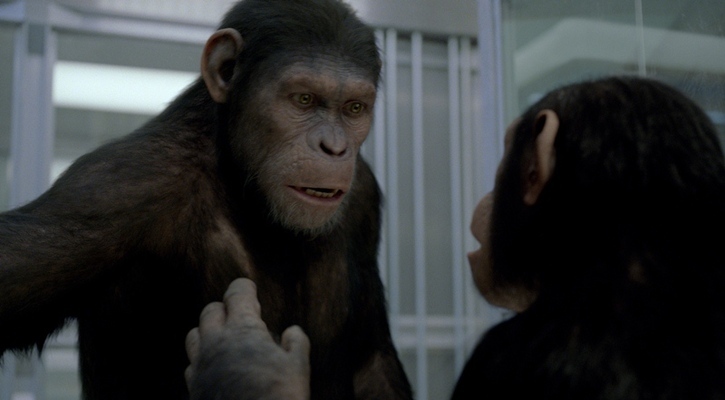
Dr. Will Rodman (played with compassion by James Franco) is a scientist looking for a cure for Alzheimer’s Disease. He develops a retrovirus and administers it to a laboratory chimp with exciting results since she quickly shows signs of human-level intelligence. Unfortunately she is killed but not before giving birth to a baby chimp. Unwilling to have the baby infant put to sleep, Rodman sneaks  him home. Soon he discovers that the chimp (that is then named Caesar) has inherited and surpassed his mother’s uncanny intelligence.

Years pass and Rodman is trying to perfect the retrovirus as he raises Caesar and administers the cure to his ailing father (John Lithgow) who also forms his own bond with the ape. Sadly this bond brings out Caesar’s primal and protective nature which causes him to be removed from Rodman’s home and imprisoned in an ape facility. The cruel treatment he and other apes receive from the handlers there hardens Caesar against mankind and foments a simian revolution.

Before long a new version of the retrovirus is developed in Rodman’s company that can be administered as an inhalant. However, while this new strain boosts simian intelligence it turns out to be lethal to humans. At the same time, Caesar builds alliances with the other imprisoned apes (one of which is a sympathetic friendly orangutan called Maurice, who is naturally smart)and is able to escape from the facility. Caesar steals samples of the new virus and uses them to liberate his own kind. The results are one of the most thrilling and rousing uprisings seen on film.

One can’t help but root for the apes while at the same time be taken aback by their brutality and sheer power. Of course, it’s a story that speaks out against the way animals are treated not just by the medical/scientific community but how we as a species view our fellow creatures in zoos, as pets and in the wild.

Kudos should go all around to everyone who made this film possible from the actors (Franco, Lithgow, Frieda Pinto, Tom Felton, etc.) to writers Rick Jaffa & Amanda Silver to director Rupert Wyatt (these three have reinvigorated the Apes saga in one fell swoop) to Weta Digital. Yes, you can tell in many scenes that CGI is being used, which makes one wonder if real-life apes could’ve been used in many scenes, but honestly it doesn’t take away from the story. That is a sign of a truly great film. Take the original Planet of the Apes, King Kong or Jaws. We know that the filmmakers in those days used dated f/x to bring their creations to life but the audience doesn’t care since they’re so caught up in the storytelling.

Special accolades go to Andy Serkis for his performance capture of Caesar. As with Gollum from The Lord of the Rings films he really brings his creations to life. He and the filmmakers make Caesar the main protagonist as he is transformed from a gifted child prodigy to a tortured prisoner to finally a heroic liberator and leader who despite his hardships holds onto a sense of decency. Serkis deserves at least a special Oscar for his work in this movie.

Viewers don’t have to be fans of the previous films to enjoy this cinematic triumph, which skillfully throws in many references to the series including a Charlton Heston cameo and his famous line from the original film “Get your stinkin’ paws off me you damn, dirty ape!” The line is followed by one of the most powerful one-word replies heard on screen. There are many ways the story can be continued and this film is peppered with many suggestions of potential sequel ideas.

Rise Of The Planet Of The Apes is a must-see for any film lover, it’s not only the best film of the summer but also one of the year’s best.

José Soto