Syfy’s Brave New Worlds Of The Expanse

expanse poster

The latest TV show on the Syfy channel, The Expanse, is that channel’s most ambitious and intriguing series since their re-imagining of Battlestar Galactica. Easily one of the best TV shows ever done from Syfy, The Expanse has been described as a Game of Thrones in outer space. It’s an easy hook to bring in viewers, and one that doesn’t do the TV show justice.
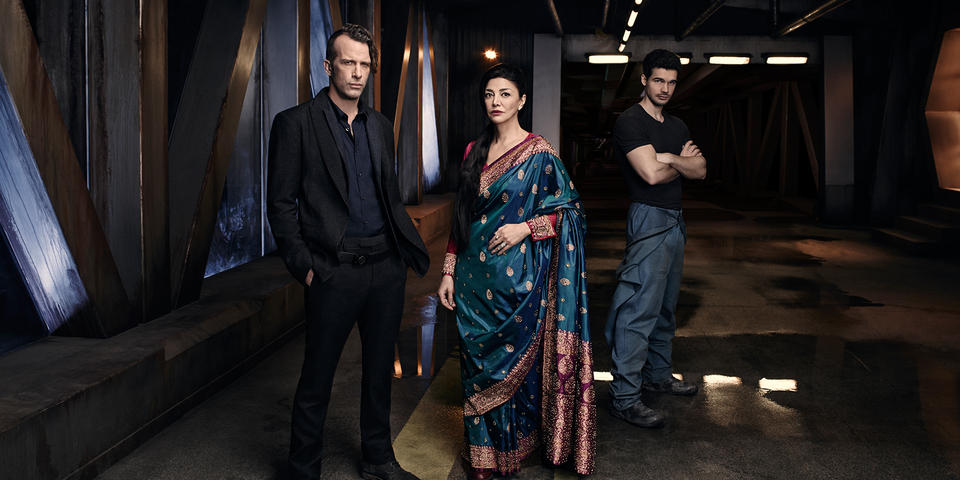
expanse cast

Based on a series of books by James S.A. Corey, The Expanse takes place in the 23rd century where humanity has colonized Mars and the asteroid belt, as well as the moons of the outer planets. A fragile state of cold war exists between Earth, Mars and the colonists living in the Belt, with Earth and Mars being the two superpowers that rely on the resources mined from the Belt. Those living on the Belt, principally on the dwarf planet Ceres, are called Belters and live a hardscrabble existence. Looked down upon by the rest of humanity, these Belters disdain non-Belters and are on the verge of open rebellion. A group called  the Outer Planets Alliance (OPA) has emerged and become a major thorn for Earth and Mars, which considers them to be a terrorist organization.

The Expanse has three peripherally linked storylines; miller investigatesone takes place on Ceres and details the investigation by a gumshoe-like detective called Josephus Miller (Thomas Jane), who dresses the part and has a combover from hell. He gets an assignment to track this missing rich girl from Earth called Julie Mao (Florence Faivre). During his investigations which take him into the seediest corners of the station, Miller begins uncovering a huge conspiracy that threatens to upset the balance of power in the solar system.

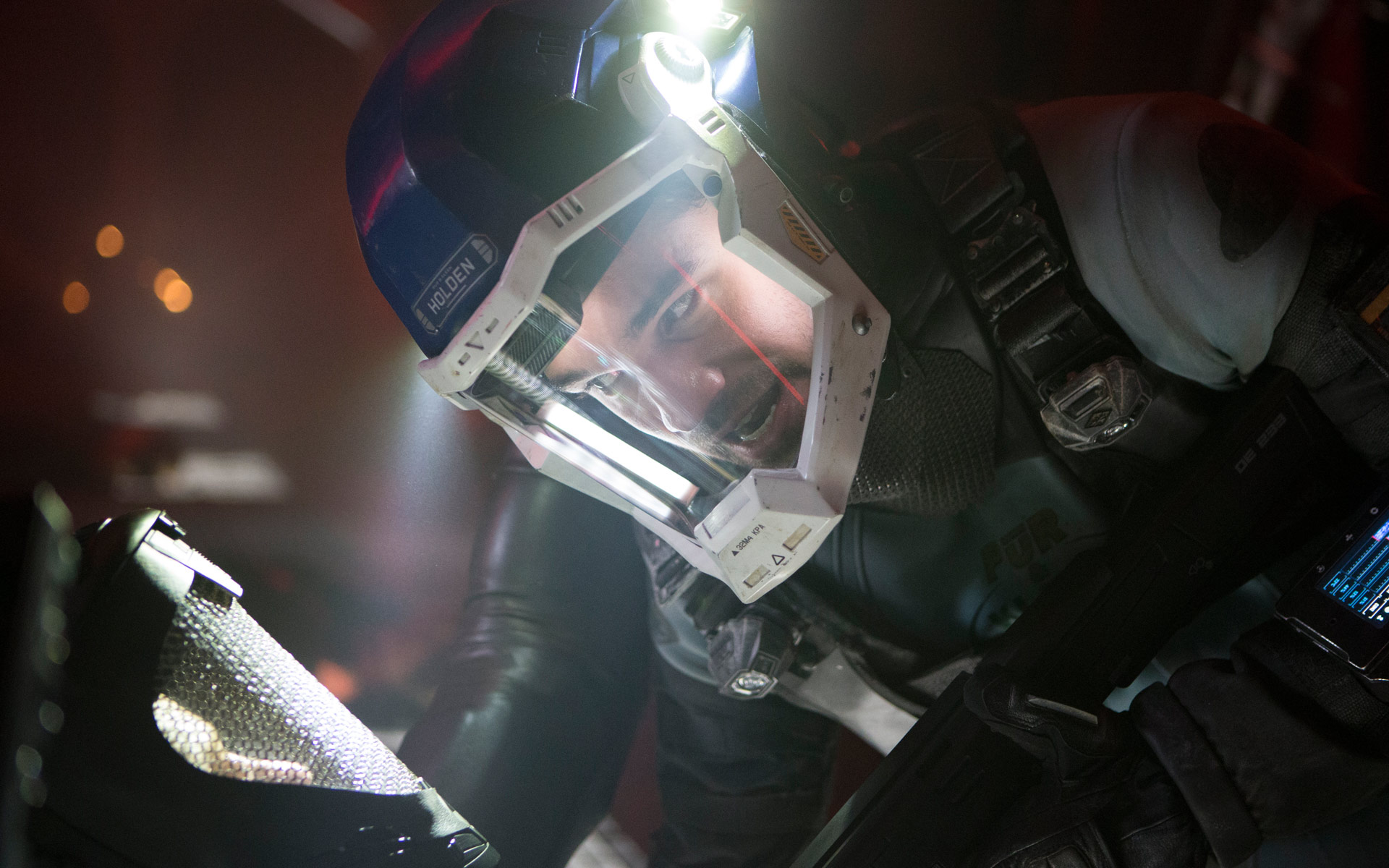
expanse EVA

At the same time, The Expanse chronicles the odyssey of James Holden (Steven Strait), the first officer on the Canterbury, an ice freighter on its way back to Ceres. After answering a bogus distress call from a ship that was the last known location of Julie Mao, the Canterbury is destroyed by an unknown party. Only Holden and a handful of his crew manage to escape in a shuttle. As they struggle to make it back to Ceres, they witness first hand elements of the same conspiracy that threatens to ignite a war.

Meanwhile, on Earth, United Nations diplomat Chrisjen Avasarala (Shoreh Aghdashloo), suspicious of the OPA, becomes aware of the machinations to foment a war between her world and Mars, and tries to uncover the truth before it’s too late.
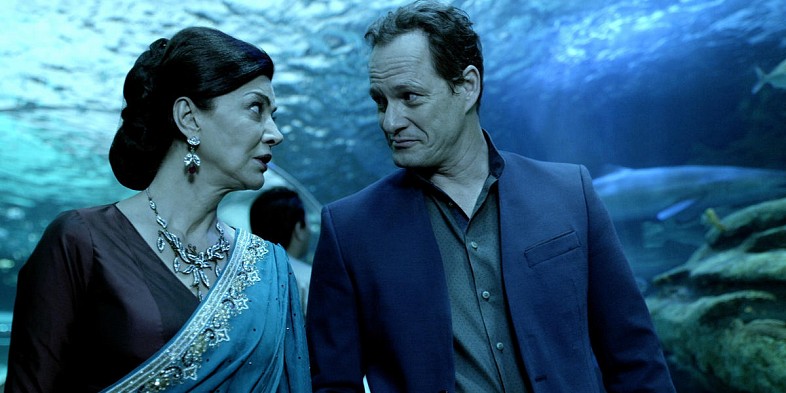
expanse earth

The Expanse has so many nice touches in its depictions of what life in the 23rd century might be like. It’s very commendable that the showrunners often go out of their way to depict environments with low to zero gravity, people griping about paying for air, how much of a paradise Earth seems nyc future(the future skyline of New York City was simply stunning) compared to the cramped, squalid neo ghettoes of Ceres, the strange mishmash dialect of the Belters, and so on. The meticulous production values are worthy of awards and envelop viewers into an imaginative, all-encompassing future that’s reminiscent of sci-fi classics like Blade Runner.

Fortunately, the show also makes the effort to develop the storyline. Watching The Expanse is a lot like peeling an onion. At its core, is a mystery, and we the viewers are forced to figure it out along with the main characters. During the scenes at Ceres, again echoing Blade Runner, we’re presented with a future noir atmosphere that is colder than the space outside the fragile habitats that is hard to look away from. It may be cliché but it’s still effective. The Expanse - Season 1Then the plight of the former Canterbury crew as they witness realistic space battles and life in outer space evoke the grounded grittiness of the Battlestar Galactica reboot only it’s less cluttered with the former show’s ponderousness about lofty themes. At the same time, we’re plunged into this completely immersive and realistically rendered future. The result is a gratifying and involving viewing experience.

The characters are mostly interesting, though some could use more development. They’re all well played with exceptions given to Thomas Jane whose portrayal of Miller would fit perfectly in a Mickey Spillane story and Shoreh Aghdashloo’s dignified performance. However, her scenes often get the short shift in many episodes and many times feel superfluous. For that matter, aside from seeing militaristic Martian crew, we have little to go on how Mars is like except for some spoken descriptions. The red planet and more of Earth are definitely worth exploring in greater detail in future episodes.

naming ship

Showing some wise patience, Syfy has already renewed The Expanse for a second season. Personally, I haven’t read the books this show is based on (something that will be rectified soon), but I hope that the answers to the core mystery will pay off well. In the meantime, I eagerly look forward to the next episode of one of the best sci-fi shows in recent memory.

Lewis T. Grove
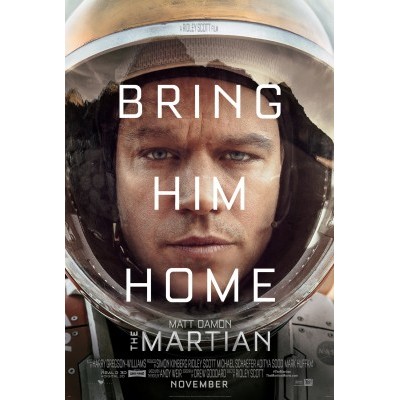
The Martian Survival Tale

martian poster1

Director Ridley Scott’s latest sci-fi offering, The Martian, is a sometimes riveting, but always entertaining survival tale taking place on the red planet.

Based on the novel by Andy Weir, It stars Matt Damon as Mark Watney a botanist who is part of an exploratory mission on Mars. A sudden sandstorm causes the mission to be aborted, but Watney is struck by debris and lost in the storm. Presumed dead, Watney is left behind Mars as his fellow astronauts leave the planet.

watney on mars

Miraculously, Watney survives the storm and makes his way back to his expedition’s habitat. From there he uses his skills and training to live on Mars by growing food, creating water, etc. His dilemma is how to stretch out his limited supplies long enough for an eventual rescue mission that won’t happen for four years. In the meantime, NASA discovers that he is alive and is able to establish communications. With the world now aware that Watney is marooned, all attention and resources are devoted to find a way to rescue the stranded astronaut.

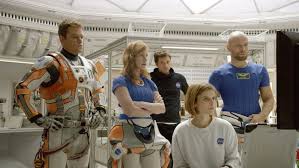
ares 3 crewThe Martian is a well-put together, hard sci-fi yarn that thankfully uses real science to come up with plausible means for a human to survive on Mars. The film is bolstered by a smart script by Drew Goddard and heartfelt performances not just from Matt Damon, who is the centerpiece, but by the entire cast. The Martian literally has an all-star cast which includes Chiwetel Ejiofor, Jessica Chastain, Kate Mara, Sebastian Stan, Jeff Daniels and many more. They all turn in solid work and inject The Martian with needed humanity. This film unexpectedly has a human heart at its core, it isn’t dry or lifeless, and that is what makes it stand out. We see this many times with the scenes back on Earth and in the return vehicle as everyone scrambles and makes sacrifices to bring Watney home. The altruistic efforts certainly give one a pause to hope for humanity. Watney’s plight is shown to be in the film as some kind of unifying event for the world as seen by the large crowd scenes that hark back to the early Apollo missions.

It does have its issues though. It’s heart and emotion are assets, but sometimes they take away from other needed aspects. Many critics are praising its use of humor, but this colonistfilm isn’t some slapstick comedy nor is it that funny. For the most part, the humor works, but it also undercuts the tension that a film like this requires. This doesn’t mean that The Martian is without any thrills, several scenes are captivating and makes audiences curl in theater seats, especially the final act. However, it could’ve used more of a gritty survival aspect that was sometimes glossed over. While audiences saw how underweight he got from lack of food and detailing his efforts to create water, it should’ve have dwelled on his isolation and boredom a lot more. It would have been a bonus to see Watney act as an explorer and let us witness the barren beauty of the red planet. Perhaps he would’ve discovered the flowing water that NASA recently discovered in real life.

watney kneel


Complaints aside, The Martian is an enjoyable adventure that can be enjoyed not just by sci-fi fans but by general audiences.

Lewis T. Grove

Zombies Impossible

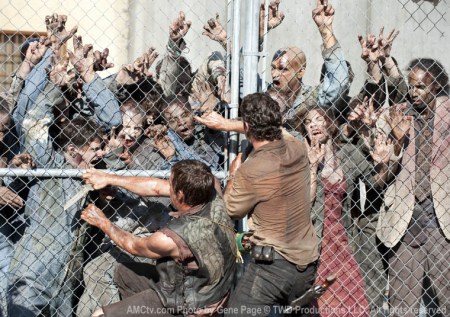
securing-yard

Ever since George Romero popularized flesh-eating zombies in his masterpiece Night Of The Living Dead, the creatures’ popularity have grown. Undoubtedly, zombies are the most popular monsters today, beating out the ubiquitous vampires.

The thought of a deceased loved one, reanimating into a decaying ghoul that only wants to consume you is a terrifying idea. It cuts down to our primal fears of being eaten alive by predators. Zombies have also come to symbolizes the supposed coming apocalyptic breakdown of civilization. As dreadful as all that sounds, we have to ask ourselves how likely is it that the dead will rise up and eat us?

From a scientific standpoint, there isn’t any way that will happen. Let’s think about the concept and go into the logistics.

When a person dies, all their bodily functions cease to function. No blood is being pumped, the brain doesn’t send any signals via nerves to tell the body what to do and so on. Now when zombies are reanimated in these films and other media, a point is made that the zombies are immune to bodily harm. Shoot them, stab them,more brains they keep on coming. Remember that scene in Day Of The Dead when that loony scientist was reporting that the organs in a zombie weren’t working, yet the creatures were animated and hungry. Along the way in these stories, it’s stated that something in the brain is keeping the dead body going, which is why you have to shoot or bludgeon the undead in the head. This was seen in The Walking Dead episode “TS-19” where CDC scientist Dr. Edwin Jenner reported this fact to the show’s main characters.

On the surface it makes sense. Something, a virus, radiation, chemicals, nanobots, and or something else have taken over a dead person’s brain and are sending signals to the body to move and consume flesh. Cut off or destroy the brain and the problem is solved.

The problem is that taking over the brain isn’t enough. The mind needs a system to send out messages, hence the nervous system. A zombie’s brain has to be able to send signals throughout the body, via the spinal cord. Once a message is received, the body still needs energy and the means to move. That is where muscles and blood come in. The heart is the organ that pumps blood throughout the body and the blood transports nutrients and oxygen to mobilize the muscles enabling movement. So a zombie needs a functioning circulatory and nervous system. Therefore, humans should be able to shoot zombies in the heart and elsewhere to kill them.

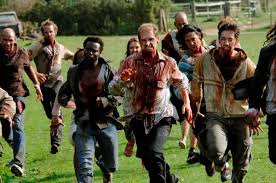
28 weeks laterA more realistic look at zombies are the creatures seen in films like I Am Legend and 28 Days Later. Deadly viruses are to blame for people being transformed into deadly killers, yet they never actually die, but instead mutate. And they can be killed through normal means. That would explain why the infected are able to run after their victims, unlike the lumbering undead in Night Of The Living Dead. In fact, in 28 Weeks Later (the sequel to 28 Days Later) humanity just waited for the infected humans in Great Britain to starve to death before attempting to resettle the decimated country.

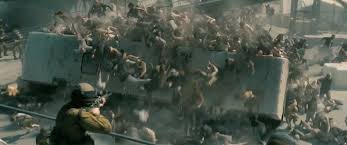
But one thing that doesn’t ring true in those films is how fast the virus mutates a person. Anyone who was infected in 28 Days Later would transform in seconds. This was also seen to varying degree with the walkers in The Walking Dead, the film version of World War Z and other zombie stories. Viruses can’t work that fast. It takes time for the invading viruses to replicate, travel throughout the body and infect the brain. Depending on where a victim was bitten, that person would have a few hours before transforming into a monster.

bicycle-woman[1]Now let’s look at their diets. Why would a zombie eat? To get energy that is needed by the body. This suggests that a zombie would need a working digestive system to break down and process the meat. We go back to the zombie’s body needing circulating blood to help in the process. Yet in these stories, people point out that the zombies aren’t processing the consumed flesh. If that is so, where does the flesh go? If they’re not processed the meat would just collect in the stomach until that organ would burst. We never see any zombies with bloated bellies, do we?

world war z

Of course, the conclusion is that zombies are something that belong strictly in the fantasy/horror realm. George Romero’s films and other works like Dark Horse Comics’ Zombie World speculate or flat out state that the dead are reanimating due to supernatural means. In other words,  magic spells, curses, demonic possessions, pick your poison. Based on how our reality works, zombies can’t exist except in the fervent imaginations of creators and fans. So anyone watching the latest episode of The Walking Dead or playing Resident Evil can relax…for now.

Lewis T. Grove

Gravity Won’t Let You Go

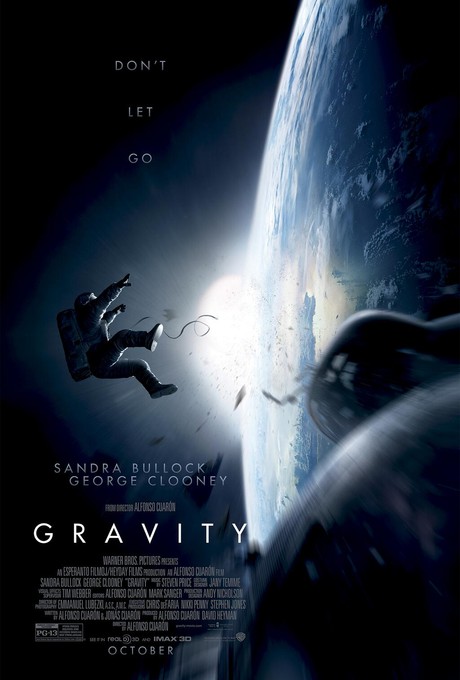
gpWhat Alfonso Cuarón, Sandra Bullock and George Clooney pull off with the film Gravity is nearly miraculous. It’s astonishingly accurate in its depiction of being in outer space, as we experience its dangerous but beautiful aspects.

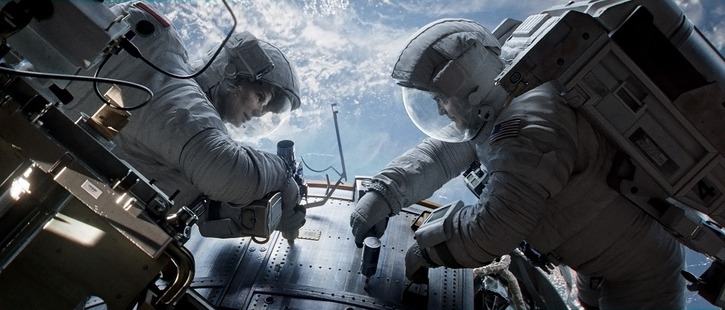
Director Alfonso Cuarón triumphantly filmed this unforgettable movie experience starting with the very first shot. It’s one of his signature minutes-long takes that begins with the majestic vista of the Earth seen from orbit as a space shuttle slowly appears, seemingly out of nowhere. The spacecraft gradually fills the screen as we are introduced to Gravity’s main characters. Darting around the shuttle are Dr. Ryan Stone (Sandra Bullock), a rookie astronaut, who is repairing the Hubble telescope that is docked to the shuttle’s main bay. Darting around her and the ship, almost playfully, is retiring veteran astronaut Matt Kowalski (George Clooney), who still can’t get enough of the space experience. Stone, on the other hand, seems unimpressed with the magnitude of where she is and is somewhat withdrawn. Later in the film, we learn why.

GRAVITY

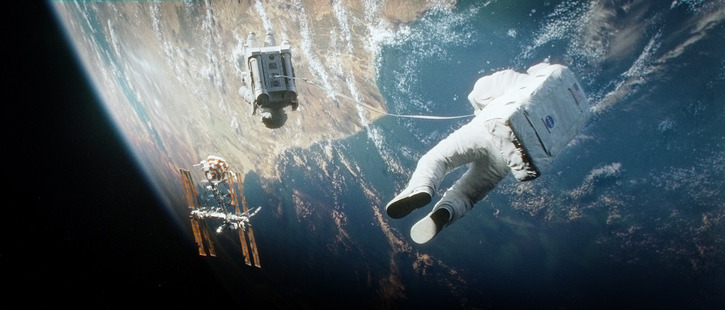
Before Gravity can turn into another one of those pleasantly relaxing IMAX films about space travel, the astronauts are abruptly warned about an approaching debris field from a destroyed satellite. Then the chilling terror begins as metal debris showers the shuttle. The astronauts are thrown about like rag dolls and the shuttle is damaged beyond use. These pulse-pounding scenes create a sense of terror since we see early on how fragile our heroes are and realize the enormity of their life-and-death situation. Despite the turmoil, Kowalski stays cool and collected, while Stone, like most of us, is in panic mode and for good reason. Somehow, she has to fight her terror and find a way to safely return to Earth.

Bullock gives one of her very best performances in this film. Through minimal dialogue and tension-filled sequences we feel an empathy for her. Stone is a rather nuanced person; GRAVITYwhen we first meet her she is passive and gives in to her feelings of helplessness. She almost seems innocent, and the moments when she is floating in a space station curled up like an infant drive this point home. But by the end of the film, she undergoes a rebirth of sorts as an intense, spiritual metamorphosis takes place. Stone develops an inner, steely resolve. She becomes a fighter, not in the screaming warrior sense, but as someone who can think clearly during a crisis, while displaying a indomitable fighting spirit.

The director uses a minimalist approach to express these themes. There aren’t any great mysteries or philosophical questions to ponder. It’s a movie about survival and finding that inner strength that most of us have to fight against the odds. In this case, Stone has to find a way to return to Earth despite overwhelming odds and her tenuous circumstances. That’s what is so inspiring about Gravity.

GRAVITYAlfonso Cuarón demonstrates why he is a filmmaker to be revered. His work drew me into the film and made me feel like I was there. There are so many little touches that sell the impression that the characters are in space. Things like the lack of sound, except what is heard inside the spacesuits, and the cramped interiors of the I.S.S. with all the floating objects. It’s so realistically rendered that a part of me wondered at times how he filmed all those scenes of weightlessness. It seems like Cuarón took a camera up to the I.S.S. and filmed segments in zero gravity. It’s needless to say that the special effects and cinematography are beyond flawless.

Are there flaws with Gravity? Of course, there are. But so does Star Wars, Avatar, 2001: A Space Odyssey and other groundbreaking movies. Without going into details, let’s just say that a careful observer can spot when dramatic licenses were taken during pivotal moments. But that’s just nitpicking, and such instances don’t approach the level of inaccuracies and plot flaws seen in other recent blockbuster films. Without sounding too hyperbolic, Gravity is a game changer. We see the majestic wonder of observing the Earth from above, but are made too aware of how precarious life is outside of the world’s protective influence. However, its core message was about the resiliency of the human spirit and the fragile but beauteous nature of life. That along with breathtaking visuals, auteur direction and bravura performances, is why Gravity won’t let you go long after seeing it.

José Soto

2012 Doomsday Scenarios: Month Eleven

earth

Ever since the first atom bomb was detonated people became aware of our capacity to bring about our own extinction. One of the big fears spawning from the splitting of the atom was the likelihood of scientific accidents bringing about our downfall. Being that we’re so prone to making mistakes, it’s easy to worry that such destructive power has fallen on our clumsy hands.

Doomsday Scenario No. 2: Accidents Happen

The idea of a loaded gun given to a child is an apt metaphor of this doomsday scenario. Many people feel that we as a species are developing way too fast in terms of science and technology before we’re ready to truly understand the implications of new discoveries. By that concern, they point to our recent history with nuclear power.

Nuclear Fears

One of humanity’s deepest fears is that of an accidental nuclear weapons exchange. While it’s true the world powers that possess nuclear weapons have stringent safeguards there are the nagging doubt about their reliability. Back in the 1990s after the Cold War ended it became notoriously easy to acquire nuclear weapons from the former Soviet Union. The thought of such WMDs in the wrong hands is horrifying. But there is the possibility of failed safeguards. This was seen in the film and book Fail-Safe where U.S. bombers are mistakenly sent to bomb the Soviet Union. Despite all efforts, Moscow is destroyed and to avert World War III, the U.S. president arranges to restore the balance by having New York City nuked. A similar situation happened in the Stanley Kubrick film Dr. Strangelove but to a more comedic effect. Accidental nuclear war has also been the subjects of many songs like Nena’s “99 Luftballons” (“99 Red Balloons”) or Men At Work’s “It’s A Mistake”. But what is deeply chilling is that many times military personnel and governments almost used nuclear weapons by mistake. One such incident happened in the mid 1990s when a rocket test launched in Europe was mistaken by Russia to be a nuclear first strike against them and Russian leader Boris Yeltsin was urged by his military to launch a nuclear counter-attack.

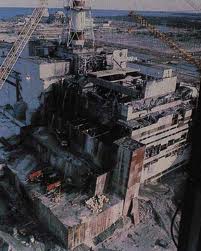
chernobylThen there are the problems with nuclear fission used as an energy source. For the most part, nuclear power plants are safe but the idea of a meltdown and the environmental impact is enough to keep most people leery about them. There was the Three Mile Island incident which thankfully ended well, but on the other hand we’ve had a nuclear meltdown in Chernobyl and most recently there was the Fukushima disaster in Japan. With Chernobyl that disaster left that city abandoned and uninhabitable to this day, while the impact of the Fukushima meltdown is still ongoing with an untold number of people having been exposed to deadly radiation.

Tomorrow’s Experiments

In the world of science fiction, wondrous discoveries and promising experiments often turn into worldwide disasters. In the film The Quiet Earth, a scientist working for a company worked on a global energy grid. What happens next is that the experiment makes all the people, except for the scientist and two other persons, disappear without a trace. At the end of The Quiet Earth, the scientist tries to undo the effect of his experiment but the result leaves him stranded in another reality by himself.

quiet earth

In Kurt Vonnegut’s book Cat’s Cradle, there is an artificial substance called ice-nine which is a type of water that is solid at room temperature. By the novel’s end, ice-nine is accidently released into the ocean which turns practically all the water in the world into solid ice and nearly all life on the planet ends a few days later.

Some scientific experiments and discoveries aren’t as world devastating as those found in The Quiet Earth and Cat’s Cradle, but they come close. In the book FlashForward, an experiment at CERN (European Organization For Nuclear Research) regarding Higgs boson particles unleashes a side effect wherein the entire world population briefly loses consciousness and experiences a few moments of the future. In the TV show based on the book, CERN isn’t responsible for the blackouts but rather a consortium of sinister scientists.

Then there are the dinosaurs of Jurassic Park. In the books and films, dinosaurs are brought back to life through cloning and chaos erupts. The humans are unable to control the dinosaurs in the upcoming Jurassic Park theme park, and this results with the unhindered dinosaurs driving out humans from the park. In the sequel book The Lost World and the film Jurassic Park III dinosaurs are multiplying and beginning to move past their island boundaries. This was dramatically shown at the end of Jurassic Park III when several pteranodons are shown flying out of their island. If dinosaurs were to invade other territories, they would decimate local flora and threaten humanity. Basically our world could turn into a monster film where humanity is at war with giant creatures.

Scientific WMDs

Sometimes the plot lines in these tales has it that the military is secretly testing new weapons or devices with unexpected results. The urban legend about the Philadelphia Experiment details how supposedly during World War II the U.S. Navy performed an experiment onboard the U.S.S. Eldridge to render it invisible but harmed the sailors onboard. A film based on the incident also called The Philadelphia Experiment took the premise a step further and the experiment threatened the Earth when it created a vortex.

The military is also responsible for the catastrophes that ravage the world in the movie The Core. It turns out that after testing a seismic weapon by the U.S. military, the Earth’s core stops rotating, which begins to collapse the protective electromagnetic field  surrounding the world. As the heroes in The Core journey to the Earth’s center to explode nukes that will restart the core’s rotation (!), electromagnetic storms raze the world and structures like the Golden Gate Bridge and the Roman Coliseum are destroyed.

the core 2

This fear about the military experimenting with secret weapons and technology is influenced by their secretive nature and the fact that so little is known about them. Take the H.A.A.R.P. (High Frequency Active Auroral Research Program) project for example. Reportedly, its purpose is to study the ionosphere for applications in advanced communications and surveillance. A lot of conspiracy theorists are convinced that H.A.A.R.P. is being used to create natural disasters like superstorms and earthquakes. Some even claim that it was used a week before the recent U.S. presidential election to create Superstorm Sandy so that the president had an opportunity to appear presidential and win the election. H.A.A.R.P. has also been used in fiction like The X-Files and in several Marvel comics.

Mini Holes and Goo

Some worry that uncontrolled or careless science experiments could lead to the decimation of food, water and oil supplies (in the case of water, this was presented in Cat’s Cradle). But two dominant concerns have arisen about consequential scientific research.

grey gooIn addition to Jurassic Park, author Michael Crichton also penned a book called Prey which was also about technology run amok. In Prey’s case, it was nanotechnology which worries many scientists. Nanobots are recognized as the next step in medical technology. Tiny self-multiplying robots that are invisible to the naked eye can be injected into patients to treat them for cancers and other ailments more effectively than with conventional methods. The same nanotechnology also has other applications but all of this is in the research phase.

One drawback with nanobots is that people may lose control over the self-replicating machines. This would result in out-of-control and rapid propagation. The nanobots will then consume all matter to self-multiply which results in the grey goo phenomenon. In that case unhindered, runaway nanobots will turn everything on Earth into shapeless masses. Grey goo has also covered in other novels like Wil McCarthy’s Bloom and Greg Bear’s The Forge Of God.

Another developing concern has to do with the Large Hadron Collider at CERN, which is the world’s largest particle accelerator. Many fear that the Collider can create mini black holes in the Earth as it collides protons together at near light speeds. Once the miniature black holes are created, they will grow and consume the Earth. However, this hasn’t happened and probably won’t. Scientists believe that any micro black holes will dissipate and actually these proton collisions take place naturally in our atmosphere and we’re still here.

 black hole 2

These micro black holes have plagued several science fiction stories and books like the novel Earth by David Brin is about an artificially created black hole that burrows itself in the planet’s interior which threatens the Earth. Other examples include Larry Niven’s The Hole Man and The Borderland Of Sol, Dan Simmons’ books Ilium and Olympos, and Martin Caidin’s Star Bright.

cern

It was also feared that the Collider would also create strangelets or strange matter. This subatomic matter is largely theoretical but if they were to be formed they would tear holes on our planet. The novel Impact by Douglas Preston has an alien machine that creates strangelets and the TV special End Day featured a scenario where a created strangelet destroyed the Earth.