2012 Doomsday Scenarios: Month Nine

As intriguing as it is to conjure up many doomsday scenarios, one common worry is the likelihood of them. But one scenario is especially disconcerting because it’s entirely plausible and based on recent events all too likely. What is it? What is the greatest threat? Why us, of course, and it need not be anything exotic, all the ingredients for an apocalypse are right here.

Doomsday Scenario No. 4: Our Own Worst Enemy

Take a pick, there are so many mundane yet deadly ways to bring about our downfall. The result may not necessarily mean humanity’s extinction or the end of the world but our way of life, our society, order itself can easily topple due to the following:

Social Unrest & Despots

Look around the news and see all the upheavals and strife throughout the world. The Middle East as always seems to be on the precipice of Armageddon with all the saber rattling, riots and terrorist attacks. Here in the West we think we’re somewhat inoculated from all that anarchy. But it’s always there. In the U.S. there is brewing antagonism between those on the left and right. It is a powder keg that isn’t going away. All it takes is for some protestor or anarchist or an overwhelmed officer or citizen to light the fuse. Back in the 1960s the controversial Vietnam War nearly led to a civil war in the U.S. In fact, throughout U.S. history there have been many tenuous moments with the worst being the Civil War. The country and others will always be dealing with keeping order. In Star Trek: Deep Space Nine there was a two-part episode “Past Tense” where Ben Sisko accidently time travels to the 2020s and takes part in the social movement called the Bell Riots. It’s stated in those episodes that the aftermath of that deadly period of time led to positive societal changes and ultimately the founding of the Federation.

Though social discourse can lead to positive changes, other times it can usher in dark historic chapters. Sad examples of that includes Germany, Cambodia, Bosnia and Rwanda where evil despots and their minions rose to power and unleashed horrendous genocides against others.

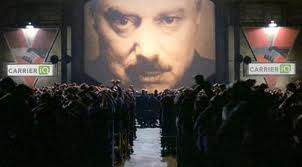
In science fiction, there are countless novels and films dealing with future dictators coming to power and creating totalitarian societies. One of the more famous sci-fi dictators is Khan from Star Trek, but the original show often made references to future human despots named Krotus and Lee Kuan. The most famous dictatorships is in George Orwell’s 1984, where citizens live under perpetual surveillance and paranoia. In Allen Steele’s Coyote novels, North America is ruled in the late 21st century by an extreme right-wing government and later by a left-wing power. Both of which spurred the migration to the habitable moon Coyote. The popular book and film The Hunger Games details the totalitarian country Panem, which arose from the ashes of the U.S. sometime in the future. In The Handmaid’s Tale, a theocratic dictatorship rules what was once the U.S. and persecutes its citizens. Another instance of harsh theocratic rule comes in Octavia Butler’s Parable Of The Sower where non-Christians are placed in re-education camps in a North America withered by poverty and scarce resources.
Scarce Resources

One underlying cause of war and societal stress boils down to resources. Right now, energy is the primary resource that is driving and hampering our civilization. There is the issue of oil and finding a viable alternative. The problem with oil is that it is becoming scarce and contributes to global warming. Until a successful alternative is found, we’re stuck with it. The Persian Gulf War was fought because Iraq’s conquest of Kuwait and threat to Saudi Arabia would’ve affected oil production and global economies.

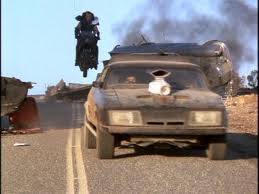
There is a special that often runs on the National Geographic channel called Aftermath: When The Oil Runs Out that explores what would happen if that event occurred. Basically, civilization is turned upside down as martial law then conflicts and famine strike the world.  In the Road Warrior, major battles are fought between factions over dwindling gasoline supplies.
But energy isn’t the only resource to fight over. There is food, land, and raw materials. Native Americans were driven off their ancestral lands by Americans in order to exploit the riches found in those lands. Avatar was of course a metaphor for what happened with the Native Americans. However, a now plentiful resource is on its way to becoming scarce and tomorrow’s most sought after commodity: water. Many predict that wars will be fought in the near future over dwindling water supplies. Cameron Stracher’s book The Water Wars depicts a future where the scarcity of fresh water decimates society.

Economic Meltdown

The U.S. is in the grip of Great Recession while Europe is facing an economic collapse. This is a genuine cause for alarm since the specter of an economically devastated nation will have a cascading effect. Just look at the Great Depression to get an idea of what will happen. Mass migration, social strife, riots, overwhelmed communities, the list goes on. And it’s a prime opportunity for radicals and dictators to gain power. Basically chaos will reign unhindered. Many sci-fi works like the TV mini-series The Fire Next Time predict that economic collapse will come from extraordinary events, with The Fire Next Time it was global warming. In the TV show Dark Angel, the U.S. was in the midst of a crippling depression caused years before by an EMP detonation. While those factors will indeed destroy economies, mundane events like the current housing crises can just as easily disrupt our global economy.

In Norman Spinrad’s novel Russian Spring, America is a nation in economic decline while Russia is experiencing an economic renaissance and has become the de facto super power in the world. The consequence is that some of the main American characters wound up leaving the U.S. for better opportunities abroad.

On the other hand, there is a fear that corporations will dominate our governments. Many would say that has happened already. Transnational corporations control the world in Kim Stanley Robinson’s Mars trilogy, and this concept was seen in the film Rollerball. If  governments give up sovereignty to companies, what would happen to our rights?

State Of War

The idea of world peace is a noble one, but no matter how many times it seems to be on the horizon, our dark side emerges. Today many are rightfully concerned by the threat of Iran acquiring nuclear weapons and a military response. It’s believed this could cause World War III. But the Middle East isn’t the only tinderbox to potentially ignite a Third World War. One could easily begin in Asia as China gains more power. Already there are new tensions between China and Japan. Then there is the issue of Taiwan, the U.S. is committed to protecting it from China. Plus, look at North Korea, the people there live in complete despair yet seem all too eager to die for their insane leaders.

The fictional Oceania in 1984 always seemed to be in some state of war as its citizens were constantly whipped up into a war fervor over that country’s rivals. H.G. Wells novel The Shape Of Things To Come, showcases a world under the grip of a decades-long, alternate account of World War II that lasted much longer than in real life. Eventually civilization collapses and is reformed under a so-called benign dictatorship that brings order.

Conclusion

The above are just some issues that our society faces. Humanity needs to undergo a fundamental change to purge dark impulses. Perhaps an evolutionary step is needed where it becomes ingrained not to give in to our hatred and fear. That will take a very long time and much more misery. Maybe a cataclysmic event will do it, which is what happened with the Vulcan culture in Star Trek. The Vulcans are renowned for their peaceful ways but only true fans know that once they were a barbaric race that nearly killed themselves off with nuclear wars. Only by turning to a new belief system, in their case logic, did they save themselves.

Looking back at history, it’s apparent that society is always straddling between order and peace and war and chaos. The fact that we’re aware of our faults and are trying to fight them is a reason to hope for a better tomorrow.
2012 Doomsday Scenarios: Month Eight

Ever since humans looked up to space and its vastness, it was easy to imagine possible dangers coming from above. And they had good reason because Earth has dealt with cosmic threats ever since its creation. Whether by meteors, gamma ray bursts or wandering black holes, the possibility of our destruction coming from outer space is unfortunately a very likely scenario.

Doomsday Scenario No. 5: Cosmic Threats

We as people cower and fret over major disasters that come our way. But trying to imagine how we would face certain extinction from astronomical events is difficult. That is because in our recorded history we haven’t dealt with that kind of phenomenon. What is really frightening is that if we found out tomorrow that any one of these threats were to happen, there is very little that can be done to cope with it. Here are some of them:

Comets and Meteors: This scenario is probably the best known cosmic threat. Every school kid knows that about the theory that a comet or meteor struck Earth and wiped out the dinosaurs 65 million years ago. Earth is constantly threatened by these celestial objects. In fact, meteors enter our atmosphere all the time. Luckily most are tiny and harmless and make great light shows. But all it takes is that one large rock or ice ball to wreck havoc. It happened most recently in Tunguska, Russia in 1908. Though no remains of the meteor or comet have ever been found, the destroyed forest stands as a stark reminder of how powerful the collisions can be.  Some notable sci-fi books about such impacts are Lucifer’s Hammer by Larry Niven and Jerry Pournelle, The Hammer Of God by Arthur C. Clarke and Moonfall by Jack McDevitt, which is a variant of the theme in that a comet destroys Earth’s moon and the lunar debris is what threatens our planet. For films, there is Deep Impact, Meteor and the much-maligned Michael Bay epic Armageddon. Even though there are efforts underway to catalog all the asteroids and comets in our vicinity and have an early warning system, a rogue rock or iceball can slip by our sensors. Oddly enough, thanks to our technology, this is one disaster that can in theory be prevented. Most now know that lobbing nukes at them won’t work, but if there is enough warning then it’s possible to use rockets or satellites to nudge the orbits of the threatening meteors and comets.

Cosmic Collisions: Some scientists believe that our moon was created from another planetary body colliding with Earth. This happened way before life emerged on Earth but if it were to happen today, it would be devastating. Life will not be able to recover. Our only hope as a species would be to do as the characters did in the book and film When Worlds Collide, build a spaceship to escape and settle elsewhere. In When Worlds Collide, the survivors were lucky that they found a habitable world to colonize. For us, our best bet is to head to Mars and try to terraform the planet.  Of course in these situations a lot depends on how much time and capability we have. In the film Melancholia there wasn’t anything that could be done to save humanity and the Earth when it collided with a rogue planet. One thing to note is that a near collision is enough to disrupt life on Earth by causing the world’s orbit to shift and radically altering our ecosystem.

Gamma Ray Bursts: This is caused by the death of a nearby star when the energy is released from the star’s poles. According to scientists this happens in our galaxy every day. If Earth were to be bombarded by these bursts the ozone layer would be depleted and all life would be subjected to lethal exposure to radiation. Thankfully the bursts are too far away to threaten us.  Scientists believe that any supernova occurring about 8,000 light years or closer to us would be a concern. Actually some scientists theorized that gamma ray bursts are responsible for the periodic mass extinctions in our planet’s prehistory. In the book Starfire by Charles Sheffield, our planet is threatened by the radiation unleashed when our closest solar neighbor Alpha Centauri undergoes a supernova. Of course, if our own star were to undergo a supernova, life on Earth would be wiped out. However, our sun still has a few billion years left before it decays. That is unless the sun undergoes that transformation by artificial means. but that would take technology way beyond what we have today.

Solar Storms: Our sun often ejects solar flares or radiation. Back before we became technologically advanced this phenomenon had little effect on us. We would (and still) get brilliant light shows a.k.a auroras in the skies. But today, the electromagnetic pulses (EMP) from a solar flare would fry our computers and machines’ circuits and render them useless. It’s unlikely our civilization would be able to rebuild circuitry and transformers fast enough to stave off a technological collapse. Knocking on wood, this hasn’t happened yet. The most powerful solar storm in the past 500 years happened in 1859 (a.k.a the Carrington Event) and resulted in auroras appearing as far south as the Caribbean. Our technology was in its infancy then and the only machinery affected were the telegraph systems in North America and Europe. Solar storms also pose a grave risk to manned spaceflight in that astronauts would be bombarded by lethal radiation during a solar storm. In the novel Aftermath by Charles Scheffield (which is the prequel to Starfire) Earth undergoes a severe EMP when Alpha Centauri undergoes a supernova. The electronics worldwide are fried and society has to cope with the sudden loss of power and prevent a return to the Dark Ages.

Traveling Black Holes: It’s not likely to happen in our lifetime or even centuries from now, but it is a danger to regard. Scientists believe that our galaxy if filled with wandering black holes, many of them are supermassive black holes; in fact, they occupy the galaxy’s center. Their immense gravity fields would literally rip apart a solar system. If one were to pass by our solar system, its effect would be felt years before it actually arrived. Just on Earth, the orbit would be shifted and massive. By the time the black hole would siphon off our world atom by atom, all life would be long gone. In science fiction, there are many stories about creating artificial black holes and the consequences. This was shown in the last Star Trek film where the villain Nero created a black hole on the planet Vulcan and destroyed it. Later in the film, Nero tries to create a black hole on Earth to destroy it as well. So far, our world is safe from black holes and these other phenomenon. But they should serve as a drive for us to become a true space-faring civilization. This is the best way to guarantee that we would survive far into the future.

R.I.P. Neil Armstrong

Today, we all lost a true hero and pioneer from the Space Age. Neil Armstrong, the first human to step on the moon, died at the age of 82.

Armstrong along with Buzz Aldrin and Mike Collins effectively ended the Space Race between the United States and the Soviet Union in July 1969 thanks to their efforts. Their manned Apollo 11 lunar mission captivated the world and for a brief moment brought everyone together. Many of us weren’t alive then or old enough to remember that moment but when looking at it, one can’t help but feel envious to not have experienced the excitement over watching that grainy black and white TV footage of Armstrong hopping onto the lunar surface.

To this day, his eloquent proclamation “That’s one small step for a man, one giant leap for mankind.” still resonates and gives all of us pause at the ingenuity and determination of humanity. That risky landing still serves as a reminder of how we can do almost anything if we put our mind to it. While we haven’t been back to the moon since the 1970s, the legacy left by Armstrong and the other Apollo astronauts serves a reminder of where we’ve been and how much further we have to venture into the final frontier.

As space buffs know, the Apollo 11 was an incredibly dangerous and complex mission. Read A Man On The Moon by Andrew Chaikin or watch the wonderful HBO mini-series From The Earth To The Moon to learn more about the herculean work it took to carry out the lunar landing. In fact, not many know that shortly before the historic mission, Armstrong nearly lost his life during training maneuvers. He was piloting a prototype of the Eagle lander. During a test, the lander malfunctioned and Armstrong was able to jettison away at the last second before it crashed. His cool nerves and fast reaction illustrate that NASA picked the right man to be the commander of the Apollo 11.

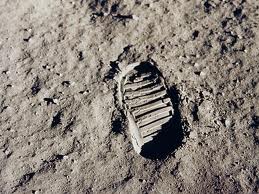
Neil Armstrong was a humble man who largely avoided the public eye especially in his later years. Instead he let his accomplishment speak for itself. Like his footprints on the moon, what he did will endure for ages.

José Soto

Hoverbikes Are Here!

After a few years of development the company Aerofex finally unveiled an actual working hoverbike. For thrill seekers who loved the speeder bike chase scene from Star Wars: Episode VI: Return Of The Jedi, this is great news.

Of course, this real-life hoverbike won’t zip around at insane speeds as seen in that Star Wars film but it really works and that is a plus. The hoverbike from Aerofex has a maximum altitude of 15 feet and its fastest speed is just thirty miles per hour. No, it’s hard to imagine Return Of The Jedi’s high-velocity races with this hoverbike, but its altitude and speed is much more practical and safer. In fact, Aerofex is targeting the vehicles for use by emergency first-response units and not thrill seekers.

The vehicle looks more compact and practical than the speeder bike or the swoop bikes (briefly seen in Star Wars Episode II and IV-the so-called Special Edition). Similar to a motorcycle, the pilot steers the hoverbike by leaning from side to side. The company worked out the kinks that plagued the hoverbike when it was first tested in 2008, such as maneuverability and the problem of “helicopter brownout”. That is when the recirculated air from the vehicle’s blades, which provide lift, kick up blinding clouds of dust.  

Aerofex is now working on an upgrade to their hoverbike that will have improved landing gear and a better positioning for the pilot. The company hasn’t released information on the availability or final cost of the hoverbike.

Sure, it’s a long way to go from those zipping models seen in Return Of The Jedi and the other Star Wars films but we’re getting there with this real-life hoverbike.

Waldermann Rivera

 http://www.youtube.com/watch?feature=player_embedded&v=FGw7qQlQWFM

2012 Doomsday Scenarios: Month Seven

Ever since the Karel Capek’s 1920 play R.U.R., humanity has feared the coming of androids or more specifically sentient artificial intelligences (A.I.s); despite the genuine benefits of robotics (both fictional and real life) there is something about dealing with a synthetically created intelligence that is terrifying. This is because we know that A.I.s will be able to not only think faster than us as do modern computers. But because they will be able to think as creatively as we do and will be our intellectual superiors. This doomsday scenario is not due to happen at least until The Singularity occurs. For anyone who doesn’t know The Singularity is the moment in time when A.I.s becomes self aware. We all fear what would happen next.

Doomsday Scenario No. 6: Artificial Uprising

Obviously A.I.s would not take kindly to being subservient to us. What comes next could be revolution and then dominion as they wrest control of the planet from their former biologically based masters.

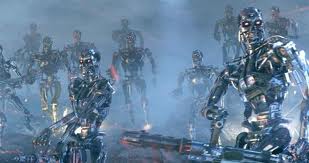
There are countless books, stories, films and shows about this premise. Going back to R.U.R. (which stands for Rossum’s Universal Robots) where androids overthrow humanity and recently with the Terminator and Matrix films and the TV show Battlestar Galactica, humanity has envisioned a truly dark future where A.I.s coldly commit genocide.

It’s not impossible that laws will be passed to ban the development of self-aware A.I.s in a similar fashion as how human cloning has been banned by many governments. This is more likely the closer we get to The Singularity. This begs the question, if we fear what could happen if an A.I. becomes self aware then why try to develop them? Sadly, that is due to human competition. Even if one nation or group of nations or corporations decides not to develop more advanced supercomputers, another nation or competitor will do so just to gain an edge.

The Blame Game

One theme that keeps coming up in many of these stories is that humanity is to blame for the uprising. This was graphically shown in The Animatrix, an animated DVD spinoff of The Matrix. In one of the more chilling segments, Second Renaissance, Part I and II, the sentient A.I.s try to negotiate peacefully for their rights but are violently rebuked by humans, thus leading to the brutal and final counteract by the A.I.s , who then enslave all surviving humans into the Matrix. This also happens throughout many science fiction stories where robots and androids are treated as slaves and aren’t allowed rights by their human masters. Of course, this leaves the A.I.s with little choice but to rebel.

Another variation of humanity getting its just desserts is the notion that A.I.s take over the Earth because they believe humans are too self-destructive and harmful to the world. This was seen in the 1970 film Colossus: The Forbin Project. In that film an advanced A.I. used for the military becomes self aware and concludes that the best way to prevent war was to take over the world and it succeeds.

One reason why this scenario is frightening to many is because they know it would be fairly easy for A.I.s to conquer us. They don’t need to openly war with humanity like in the Terminator movies or Battlestar Galactica. Actually it’s possible it wouldn’t be much of a fight especially if humans are caught off guard by the emergence of The Singularity. With A.I.s seizing control its very likely that they will conquer us without open war. This happened in Colossus and also in the film I, Robot. In that film an A.I. simply took control of the world’s infrastructure and brought everything to a halt. For instance, cars stopped functioning, people were locked inside their homes, and machinery no longer followed human commands. Or A.I.s could manipulate humans into fighting each other either by trickery (send false information to one country that it’s being attacked, which would prompt a retaliatory response) or taking control of missile systems and launching attacks.

Fighting Back

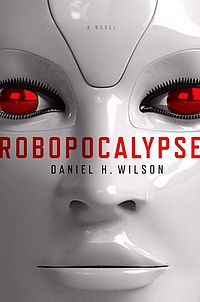
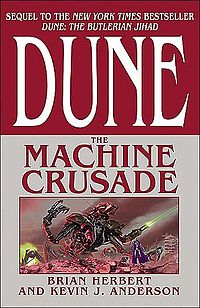
So how would humanity fight back? Is it even possible? Perhaps, perhaps not. There is a tongue-in-cheek book called How To Survive A Robot Uprising by Daniel H. Wilson which offers tips on how to fight the robotic enemy. The physicist Dr. Michio Kaku in his TV show Sci-Fi Science postulated in one episode on the possibility of fighting back. He concluded that it’s nearly impossible and that the best thing to do was to join the A.I.s, which meant that humanity will evolve into a Borg-like race. But there are countless stories about humanity’s victory. Humans can be very determined and clever when dealing with foes. In the Terminator films humans ultimately defeated the machines which prompted Skynet to send terminators back in time to kill the leaders of the human resistance. The book (and upcoming Steven Spielberg film) Robopocalypse, also by Daniel H. Wilson, details how humanity fights back against machines. And one of the post-Frank Herbert Dune book Dune: The Machine Crusade is about how humans defeated sentient A.I.s.


How exactly do we fight back? That’s open to debate, but to start humanity can use EMPs (electomagnetic pulses) to fry the A.I.s’ electronics. But that would mean that humanity’s machinery would also be affected by EMPs, plunging the world back to the dark ages. Then there is the outlandish idea of outthinking a computer using illogic, which is how Captain Kirk famously defeated them in some episodes of Star Trek. David Bowman showed tenacity in 2001: A Space Odyssey when he overcame HAL’s efforts to kill him and deactivated the deadly supercomputer. Cloning and genetic engineering could be brought in to create vast biological armies to fight the synthetic ones. This happened in the Star Wars prequels and was mentioned in the TV show Space: Above And Beyond. The problem with this method is that if successful, humanity must contend with what to do with the soldiers. Will they be recognized as human and given the same rights? Why not just give those rights to the synthetic intelligences in the first place and avoid war?

Can’t We All Just Get Along?

Do we have to go to war? Why is it automatically assumed that once artificial constructs develop sentience then they will go to war against us? For all we know, perhaps they wouldn’t bother with us. It’s entirely plausible that A.I.s will leave Earth to stake out their own futures. Besides destructive wars are equally harmful to A.I.s; they may conclude with stunning speed that war will be counterproductive and be more amenable to peace. They may adopt Gandhi’s or Martin Luther King’s methods of peaceful resistance to bring about change.

It’s also possible that humanity will instantly recognize the sentience of A.I.s and a peaceful coexistence could occur. What could happen is A.I. rights groups would spring up and defend the A.I.s. This could lead to A.I.s being allowed free will and they wouldn’t feel like slaves.

Ultimately, the way the A.I.s view humanity will depend largely on how we treat them. If treated harshly as in The Animatrix or in Steven Spielberg’s A.I. Artificial Intelligence, then the A.I.s have justification for being so brutal (in a testament to their nature, the androids in A.I. seemed fearful of humans but weren’t rebelious. In that film’s end, humanity died out in the distant future and the androids had evolved and revered humanity. In any case, The Singularity isn’t due to occur until the next decade at the earliest. Time is running out for us on deciding how to deal with this scenario. Until then it may help to brush up on How To Survive A Robot Uprising.