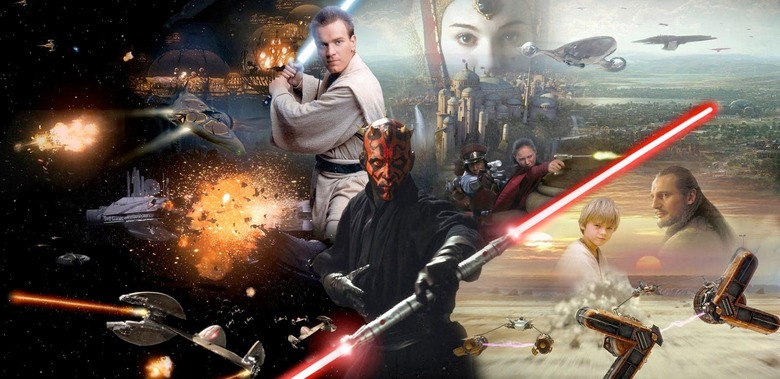
Looking Back At Star Wars Episode One: The Phantom Menace 25 Years Later

This year is the 25th anniversary of Star Wars Episode I: The Phantom Menace, which is one of the most divisive films ever made. It was the first Star Wars film since Return of the Jedi in 1983, and saw George Lucas return to his epic universe and present the backstory to his original trilogy. Iconic villain Darth Vader is shown as 9-year-old Anakin Skywalker, a slave living with his mother in the backwater world of Tatooine. His encounter with Jedi Knights Qui-Gon Jin and Obi-Wan Kenobi (his future mentor), as well as his future wife, Padme Amidala, put him on the path to his later role as a powerful Jedi Knight and eventually, his turn to the dark side as the evil Sith lord Darth Vader. 
Star Wars Episode I: The Phantom Menace was eagerly anticipated from its announcement and was greeted with very diverse reactions when released. Many fans were just ecstatic to have another Star Wars film in theaters after more than a decade of nothing being released. It was a very different time than now with many TV shows on Disney +and several films being planned. The only Star Wars materials since Jedi was released were the well-received series of books by Timothy Zahn and other novels and comics such as Star Wars: Dark Empire. A new film, especially one that would be the missing first three episodes, (the original trilogy was marketed as Episodes IV to VI), was a thrilling prospect.

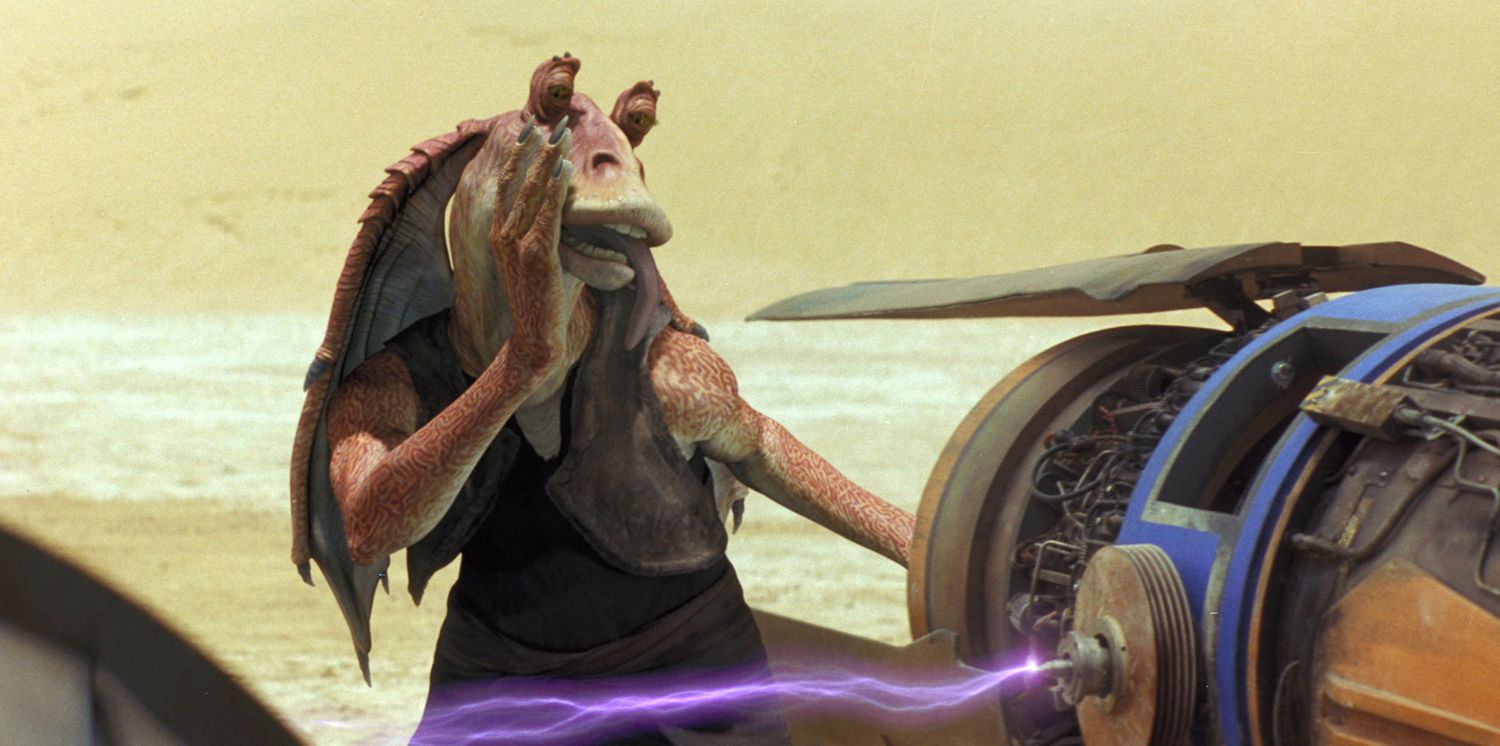
However, there were many fans who were disappointed with what they saw as a film with a more childish tone due to the introduction of Jar Jar Binks, an alien Gungan that helps the Jedi and Anakin to battle the forces of the Trade Federation, the villains in the film who were controlled by Darth Sidious, who is really Senator Palpatine, the future Emperor seen in Return of the Jedi. Jar Jar’s antics, weird mannerisms and manner of speaking was a turn off for many. Critics of the film were also unhappy with the more complicated plot of the movie, which focused on political intrigue in the Galactic Senate, as Palpatine maneuvered his way to the office of Chancellor of the Republic. This was unlike the simpler plots of the first films, which were a more basic story of good vs evil. The introduction of a more scientific explanation of the Force was also criticized, with the idea of midichlorians as being the reason for people having Force powers was seen as less interesting, as opposed to the more mystical view of the Force from the original movies.
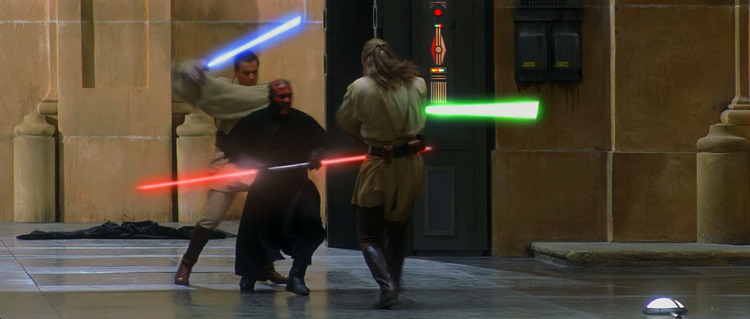
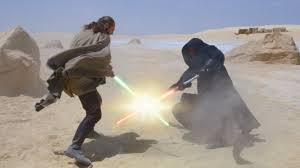
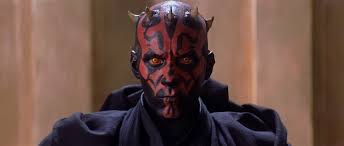
Having said this, I liked Lucas’ idea of expanding the mythology of the Star Wars universe and showing how a democracy like the Republic would descend into a tyranny in the form of the Galactic Empire. it was also interesting to see a different era in Star Wars. Instead of the battle-scarred ships and planets seen in the original trilogy, we are shown more peaceful and polished areas in the galaxy. It makes sense since the film takes place over 30 years before A New Hope. Seeing the Jedi Order in its prime is great to see, with Qui-Gon and Obi-Wan battling Palpatine’s protege, Darth Maul in spectacular light saber battles, which were incredibly choreographed.

The reputation of the film has been somewhat improved in the subsequent years as many have come to appreciate the film for its positive attributes. The special effects were groundbreaking with the CGI used to created Jar Jar being a precursor to later films and characters that were brought to life via this technique. Gollum from The Lord of the Rings films being one such example. The effort of George Lucas to broaden the scope of the franchise with new ideas, planets and creatures is also something to be commended. He set the stage for the prequel trilogy, which would result in the well-received Star Wars: The Clone Wars TV show and introduce new characters that would become fan favorites, such as the previously mentioned Darth Maul, Count Dooku (Palpatine’s other protege) or the powerful Jedi Knight Mace Windu. One sign pointing to the film’s improved reputation was the fact that the re-release this month of the film in theaters to celebrate its 25th anniversary actually earned a respectable box office haul.
The release of later Star Wars films would have the franchise move away from this era and take us to the future of the Skywalker saga, some 30 years after Return of the Jedi. Starting with The Force Awakens, it was obvious that Disney wanted to go back to the roots of the original trilogy as opposed to Lucas’ prequels. I think the results were mixed, as The Force Awakens has a simpler plot that was similar to A New Hope, but is also somewhat too derivative of it. The prequels told a new story in the Star Wars universe starting with Star Wars Episode I: The Phantom Menace, while the sequels seemed to retell the story of the rebels against the empire, although I do think that Episode IX really pushed the story forward and ended things on a good note.

However, one area where the sequels improved on is the overall look the films, as they seemed to blend the use of practical effects with CGI, which made things seem more grounded. Whereas with the prequels, they did sometimes go overboard with CG effects. While groundbreaking as previously mentioned, it did give things a strange look, with an overload of visuals and backgrounds that in some scenes, were obviously a green screen and look dated today in some instances.

Despite all of that, Star Wars Episode I: The Phantom Menace is a very important film in the saga and in the genre as a whole as it popularized the idea of prequels to popular movies and reintroduced Star Wars to a whole new generation of fans who have since enjoyed a renaissance of the franchise that is still being being enjoyed to this day.

C.S. Link
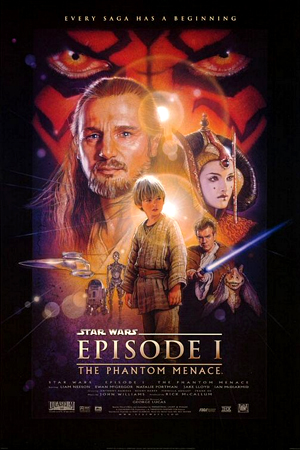
Star Wars Movie Retrospective: Star Wars Episode I: The Phantom Menace

 poster

“Fear is the path to the dark side. Fear leads to anger, anger leads to hate. Hate leads to suffering.”–Jedi Master Yoda

As we get ready for the continuation of the Star Wars saga with this December’s Star Wars: The Force Awakens, let’s look back at the previous six films of this iconic film series. Putting opinions aside, the first six Star Wars films will now forever be known as the ones that Star Wars creator George Lucas directly worked on. They bear the mark of what he intended for the overall story and for better or worse reflect his vision for the Star Wars saga. For the first retrospective of the entire star spanning saga, we begin not with the very first Star Wars film made but with the first chronological film in the saga: Star Wars Episode I: The Phantom Menace.

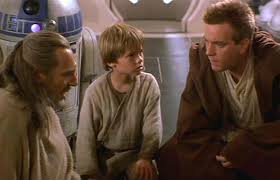
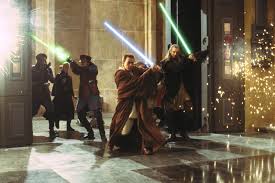
jedi trio

The setting for Episode I as are the rest of the films is long ago in a distant galaxy. Large parts of it are ruled by the Galactic Republic. Consisting of thousands of worlds, the Republic’s relative peace for generations is at risk because of one of its members: the Trade Federation. In the film’s opening crawl, the Trade Federation is up in arms with the Republic over taxes on trade routes of the outer worlds. Their idea to resolve this issue is to place a blockade on the planet Naboo.

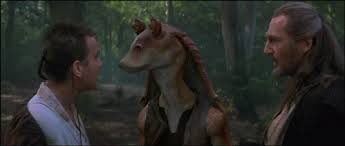
The Republic’s ruling chancellor dispatches two Jedi Knights, Qui-Gon Jinn (Liam Neeson) and Obi-Wan Kenobi (Ewan MaGregor), to negotiate with Nute Gunray (Silas Carson), the Viceroy of the Federation. at his flagship orbiting Naboo. Not long after they arrive , the mystical warriors are attacked by the Federation’s droid soldiers who have orders to kill the Jedi. The relative ease to which the jar jar and jediJedi take out the mechanical troops is our first taste as to the true height of the Jedi’s powers. During the battle, the Jedi learn that the Federation are about to land troops on Naboo, so they hitch a ride on one of the invading ships and arrive on the planet to warn the inhabitants. Along the way, Qui-Gon saves a strange and goofy alien native, an amphibious Gungan called Jar Jar Binks (Ahmed Best). The floppy eared alien decides to tag along with the Jedi because of a life debt owed to them as they make their way to the Naboo capital.

Once the trio reach the capital, the Jedi manage to rescue the planet’s ruling queen, Padme Amdilla (Natalie Portman), and her royal entourage, who were being held hostage by the Trade Federation’s droid army. They were captured by Gunray because he wanted to force the queen to sign a treaty legalizing the occupation of Naboo. After easily dispatching the cannon-fodder droid army in the city, the Jedi and the others board a spaceship and break the orbital blockade.

The queen wants to go to Coruscant, the capital world of the Republic, to plea for intervention. But although the ship is able to jump into hyperspace during the escape it was damaged. This forces them to set down for repairs in a nearby world: Tatooine, a desert planet that is outside the Republic’s domain.

On the backwater world, Qui-Gon, Obi-Wan, and Jar Jar leave for one of Tatooine’s towns Mos Espa to get spare parts for their ship. Joining them at the behest of the queen is one of her handmaidens, who is actually Padme herself pretending to be a commoner.

watoo

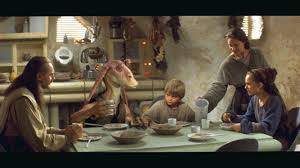
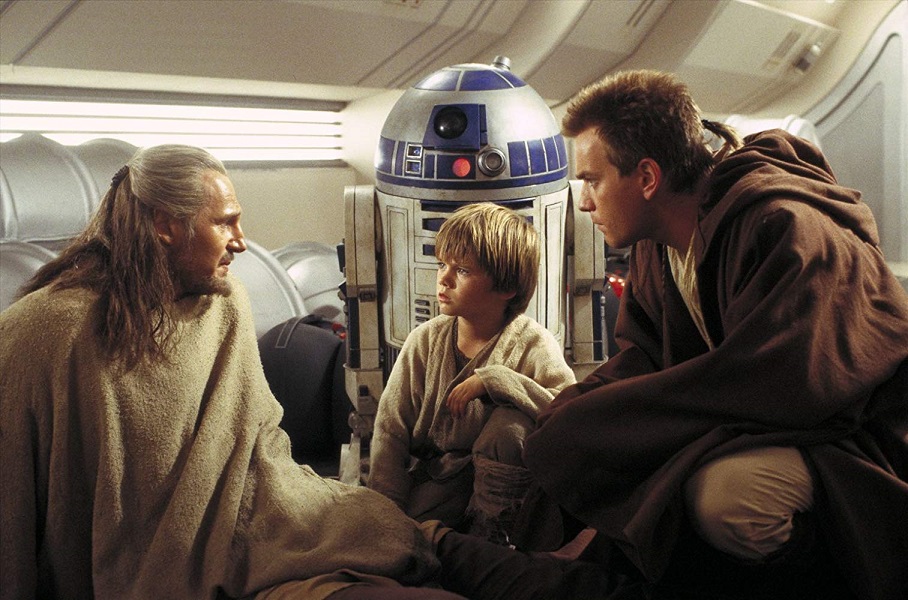
They meet a coarse junk dealer called Watoo (voiced by Andy Secombe) who has the engine parts they need, but they’re unable to pay for them. During the visit to Watoo’s business, they meet his young human slave, Anakin Skywalker (Jake Lloyd), who befriends them and offers shelter in his mother’s home from a coming sandstorm. Qui-Gon immediately senses that the Force is strong in Anakin and takes a fast interest in the boy.

dinner with the jedi

For those who have been living under a rock since 1977 the Force is a metaphysical power in the Star Wars universe that is wielded by the Jedi and their opponents the Sith. According to Star Wars lore it’s a form of energy that flows through all life forms and those who are adept at using it can perform superhuman acts like telekinesis, controlling weak minds and so on.

qui gon vs maulQui-Gon wants to recruit the young slave and train him as a Jedi, but first he has to win the boy’s freedom. To accomplish this, he convinces Watoo to enter Anakin in a dangerous pod race where racers speed through the desert climes of Tatooine in cobbled together engine parts and makeshift carriages. If Anakin wins he’s to be freed as part of the conditions of a bet the Qui-Gon and Watoo placed with each other. Additionally, if Anakin wins, Qui-Gon will be able to get the parts needed for the queen’s ship so they can leave for Coruscant.

Unbeknownst to the group is that the Jedi are being tracked by Darth Maul (Ray Park) a devilish Sith apprentice and his superior Darth Sidious (Ian McDiarmid). Throughout the film, Sidious has been manipulating and controlling the Trade Federation for his own mysterious reasons and is the mastermind behind the Naboo invasion. More importantly, Sidious wants to renew the ancient feud his order has against the Jedi.

maul

While the heroes busy themselves with leaving Tatooine, reaching Coruscant and finding a way to end the Federation occupation, sinister forces are aligning against the Jedi and the Republic. Soon, Qui-Gon and Obi-Wan will confront the deadly Sith as they attempt to free Naboo, and it’s an encounter which will have lasting ramifications throughout the galaxy.

naboo battleStar Wars Episode I: The Phantom Menace was probably the most eagerly awaited film in history. For sixteen years, fans had to endure a drought of Star Wars films after Return of the Jedi (ROTJ) came out in 1983 and there was doubt if there would ever be another Star Wars film. After ROTJ, George Lucas was burned out, plus the limitations of effects technology hampered his ability to bring forth his visions in additional films.

However, Lucas changed his mind after some time. He saw in the early ’90s that Star Wars was still popular thanks to the success of spinoff books and comic books. More importantly, he was impressed with the effects technology, specifically the emerging CG effect featured in films like Terminator 2: Judgment Day and Jurassic Park. At last, he felt that he could bring his true unhindered vision to film thanks to the new CG technology.

Lucas had been fascinated with the backstory to the Star Wars saga and Darth Vader’s origin, which he wrote as a fifteen-page outline back when he was developing the very first film in the ’70s. Hence, the reason why his followup to the original trilogy would be prequels.

Continue reading