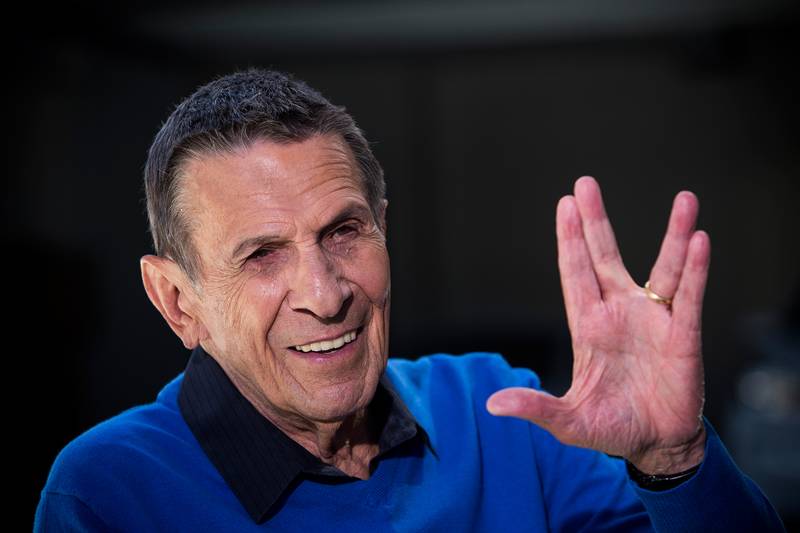
Leonard Nimoy, who played Spock the first officer of the starship Enterprise on Star Trek, has died today at the age of 83.
Nimoy not only was renowned for portraying the stoic, emotionless Vulcan, but he was a noted film and TV director, photographer, musician and poet. Among his best known directorial pursuits were Star Trek III: The Search for Spock, Star Trek IV: The Voyage Home and Three Men and a Baby. The first two films helped to increase interest in Star Trek , which led to numerous successful spinoff films and TV shows. Nimoy also capitalized on his fame and appeared in or lent his distinctive deep voice to other well received TV shows and films like Star Trek: The Animated Series, Invasion of the Body Snatchers, A Woman Called Golda, Columbo, Mission: Impossible, Night Gallery, The Big Bang Theory, The Simpsons, Atlantis: The Lost Empire and The Outer Limits. He also hosted the ’70s paranormal documentary TV show In Search of…, which still has a cult following. His other prominent genre work was appearing as the enigmatic scientist Dr. William Bell in several episodes of Fringe.
But Nimoy will be best remembered for his portrayal of Spock. The cool and logical alien on Star Trek was an instant hit with fans and helped popularize the fledging show back in the mid ’60s. Although Star Trek only lasted three seasons, the show’s popularity grew afterwards in syndication and has become an integral part of our modern culture. A large part of merit is due to Nimoy’s performance, which garnered him Emmy nominations.
Still despite his fame, Nimoy was enigmatic about the benefits of having played Spock and feared being typecast. His ambiguous feelings led to him writing his famous autobiography I Am Not Spock. He was so ambivalent about the Spock character that he was hesitant to reprise the role when Star Trek was revived as a series of films. This was why Spock was killed off in Star Trek II: The Wrath of Khan, since the death would allow him to have some closure with the character. However, as we all know the film was so well done and Nimoy had a positive experience while filming it, that he changed his mind and was willing to continue playing Spock. This led to him directing the next two Star Trek films, the latter being considered one of the series’ best films. He also reprised the role in Star Trek V: The Final Frontier, Star Trek VI: The Undiscovered Country, two episodes of Star Trek: The Next Generation and in the last two Star Trek films. By this time, he had embraced the character and realized how it helped open other opportunities for him like his directing and artistic endeavors.
With his passing, we are again reminded how the past is slipping away from us being that three of the original Star Trek actors are now deceased. But his boundless legacy, which includes introducing the world to the most famous alien in sci-fi culture, will live long and prosper long far into the future.
Star Trek movies have been with us since the late ’70s and have received very mixed reactions. Some are revered as the very best of sci-fi films, while others received vicious barbs from fans and critics alike. Now that there is an even dozen films, it’s time to rank them in order.
The way my rankings work are basically four tiers. The first tier includes genuine classics that still hold up today and are iconic; the second tier features films that are undeniably enjoyable and worth watching, though they have their faults; the third tier is filled with flawed but noteworthy movies that have some good qualities and are sometimes underrated; the fourth tier, naturally is littered with the bottom-dwelling movies that are just terrible with little to recommend about them.
Tier One
1. Star Trek IV: The Voyage Home (1986): I know this may shock most fans who expected Star Trek II to be the number pick. Choosing the very best Star Trek film was quite difficult and honestly, it’s more of a tie between the two films. To those that would argue that Star Trek II is the best one, you won’t get an argument from me, but time and time again I keep going to the fourth film in the franchise.
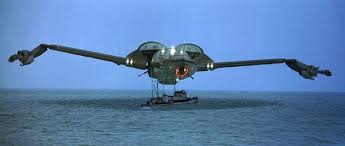
Why? To me this one showed the original cast and filmmakers at the top of their game. Everything was top notch with this film: production values, special effects, acting, and the story. The movie which was about the original Enterprise crew time traveling to San Francisco in the late 20th century to find whales was a great example of a fish-out-of-water yarn. We got to see the crew out of their element, yet persevering in the strange environment of the past. The movie presented a lighter, more comedic side but it was still exciting and engaging. It also showed that a Star Trek film didn’t need a scene-chewing villain to carry a film.
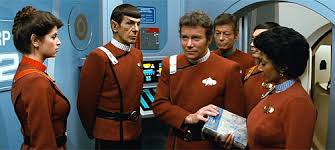
Finally, this film allowed all of the cast members to have their moment in the sun. They contributed to the story and had many outstanding scenes. Still, William Shatner, Leonard Nimoy and DeForest Kelley were the highlights, especially Shatner. His James T. Kirk wasn’t morose as in previous films, he was more confident, surprisingly funny and showed off his famous romantic, charming demeanor. By the film’s end, you feel completely satisfied. The crew had a new ship, Kirk was doing what he was meant to do and there was the promise of new beginnings as the Enterprise-A headed out to the unknown.
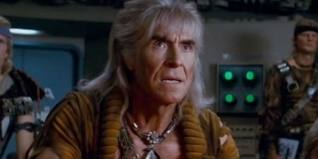
2. Star Trek II: The Wrath Of Khan (1982): On a different day I might’ve ranked this as so many do, as the best Star Trek film ever made. This is still the most important film in the franchise because it’s the one that saved it in its infancy. After the wooden and pedestrian debut film, there was doubt another expensive Star Trek film would ever be made. The filmmakers’ challenge was to put out an exciting, edge-of-your-seat thriller that would leave people talking about it for a long time to come. And they succeeded.
One of Kirk’s enemies from the original show, Khan (Ricardo Montalban), commandeers a Starfleet ship and goes on a warpath against Kirk. He blames our hero for marooning him on a desolate planet and wants Kirk to suffer as he did. And boy does he give it to Kirk. The battle of wits between the two adversaries became famous thanks in part to the performances from both actors. This is Shatner’s best performance as a Kirk, who finally faces middle age, while Montalban clearly relishes his role as the battered but regal Khan. His character is undeniably one of the best movie villains of all time.
Even though the special effects and Nicholas Meyer’s direction are exemplary, what makes the film endure is its focus on the characters and its themes about dealing with your past, the destructiveness of vengeance and facing the future with dignity. So why isn’t this my favorite Star Trek film? Well, it nearly is and on some days I’ll admit it. But the film feels a bit ponderous and pompous at times. The script tends to go overboard with its constant quoting from classic literature. Then there’s Spock’s (Nimoy) death, while it’s eloquent and heartfelt, given that the character returns in later films, the death feels a bit empty. Those are just minor quibbles though and this movie is a must-see classic for everyone.
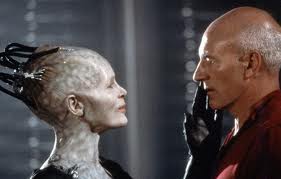
3. Star Trek: First Contact (1996): It’s not only the best Star Trek film that features The Next Generation cast but one of the franchise’s very best efforts. Director Jonathan Frakes (who also plays Riker) and the production team hit all the right marks in this great Star Trek film. Its success started with this well-written time travel/alien invasion saga.
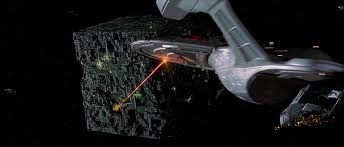
Capt. Jean-Luc Picard (Patrick Stewart) and his Enterprise-E crew time travel to Earth’s mid-21st century to prevent the evil cybernetic Borg from conquering the planet. Successfully incorporating action and horror elements, Star Trek: First Contact was both exciting and suspenseful with a morality tale about obsession and dealing with destiny. This film is full of so many cool moments. One of the best was when the experimental warp ship the Phoenix launches from a missile silo as its pilot, Zefram Cochrane (James Cromwell) blasts Steppenwolf’s “Magic Carpet Ride”. Another was Picard’s histrionic ranting about the Borg, which forced him to look within himself. The Borg themselves are presented as the fearful, unrelenting force they were meant to be. The movie’s main villain, the Borg Queen (Alice Krige), is one of the more interesting and unique foes. She isn’t some revenge-minded madwoman but is cold, calculating, and with a strange allure.
As with the better films, this one showcased many of the supporting characters and featured smile-inducing nods and cameos from the other Star Trek shows. The best one had to be the cameo of Star Trek: Voyager’s EMH (Robert Picardo) who appears as the Enterprise-E’s own EMH. One of his lines is also a nice tribute to Dr. McCoy. After falling short with the previous entry Star Trek Generations, the filmmakers had to get the franchise back on track and succeeded with this one. Everyone involved is to be lauded, from the actors, to the composer, to the production team and, of course, the director, who like Nimoy understood Star Trek. Continue reading →
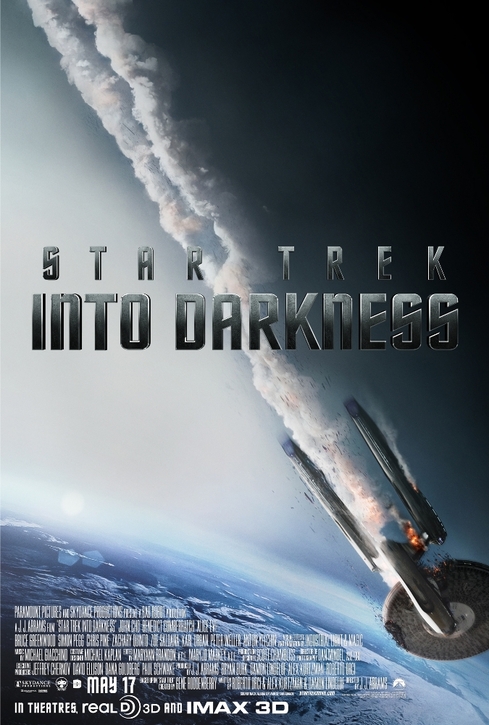
A valid criticism about the last Star Trek film was that it was too much like Star Wars with its emphasis on flashy special effects and high-octane action. This same critique is applicable to Star Trek Into Darkness, the latest entry in the long-running film series. But at least more of an attempt is made to make this film seem more like Star Trek.
How so? Concern is brought up on more than one occasion that Starfleet is becoming too militarized and that they should be explorers. By the end of the film, the main characters wholeheartedly embrace that concept based on their experiences throughout the film. In some ways, Star Trek Into Darkness is a battle for the soul of Star Trek and to try to go back to its roots. The film doesn’t always succeed in getting that point across, since it wants to revel in the big-action scenes that define the J.J. Abrams era of Star Trek. In fact, it’s best to think of this film as Abrams’ audition tape for directing the next Star Wars film.
Star Trek Into Darkness opens on an alien planet where angry, primitive natives are chasing Captain James T. Kirk (Chris Pine) and Dr. Leonard “Bones” McCoy (Karl Urban) after Kirk insulted them.
As the two men flee to their hidden starship, the Enterprise, the ship’s Vulcan first officer, Spock (Zachary Quinto) is trapped in an active volcano. He was trying to keep it from erupting using a cold fusion process. Once Kirk and McCoy make it back to their ship, Kirk orders a rescue of Spock. The ship is able to rescue the Vulcan but violates the Prime Directive when the natives see the advanced starship rise out of its hiding spot in the ocean.
When the Enterprise crew returns to Earth, Kirk is called to Starfleet’s headquarters by Admiral Christopher Pike (Bruce Greenwood). Expecting a lucrative assignment, instead, Kirk is berated for being too reckless and thinking rules don’t apply to him. Kirk is stunned to find out that his command is taken away for violating the Prime Directive and for not being ready to be a starship captain. This was based on Spock’s accurate report about the incident on the planet.
Kirk is justifiably incensed at his friend and starts berating Spock later before they attend a high-level meeting with Starfleet brass. This meeting is to discuss a recent terrorist bombing in London by a Starfleet operative named John Harrison (Benedict Cumberbatch), who has gone rogue.
The meeting is interrupted when Harrison shows up outside the building where the meeting is held in a fighter craft and fires weapons at the attendees. Kirk is able to stop the attack but Harrison beams away and one of the casualties is Pike. Investigations reveals Harrison’s current location: Kronos, the Klingon homeworld.
An enraged Kirk asks Admiral Alexander Marcus (Peter Weller) to be reinstated as captain of the Enterprise so he can pursue the terrorist. Marcus agrees and tells Kirk to go to the border of Klingon space and launch several long-range, prototype photon torpedoes at Harrison’s location to kill him.
Later, the Enterprise has to drop out of warp space near their destination due to a malfunction. Kirk then takes a shuttle to Kronos with Spock and other crewmembers and are saved from Klingons by Harrison himself, who quickly surrenders to him.
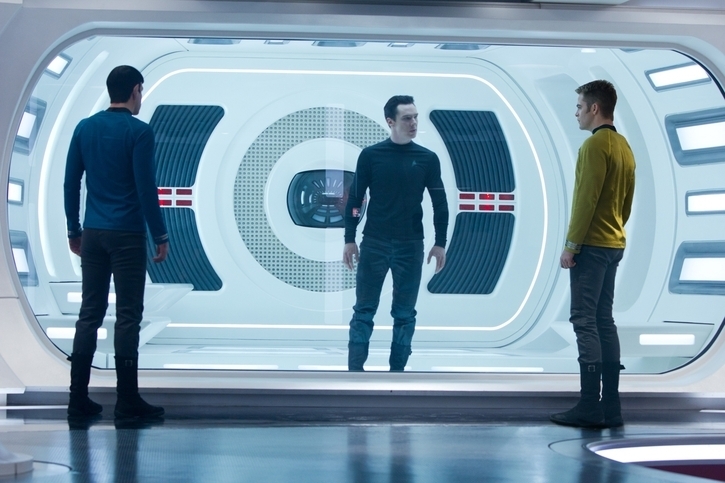
Now a prisoner onboard the Enterprise, Harrison reveals to Kirk that his name is really Khan and that he is a genetic superman who was in cryo sleep for three hundred years in sleeper ship along with 72 other superhumans. Starfleet discovered their sleeper ship and only Khan was revived. Marcus, anticipating an all-out war with the Klingons, wanted to utilize Khan’s superior intellect to develop advanced weapons and is holding hostage the other superhumans as leverage. Furthermore, Marcus wants to use the Enterprise and Harrison to instigate a war with the Klingons.
Kirk’s suspicions about Marcus are soon confirmed when a massive starship arrives armed to the teeth. It’s commanded by Marcus, who demands that Khan be turned over to him.
Star Trek Into Darkness is one of the most exciting films in the series thanks to J.J. Abrams’ directing. Like its main character, the film is brash, bold and in your face with wild and intense action scenes. Highlights include a thrilling chase of Khan in San Francisco by Spock that culminates in a heart-pounding fight, where Spock nearly loses his control. Another is when a crippled Enterprise falls towards Earth, the special effects of those scenes are just brilliant and dazzling. Expect an Oscar nomination for special effects.
Captain Christopher Pike’s order to take the Enterprise into warp space
Don’t worry readers, the review for the new Star Trek Into Darkness is coming right up. But first, let’s look at its predecessor, the eleventh Star Trek film. After Star Trek: Nemesis became a box office failure in 2002 and the series Star Trek: Enterprise was canceled in 2005, the franchise seemed to have died. Paramount Studios realized they ran Star Trek into the ground and so it went on hiatus. The fortieth anniversary of the original TV show came and went without any fanfare and implied that no one cared about Star Trek anymore.
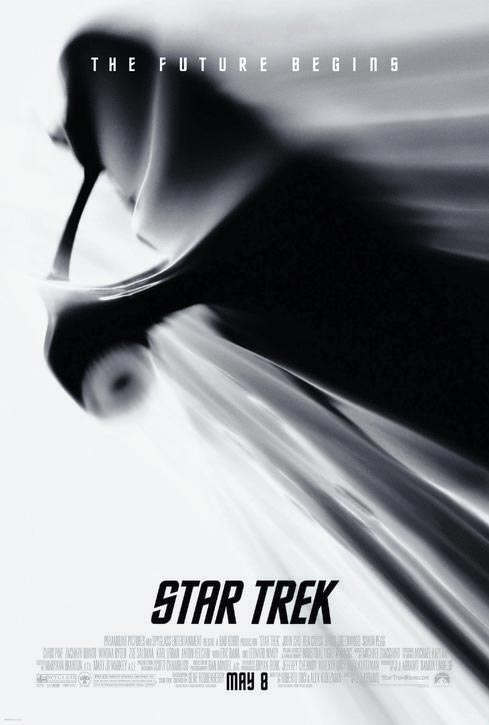
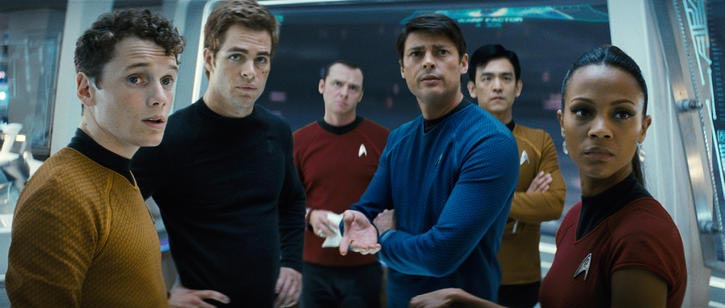
However, J.J. Abrams, the man behind the classic TV show Lost, was brought in to rejuvenate the franchise. It was decided to bring Star Trek back as a film series rather than a TV show and so Abrams and his team rebooted the franchise, resulting in the 2009 feature film Star Trek that went back to the beginning. The film was a rousing success but sparked controversy among stalwart fans.
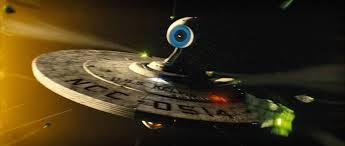
Star Trek begins with a dizzying, close up shot of the starship Kelvin gliding past the camera as it investigates a lightning storm in space. This storm turns into a black hole and from it emerges a gigantic spaceship shaped somewhat like a squid with sharp mechanical tendrils. This ship immediately opens fire on the Kelvin with advanced weaponry. The Kelvin isn’t a match but puts up a gallant fight. The attackers demand that the Kelvin’s captain, Robau (Farin Tahir), go to their ship to discuss a surrender. Right away these scenes signaled that Star Trek was reinvigorated with wild, kinetic battle scenes.
Robau leaves First Officer George Kirk (Chris Hemsworth) in command and is killed in the enemy ship by its crew, a group of bald, tattooed Romulans. Kirk orders a shipwide evacuation and covers it by setting the Kelvin on a collision course with the attacking ship. One of the evacuees is his pregnant wife Winona (Jennifer Morrison), who goes into labor in an escaping shuttlecraft. Kirk is unable to join her because he has to manually fly the Kelvin into the enemy ship. He is able, however, to hear the first cries of his newborn son James Tiberius Kirk moments before the Kelvin smashes into the Romulan ship.
George Kirk’s sacrifice wasn’t in vain, the enemy ship is crippled, giving several shuttlecraft an opportunity to escape…
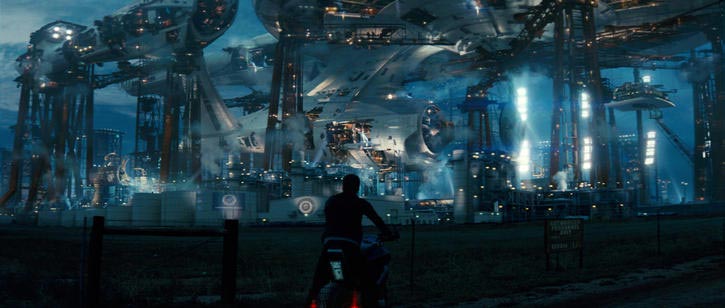
Years later, Kirk’s son grows up to be a rebellious, angry young man (Chris Pine) without any direction in life and living in Iowa by a shipyard that is constructing the Enterprise. After a bar fight, he meets Captain Christopher Pike (Bruce Greenwood), who sees some potential in James Kirk. Pike is able to convince the young man to join Starfleet.
During his training Kirk meets many people who will become important parts of his life, notably Dr. Leonard “Bones” McCoy (Karl Urban) and Spock (Zachary Quinto). Ironically, Kirk and Spock do not get along at first. Spock is a by-the-book officer who cannot abide Kirk’s brash and reckless demeanor. Things come to a head after Kirk takes the Kobayashi Maru simulator test, which Spock developed to train cadets, and is caught cheating.
Kirk is under inquiry for his actions when fate intervenes. Starfleet receives an emergency distress call from the planet Vulcan and all available ships on Earth are dispatched. Among them is the new U.S.S. Enterprise commanded by Pike with Spock as its first officer.
With McCoy’s help, Kirk is able to get onboard the Enterprise as it joins the armada. The ship is unable to jump into warp space with the other ships thanks to an error made by the helmsman Hikaru Sulu (John Cho ). It turns out that this delay and Kirk learning of a lightning storm reported by Vulcan helps saves the ship. Kirk guesses that the Enterprise will be facing the same fate as the Kelvin and tells Pike. When the time the Enterprise drops out of warp space near Vulcan, the crew finds a floating junkyard of destroyed ship parts.
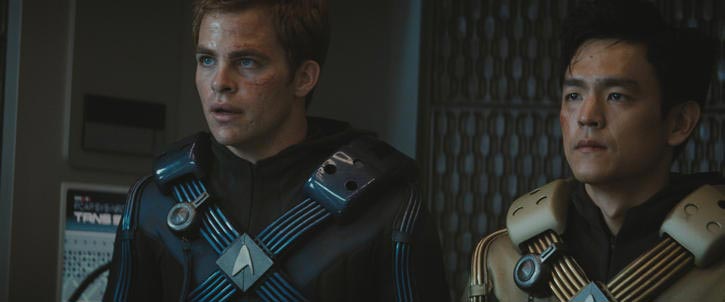
The other Starfleet ships were easily destroyed by the same Romulan ship that destroyed the Kelvin. The ship had launched a long, tethered drilling platform to Vulcan’s surface. When the Enterprise is discovered, the Romulan ship’s commander, Nero (Eric Bana), orders an attack on the Starfleet vessel but stops when he realizes it’s the Enterprise. The Romulan demands that Pike go to his ship just as was done with Robau. Pike agrees, but before leaving, he promotes Kirk to first officer and leaves command of the Enterprise to Spock. He has Kirk, Sulu and a redshirt accompany him in Pike’s shuttlecraft. Before Pike turns himself in, the trio are clandestinely launched via parachutes to the drilling platform to disable it. After fighting off Romulans on the platform, Kirk and Sulu are able to disable it. But they’re too late, the drill already reached the planet’s core. The Romulans release a substance called red matter that creates a black hole in Vulcan’s core, dooming the world.
In a desperate move, Spock beams down to Vulcan just in time to save his father Sarek (Ben Cross) and a few others but not his mother (Winona Ryder). Shortly after, he and the handful of survivors are beamed back to the Enterprise as Vulcan is destroyed from within.
Spock struggles not displaying emotions over the death of his mother and world and Pike’s capture. He decides to regroup with the fleet but Kirk tries to convince him otherwise. The Romulans are heading to Earth and Kirk demands that they try to stop them. After they argue for several minutes, Spock has Kirk removed from the bridge and ejected from an escape capsule to a nearby planet, Delta Vega, and orders the Enterprise to resume its course to rendezvous with the fleet.
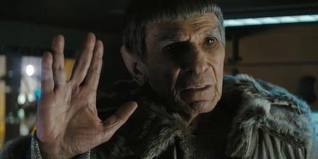
After the capsule lands, Kirk breaks out and finds himself in a frozen world filled with predatory animals out to snack on him. He is saved from one huge animal by a mysterious Vulcan who turns out to be a very old Spock (Leonard Nimoy). This Spock mind melds with Kirk and he learns that Spock is from the future as are the bald Romulans. In the late 24th century, the Romulans’ homeworld was destroyed by a supernova that threatened other worlds. From his own ship, Spock launched a sample of the red matter to destroy the supernova by creating a black hole. As he tried to escape the black hole, he encountered Nero and his ship. The Romulan was enraged at Spock because the Vulcan promised the Romulans he would save their world, now his wife and family are dead. Before anything could happen, Nero and Spock’s ships fell into the black hole, which was a doorway to the past. Nero had Spock abandoned on Delta Vega so that he could witness the destruction of Vulcan and experience the pain that Nero felt in the future.
“‘Second star to the right, and straight on ’til morning'”
Captain James T. Kirk’s final course heading for the U.S.S. Enterprise-A
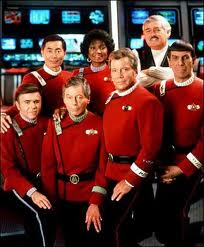
The final Star Trek film to feature the entire original cast from the Star Trek TV show has many distinguished qualities such as a thrilling story, craftsman-like direction, solid acting and yes great special effects. But Star Trek VI: The Undiscovered Country will always be known for its parallels to the end of the Cold War and more importantly as the last hurrah for the original Enterprise crew.
When the film was released, the Cold War between the U.S. and the Soviet Union had ended bringing on a new uncertain era with ramifications still affecting us today. In Star Trek VI: The Undiscovered Country, the long-running feud between the United Federation of Planets and the Klingon Empire comes to a peaceful end with adversaries on both sides struggling to accept the new normal. This was done bravely with the main character Captain James T. Kirk (William Shatner) who expressed an unpleasant side with his unhidden bigotry towards the Klingons.
Star Trek VI: The Undiscovered Country literally begins with a bang. A giant shockwave from an exploding moon reaches across space and slams into the Federation starship Excelsior. Commanded by Captain Hikaru Sulu (George Takei), the Excelsior rides out the shockwave’s destructive path. Sulu and his crew learn that the explosion came from the Klingon moon Praxis, which was overused as mining facility in an analogue to Chernobyl.
Months later, Captain Kirk and his senior Enterprise-A crew are summoned to a meeting at Starfleet Headquarters. To their surprise, their colleague Captain Spock (Leonard Nimoy) presents at the meeting not only the finding that the Klingons are dying out but that peace negotiations have begun between the two powers. Kirk is ordered by the Chief in Command (Leon Rossum) to have the Enterprise-A escort the Klingon leader Chancellor Gorkon (David Warner) to Earth for continued negotiations.
Kirk is angered that his friend Spock vouched for him to carry out this mission but Spock did so because Kirk’s reputation and antagonistic history with the Klingons will serve as an effective olive branch if he peacefully escorts Gorkon to Earth.
The Enterprise-A crew leaves Spacedock for its mission, but not before Kirk meets Spock’s protégé Lt. Valeris (Kim Cattrall), the ship’s helmsman. We later learn that Spock thinks highly of her and intends for her to succeed him as first officer of the ship.
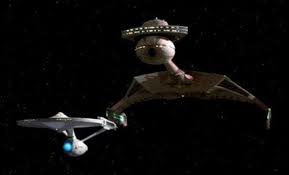
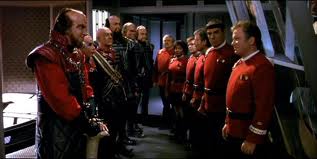
The Federation starship makes its rendezvous with Gorkon’s Klingon battle cruiser Kronos One and Kirk invites the chancellor over for dinner. Gorkon beams over with his entourage, which includes his daughter Azetbur (Rosana DeSoto) and General Chang (Christopher Plummer), a bald, crusty Klingon with an eye patch and an obvious dislike towards Kirk. He is practically chomping at the bit for the chance to engage the famous starship captain in combat and is clearly disheartened that he won’t get the chance.
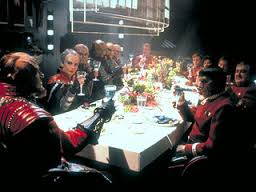
The dinner held in the officer’s mess goes poorly. There is an uncomfortable tension as both Kirk and his senior officers and Gorkon and his entourage trade charged barbs at each other. The Starfleet officers, except Spock, can barely hide their contempt toward the Klingons. It was a bit jarring to see our heroes in a negative light, but it was very bold and dimensional because we see some flaws with our heroes. The only other person who tried to be polite and engaging was Gorkon. He is a clear reference for the Soviet leader Mikhail Gorbachev and exhibited a mature, open and statesman-like demeanor. David Warner was very memorable in this too brief but important role and made the leader seem sympathetic and noble.
After the uneasy dinner, the Klingons return to their ship while Kirk retires for the night nursing a hangover from drinking illegal Romulan ale during dinner. He has no time to rest when he is called to the bridge. These scenes were quite revealing; Kirk seems weary and ready to retire. But he is still the captain and acts as one when he instantly stops slouching after the turbo lift doors open to the bridge.
As he enters the bridge, the Klingons are attacked by an unknown source. The attack damages Kronos One’s gravity field, leaving the Klingons afloat and defenseless. Two men garbed in white Starfleet suits, garbed helmets and gravity boots beam aboard the Klingon ship and fatally shoot Gorkon.
Their work done, the assassins beam back out moments before the Klingons restore power. After answering the Enterprise-A’s hail, a furious Chang accuses Kirk of an unprovoked attack and begins a counterattack. Kirk, horrified and realizing the severity of what is unfolding, orders the Enterprise-A to surrender before an intergalactic war can begin.
Wanting to help, he and Dr. Leonard McCoy (DeForest Kelley) beam aboard Kronos One. They find Gorkon and McCoy desperately tries to save the chancellor’s life, but he is unsuccessful. Gorkon’s last words are to Kirk, a plea “Don’t let it end like this.”
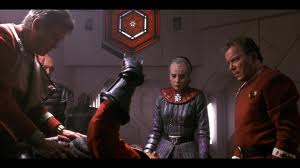
The two Starfleet officers are arrested on the spot by the Klingons. Spock assumes command of the Enterprise-A and begins investigating what happened. According to their computer, their ship did fire on Kronos One, but Chief Engineer Montgomery “Scottie” Scott’s (James Doohan) inventory reveals that all of the ship’s photon torpedoes are accounted for. Spock orders Valeris to continue investigating, convinced that the assassins are still onboard the starship.
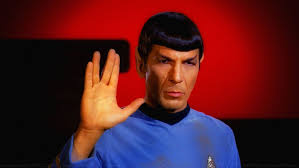 portrayal of Spock. The cool and logical alien on Star Trek was an instant hit with fans and helped popularize the fledging show back in the mid ’60s. Although Star Trek only lasted three seasons, the show’s popularity grew afterwards in syndication and has become an integral part of our modern culture. A large part of merit is due to Nimoy’s performance, which garnered him Emmy nominations.
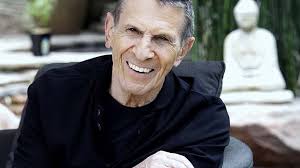 Still despite his fame, Nimoy was enigmatic about the benefits of having played Spock and feared being typecast. His ambiguous feelings led to him writing his famous autobiography I Am Not Spock. He was so ambivalent about the Spock character that he was hesitant to reprise the role when Star Trek was revived as a series of films. This was why Spock was killed off in Star Trek II: The Wrath of Khan, since the death would allow him to have some closure with the character. However, as we all know the film was so well done and Nimoy had a positive experience while filming it, that he changed his mind and was willing to continue playing Spock. This led to him directing the next two Star Trek films, the latter being considered one of the series’ best films. He also reprised the role in Star Trek V: The Final Frontier, Star Trek VI: The Undiscovered Country, two episodes of Star Trek: The Next Generation and in the last two Star Trek films. By this time, he had embraced the character and realized how it helped open other opportunities for him like his directing and artistic endeavors.
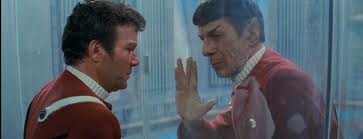 With his passing, we are again reminded how the past is slipping away from us being that three of the original Star Trek actors are now deceased. But his boundless legacy, which includes introducing the world to the most famous alien in sci-fi culture, will live long and prosper long far into the future.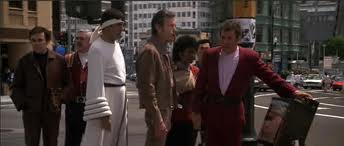



 Starloggers