Inheritors

In the Planet Of The Apes film series, humanity’s simian relatives have inherited the Earth in the far future. It’s a fascinating premise, that humankind currently the dominant life form will one day be supplanted. This goes back as early as with H.G. Wells’ classic The Time Machine, where that book’s narrator time travels to the distant future to find that humans no longer exist.

However with The Time Machine and the Apes films, the future rulers of the Earth are related to us. In the case of Wells’ story, humanity evolved into two distinct species the predatory Morlocks and the cattle-minded Eloi. But is this what will happen? Who is to say that our evolutionary branch will continue to dominate the world? For all we know, the eventual rulers will be based upon other animal species currently sharing the world with us. Or they could be something else. Let’s look at some candidates in a post-human world.

Rodents

There’s a good case to be made that some kind of rodent will dominate the world. They are a hardy species able to survive in just about in every environment. Rats are notoriously difficult to eradicate since they are very intelligent and durable. It’s easy to imagine a world where rodents become the dominant species. In Dougal Dixon’s book After Man: A Zoology Of The Future, a future Earth is presented where  rodent dog-like species called the falanx and bear-like bardelots are the top predators. Rodents have also filled other ecological niches in this future world. So it’s easy to imagine how a sentient rodent species could arise from this environment further along into the future.

Insects

This is harder to imagine but not impossible. What impedes insects from becoming dominant life forms is the environment. Earth’s gravity and atmosphere prevent insects from ever growing very large. Over 400 million years ago in the Devonian Era insects grew into monsters because of Earth’s higher oxygen content and temperatures. If such conditions were to be repeated and if there aren’t any competitors then it’s conceivable that insects could rule the land again and from there possibly lead to sentient insects. The potential for insect intelligence already exists with social insects like bees, wasps and ants. The latter are excellent candidates with their complex social hierarchies. Compared to bees and wasps, ants are very common and one species, the driver ant in EastAfrica, is a true terror capable of killing small animals. Phase IV was a movie released in 1974 that was about a newly evolved species of ants that developed a hive intelligence and began supplanting humanity. It may be far-fetched given humanity’s resilience and other competitors but given the right conditions then the opportunity is there for the insects.

Artificial Intelligence

Pretty cut and dried, the Singularity arrives in a few decades or so, Skynet comes online, etc. Humanity is enslaved or exterminated by sentient computers and robots. There is no Neo or John Connor to the rescue. Who knows what the computers do after we’re gone? Maybe they find Earth too confining or completely strip its resources and leave for the stars. Afterwards the microbes that survive will eventually yield to complex life millions of years later. It’s anyone’s guess as to what the new top life forms will be.

Marine Mammals

Dolphins and whales come to mind but despite arguments about the level of their intelligence one important factor impeding their capability for social and technological advancement is their inability to manipulate their environment. They lack appendages that allow them to handle objects. Perhaps if some cetacean evolves to return to land they can develop ambidextrous hands. But that could happen instead to the pinnipeds, namely seals. As with the insects, much depends on environmental factors. A flooded Earth will do.

Reptiles

There could be a second age of reptiles that leads to new kinds of dinosaurs. It’s happened before so it can happen again. Only this time the reptiles or neo dinosaurs evolve into a sentient species. There are several sci-fi stories that present advanced dinosaurs with technology. Harry Harrison’s alternate history book trilogy West of Eden is a good example. In Stephen Baxter’s Evolution, readers are introduced to sapient dinosaurs. Star Trek: Voyager had an episode in the third season called “Distant Origin” that featured a reptilian alien race that turned out to be dinosaurs that left Earth millions of years ago. Of course no such beings have been found in the fossil records…yet. Then again dinosaurs ruled the Earth for millions of years and they included bipedal forms with complex claws but never developed sentience as far as we know.

The Rest

Other candidates include birds. They had their chance when the dinosaurs died out but mammals beat them to the punch. As with cetaceans their lack of manipulating limbs could’ve hindered them.  Perhaps an evolutionary throwback that reintroduces hand-like claws might do the trick. Pigs are reputedly very intelligent as are elephants. But with elephants they are on the verge of extinction, seeing them taking over is difficult. Pigs are versatile creatures  but lack manipulating organs unless their flexible snouts evolve into trunks giving them a chance. The list goes on, many animal species can be candidates for evolving into a sentient, sapient race. Frankly, there are many variables that can’t be completely accounted for so we’ll just stick with our imagination for now.

Lewis T. Grove

Rise Of The Planet Of The Apes Brings New Life To The Apes Series

More than a prequel, more than a remake or even a reboot, Rise Of The Planet Of The Apes is stunning, moving and cautionary tale of man and his hubris which ultimately causes his downfall.

Strictly speaking the film is a remake of the fourth film of the original Apes series Conquest of the Planet of the Apes and it completely changes the reason why the main character of the chimpanzee called Caesar is intelligent. In the original, for non-fans, the reason for Caesar’s intelligence and ability to speak is because his parents were super intelligent apes who time traveled to the modern era. It makes perfect sense in that film’s logic only it never explains why the other enslaved apes are nearly human in appearance and intelligent.

In this film, the reason for Caesar’s rise is due to genetic engineering and therein lies the movie’s mantra about mankind’s folly and the unexpected consequences of actions both good and bad.

Dr. Will Rodman (played with compassion by James Franco) is a scientist looking for a cure for Alzheimer’s Disease. He develops a retrovirus and administers it to a laboratory chimp with exciting results since she quickly shows signs of human-level intelligence. Unfortunately she is killed but not before giving birth to a baby chimp. Unwilling to have the baby infant put to sleep, Rodman sneaks  him home. Soon he discovers that the chimp (that is then named Caesar) has inherited and surpassed his mother’s uncanny intelligence.

Years pass and Rodman is trying to perfect the retrovirus as he raises Caesar and administers the cure to his ailing father (John Lithgow) who also forms his own bond with the ape. Sadly this bond brings out Caesar’s primal and protective nature which causes him to be removed from Rodman’s home and imprisoned in an ape facility. The cruel treatment he and other apes receive from the handlers there hardens Caesar against mankind and foments a simian revolution.

Before long a new version of the retrovirus is developed in Rodman’s company that can be administered as an inhalant. However, while this new strain boosts simian intelligence it turns out to be lethal to humans. At the same time, Caesar builds alliances with the other imprisoned apes (one of which is a sympathetic friendly orangutan called Maurice, who is naturally smart)and is able to escape from the facility. Caesar steals samples of the new virus and uses them to liberate his own kind. The results are one of the most thrilling and rousing uprisings seen on film.

One can’t help but root for the apes while at the same time be taken aback by their brutality and sheer power. Of course, it’s a story that speaks out against the way animals are treated not just by the medical/scientific community but how we as a species view our fellow creatures in zoos, as pets and in the wild.

Kudos should go all around to everyone who made this film possible from the actors (Franco, Lithgow, Frieda Pinto, Tom Felton, etc.) to writers Rick Jaffa & Amanda Silver to director Rupert Wyatt (these three have reinvigorated the Apes saga in one fell swoop) to Weta Digital. Yes, you can tell in many scenes that CGI is being used, which makes one wonder if real-life apes could’ve been used in many scenes, but honestly it doesn’t take away from the story. That is a sign of a truly great film. Take the original Planet of the Apes, King Kong or Jaws. We know that the filmmakers in those days used dated f/x to bring their creations to life but the audience doesn’t care since they’re so caught up in the storytelling.

Special accolades go to Andy Serkis for his performance capture of Caesar. As with Gollum from The Lord of the Rings films he really brings his creations to life. He and the filmmakers make Caesar the main protagonist as he is transformed from a gifted child prodigy to a tortured prisoner to finally a heroic liberator and leader who despite his hardships holds onto a sense of decency. Serkis deserves at least a special Oscar for his work in this movie.

Viewers don’t have to be fans of the previous films to enjoy this cinematic triumph, which skillfully throws in many references to the series including a Charlton Heston cameo and his famous line from the original film “Get your stinkin’ paws off me you damn, dirty ape!” The line is followed by one of the most powerful one-word replies heard on screen. There are many ways the story can be continued and this film is peppered with many suggestions of potential sequel ideas.

Rise Of The Planet Of The Apes is a must-see for any film lover, it’s not only the best film of the summer but also one of the year’s best.

José Soto

Overcast For Falling Skies

TNT’s sci-fi series Falling Skies concludes its freshman season this weekend and like any good show near its final season episodes its building up to a good crescendo.

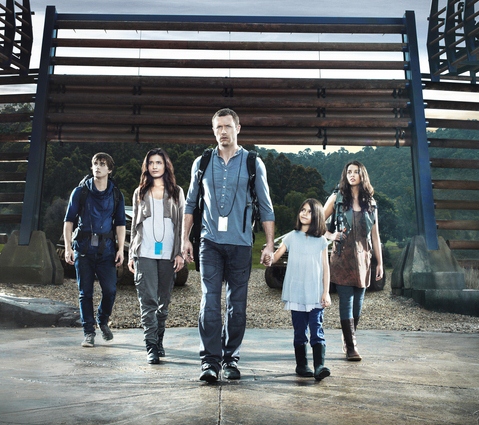
Here’s a very quick summation of the show. Earth has been invaded and conquered off-screen by aliens who are comprised of two types: the multi-legged skitters and robotic, armed-to-the-teeth bipeds called mechs. They’ve wiped out most of human civilization and have also kidnapped children and turned them into a zombified slave force via mechanical harnesses that are dug into their spines. The show follows the plight of a Boston-based militia group called the 2nd Massachusetts led by Capt. Weaver (Will Patton) and the program’s main character Tom Mason (Noah Wyle) who are trying to find a means to defeat the alien invaders.

The aliens have been scavenging the countryside for parts throughout the series and are building these huge towering structures in major cities. The purpose of the structures is unknown but guessed to be landing platforms. In the most recent episode “What Hides Beneath” the militia group is given orders to join an all-out attack on the structures. During a recon of the structure and the alien’s stronghold in Boston some revelations come up. First, the humans are able to develop bullets that can penetrate the mechs’ armor giving our heroes a glimmer of hope. Second a third alien species is discovered, and apparently it looks like they are in command of the skitters. Seeing these tall, elongated humanoids with their thin limbs was a surprise and unnerving. By the way the final look in the broadcast version differs from the clip shown on the show’s official website. But what was more disturbing was the revelation that during an autopsy of a dead skitter the humans find out that the skitters have their own slave-making harnesses attached to themselves too. What’s even worse is the implication that children who are attached to the harness for a long period of time are being mutated into a different type of life form. Already one of the rescued teenagers is showing an allegiance to the aliens and Mason’s recently liberated son has signs that he is mutating physically.

Falling Skies has been successful in answering some questions about the story and characters while bringing up new ones. What are the skitters exactly? Who are the new alien leaders and what is their agenda with our planet (please, please, please don’t let it be they’re after our water or gold–looking at you Cowboys and Aliens!)? Plus the show is giving out nuggets of information about the characters and developing them as well. For instance, in the “What Hides Beneath” episode viewers find out about Weaver’s family and their fate. There has been a hardening of sorts from Moon Bloodgood’s character of Dr. Anne Glass. Yet she is still the caring doctor we all hope for. Another good development which opened up a whole new can of worms was the rescue of Mason’s son Ben. When the show premiered the son was a captive of the aliens and the early episodes chronicled Mason’s quest to find his son and how he was held up. In other shows, this would’ve been the status quo and frustrating for viewers.  Here though, the son was freed and now the repercussions are becoming clear and it’s subtle, doesn’t hit you over the head.

Overall, the developments are coming at a perfect pace, not to slow, not too fast. It’s not a classic show but that’s fine because sometimes those kinds of shows get full of themselves. While there’s room for improvement at least they’re on the right path. If only the V revival was this good, maybe that show would still be around and remembered. Thankfully Falling Skies has been renewed for a second season and next summer can’t come soon enough. Anyone who hasn’t seen the show or missed episodes can catch a marathon on Sunday that precedes the season finale or watch them online.

José Soto

Images Courtesy of TNT

Conquered By The Planet of The Apes

This week marks the premiere of the film Rise of the Planet of the Apes, the latest entry in the Planet of the Apes series. It’s seen by some as a reboot of the series or a prequel but it’s safest to state that the film is actually a remake of Conquest of the Planet of the Apes from 1972, the fourth film in the series.    

The original film takes place in the 1990s. An off-screen plague has wiped out all the dogs and cats and human now rely on apes as both pets and servants. One thing the film doesn’t elaborate on is how modern apes were transformed into nearly human forms and essentially alike. Remember that real-life gorillas are much larger than other apes, orangutans are aboreal and in this film they both are the same size and shape along with chimps. Also by the time the film opens the apes are no longer portrayed as pets but as lower-class slaves.

The arrival of Caesar, an intelligent ape who can speak and the son of Zira and Cornelius from the earlier films brings about a change to the order of things. With the aid of some human allies, Caesar leads the apes into a bloddy revolt and out of their oppression. After the apes win their freedom, he then tells the conquered humans that this act of rebellion will be repeated all over the world and will signal the birth of “The Planet of the Apes.”

Conquest of the Planet of the Apes is one of my favorite films in the series. The premise that apes are mistreated and subjugated by humans and then liberated by an intelligent simian savior was an inspired explanation as to how apes came to dominate the world. The fight sequences between the apes and the police riot squads were very thrilling and effective. Roddy McDowall as Caesar is very convincing, sympathetic and his performance makes Caesar a distinctly different character than Cornelius. Ricardo Montalban as Armando the kind circus owner and Hari Rhodes as McDonald are also excellent as Caesar’s allies.

It will interesting to see if the new film, which star James Franco, can take advantage of the special effects technology and improve upon the source material to provide a modern-day science fiction classic. It seems very promising in that the previews have shown how Caesar was genetically engineered to become intelligent. That’s a plot point that removes any referenes to his time-traveling parents from the original series. At the very least it should make audiences forget the misbegotten film by Tim Burton that came out in 2001. It’s too bad that Burton’s film helped kill any enthusiasm for futher films given how low-key the marketing has been for the new film. Though it’s making its mark now, it pales to the omnipresent marketing push that the 2001 film had. Hopefully if the film delivers, word of mouth may recreate the Ape phenomenon.

Stay tuned

Dr. Botanist

From Flashpoint To A New Universe

All I read about DC Comics, these days, is what the New DC is…

DC’s Flashpoint the newest “event” series, is meant to last only six months. It will end at the end of August. This takes place in the screwed-up evil DC heroes universe, where Barry Allen, aka The Flash, is the only one who remembers the good ol’ wholesome DC universe.

This September, all of DC’s comics will relauch as #1, and this will be the new permanent DC. The comic book company says it’s not an “event,” not a prequel, a sequel or an alternate universe. For the current and next generation of DC readers, the DC universe starts here, in September.

Justice League #1 Cover by Jim Lee and Scott Williams

By the way, pick up the new DC’s Justice League, on sale Wednesday, August 31, by Geoff Johns and Jim Lee, who are the chief creative officers for DC Entertainment. The new DC will center around the first issue of Justice League#1 so this will start it all.

I could be wrong, but my guess is that in August, the Flash from Flashpoint, in his efforts to right what was wrong and go back to the old DC universe, never truly succeeds. Kinda like Old Spock from the 2009 Star Trek film. or maybe the readers get to see Flash make it back home, but that old DC universe is closed for readers. No more old universe. The end of Flashpoint I imagine will be the destruction of the Flashpoint Universe (which was truly dark, evil and edgy- darker than Marvel) and from September on, a new DC Universe will appear, and although it’s not as dark as Flashpoint, it seems to be way cooler than the old DC. I know DC wants to match the coolness of Marvel. DC will never portray the original DC Universe as the main universe again. It’s timeline and continuity, they believe, served its 70-year purpose.

And that’s the objective- by every one of these books relauching at #1, DC has the means to start fresh with modern sensibilities.

DC’s Crisis on Infinite Earths in 1986 did much of that, but back then, only Superman and Wonder Woman had a few of their books that relaunched at #1. And what they did then was consolidated dozens of Earths into just one. The 2011 DC Universe, is designed for readers who know nothing about DC, and is also designed for familiar readers. The reaction I sense from old fans is somewhat positive, maybe 70/30 split. But the majority of the old school readers who actively buy comics are approaching or are middle age. the new DC needs to maintain popularity with a fan base for young readers. With TV, movies, web, Youtube, videogames, and other adventure-based presentaions, comics have an uphill battle. And when guys discover girls, comics sustain a bigger loss LOL! In WWII, a single issue of Superman sold five million copies a month! A single monthly issue. These days Superman may sell only 30,000 copies, on a lucky month. And the majority of the readers today are aging fanboys.

BTW, all 52 new DC monthly titles will be available as a download or you can go to the stores and buy the paper comic. Digital download comics are undoubtedly the wave of the future. Every Wednesday, the latest DC comic will be available online and at the local comic shops. That’s a big step. According to DC editor Paul Levitz, digital download comics sell five times more than paper comics- that’s one reason why I believe this could work.

This new DC will work only if it attracts new readers, elementary school, middle and high school kids, who can click their iPhones to download the latest issue of Superman.  And these up and comers will need to want comics more than kids have in the last 30 years who had a ho-hum reaction to comic books up to now. This current generation (sometimes called millenials or Generation 9/11) has been raised on videogames, DVDs, the web, pop music and other entertainement that compete for the user’s attention against comics.
The majority of faithful comic book readers, historically fell into three groups–WWII-era young adults (young GIs stationed in Europe and the Pacific collected comics), baby boomers (who picked up their hobby from their parents) and those from Generation X. Any generation after that were less inclined to buy or collect comics. DC seems to be putting all their cards on the table for one huge gamble. If this doesn’t take off then this “relaunch” will be just another “event.”

Although it’s an uphill battle- these are the positives: it’s designed to be a new universe for new readers to jump in igital download for iPad, iPhone and Droid phones. There’s no need to walk into a store to get new DC comics every Wednesday. Of course this spells trouble for bricks and mortars businesses who will have to be innovative to survive.

My guess is that it will be more successfull than the overall 2010 sales for DC comics, at least, because 1) in 2010 only a select few DC comics were digital downloads and what DC saw is that digital downlad comics made five time more money than paper comics, and 2) from now on, all monthly DC comics are high resolution digital downloads (for the same price as paper comics).

So at the very least, the key to DC’s (and the comic industry overall)  survival is digital download sales, and the high likeleyhood that DC will make more profit than than in any given year in the last 20 or so years.

Geo