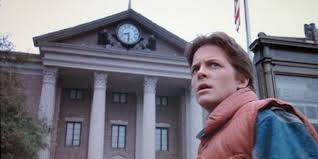
Assorted Star Trek Highlights

original enterprise

As we celebrate the 49th anniversary of Star Trek (God, that makes me feel old!), some quick thoughts came to me regarding the beloved show and the franchise it spawned. Star Trek and its many incarnations had many highs and lows, but what stuck with me throughout the decades were the highlights and some general observations about Trek.

Captain

James T. Kirk, played perfectly by William Shatner, is the best Star Trek captain. Period. Nothing more to say.
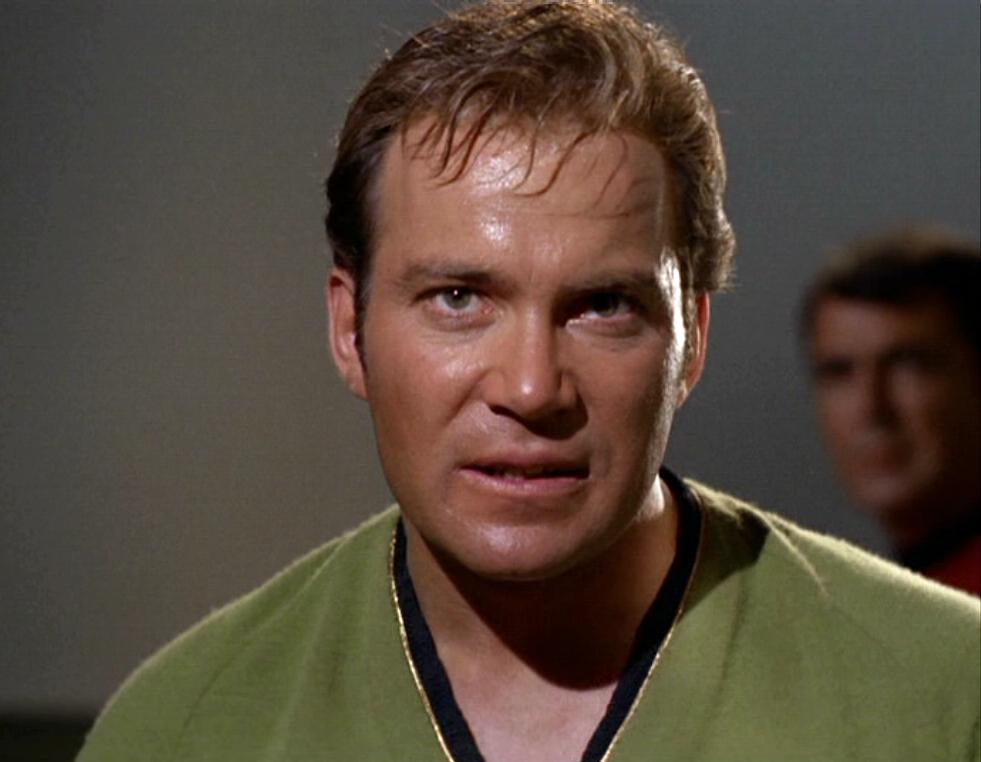
classic kirk

Villains

Star Trek has many memorable villains that faced off against Kirk, Picard and others. The biggest and baddest of them all still remains as Khan, the first version played by Ricardo Montalban. While Benedict Cumberpatch did a menacing job reimaging Khan in Star Trek Into Darkness, Montalban’s Khan was just insane. The other great Trek villains are the Borg Queen (Alice Krige) from Star Trek: First Contact, General Chang from Star Trek VI: The Undiscovered Country (Christopher Plummer had great chemistry with Shatner), Shinzon from Star Trek: Nemesis, Nero from Star Trek, Kurge (Christopher Lloyd) from Star Trek III: The Search for Spock, Q (John DeLancie) from Star Trek: The Next Generation, the Romulan Tomalak (Andreas Katsulas) of Star Trek: The Next Generation, Ron Perlman’s Nosferatu-like Viceroy in Star Trek: Nemesis, Gul Madred (David Warner) in Star Trek: The Next Generation and Gul Dukat (Marc Alaimo) in Star Trek: Deep Space Nine. In general, I enjoyed the Klingons, Romulans and Borg. Finally, I have to give a shout out to the black oil spill creature that killed Tasha Yar. It proved that oil spills will be the death of us!

khan II

Ships

Star Trek is well known for its many distinctive space ship designs. Of course, one of the best has to be the original Enterprise from Star Trek. It’s simple, classic and culturally important. With that I will state that I loooooove the Enterprise from Star Trek: The Motion Picture! As for the Enterprise seen in the Star Trek reboot, I admit that I like it, but don’t love it like I did with the earlier movie versions of the Enterprise. I also thought the space station designs in the reboot didn’t work (but I loved the ones used in the early films, the same goes for the early space dock used in the first two Star Trek films).

enterprise refit

Other great ships for me were the Enterprise D from Star Trek: The Next Generation with its amazing concept of having the saucer separating from the ship. Meanwhile, I also liked the Enterprise E first seen in Star Trek: First Contact because it had this neat, sleek look.

Starfleet also had other great designed ships. Let’s start with the shuttlecraft Galileo. It was a classic, and I’ll have to say that the updated shuttle designs seen in Star Trek: The Next Generation were nice. Two other great ships were the Defiant from Star Trek: Deep Space Nine (it’s one great, tough, little ship!) and the Reliant from Star Trek II: The Wrath of Khan. It’s got the most innovative design and was actually a happy accident. Director Nicholas Meyer saw the blueprints for it upside down and approved it. This allowed for the designs of differently shaped Federation starships.

reliant

The alien ships used in Trek were also wonderful, take the Klingon Bird-of-Prey ships that were seen in most films and TV shows. It just showed what a great design it was. I also liked the Romulan warbirds from the Trek spinoffs and the Ferengi ships, too. Other ships that deserve mentioning should be the alien probes V’Ger and the whale probe. With V’Ger I didn’t know the full shape of it until I saw the director’s cut. I think it was OK, but the closeups of it are more spectacular than its outside silhouette shape. What I liked about the whale probe from Star Trek IV: The Voyage Home was that it kind of mimicked the elongated shapes of the whales.

vger

I should point out that the Borg cube first seen in Star Trek: First Contact is Trek’s answer to the spherical Death Star. Maybe the next sci-fi franchise should have the enemy ship look like a cone! Star Trek: Deep Space Nine, Star Trek: Voyager and Star Trek: Enterprise had many more ship designs, but they weren’t very memorable to me except for the Bajoran solar sail ship.

Costumes

A common thread in these musings of mine is how great the original Star Trek was and how it got so many things correct. Any so-called improvements made by the movies and spinoffs, while mostly good, just can’t compare to Classic Trek. A good example of this is the costuming of the original show. They used simple multi-colored costumes that made it easy to denote rank and division. The design and colors were so great and the 2009 movie reboot kept the same pattern, but improved on the fabrics and patterns used.

Star trek reboot

A close second would be the classic red uniforms that were used for most of the original cast movies starting with Star Trek II: The Wrath of Khan. They had a naval design that was just perfect for the movie’s tone.
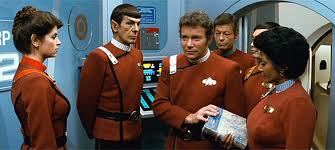
khan cast

The spinoff Star Trek TV shows also had some nice costumes, especially the ones used in Star Trek: The Next Generation that followed the spirit of the original series in having different colors denoting rank and division.

As for costumes that didn’t work, that dishonor goes to the bland outfits used in Star Trek: The Motion Picture. They looked like grey pajamas! But the fancy white and grey uniform worn by Admiral Kirk and Spock’s black Vulcan tunic were great.

Music

The original theme by Alexander old trek castCourage has a resonating hailing overture that builds to a sense of adventure thanks to the use of a singer and bongo drums. I just love listening to it. Composer Michael Giaccino built on that mood with his take of the original Star Trek theme in J.J. Abrams’ reboot. His version of the original theme is magnificent.

The second best Star Trek theme for me is actually a tie between Jerry Goldsmith’s majestic score for Star Trek: The Motion Picture and James Horner’s adventurous work in Star Trek II: The Wrath of Khan. Goldsmith’s fanfare is a hail to adventure and the rest of the soundtrack made the movie better than it was. Horner’s work meanwhile had the right tone for the movie which evoked naval ships and battles.

Star Trek VI: The Undiscovered Country had a score that I liked a lot. It was dark, intriguing, yet had fanfares that were sentimental farewells for the original cast. The signature send off at the film’s end was fantastic. Other noteworthy scores are the ones for Star Trek: First Contact, Star Trek: Voyager, while the one for Star Trek: Deep Space Nine grew on me.

Background Design and Cinematography
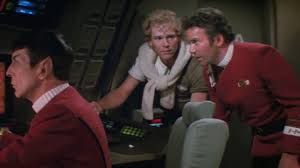
wrath of khan bridgeFor me, Star Trek II: The Wrath of Khan had the best look on the whole because of its slightly darker lighting. It’s funny to think that the sets used in that film were the same ones from Star Trek: The Motion Picture. It’s amazing what lighting can do! On that note, I’ll say that I hated the bridge lighting used in Star Trek V: The Final Frontier, but loved the improved lighting in Star Trek VI: The Undiscovered Country thanks to Hiro Narita, who also worked on The Hunt for Red October.


Star Trek: The Next Generation had the best computer interfaces, it still looks futuristic and I love the look of the graphics. Meanwhile the look of the Trek reboot sports a fresh interpretation. It’s like walking into an Apple store with mirrors that produce lens flares! I didn’t mind the look, but I know purists object to it.


Walter L. Stevenson

Star Wars Movie Retrospective: Star Wars Episode III: Revenge Of The Sith

episode III poster

“You were the Chosen One! It was said that you would destroy the Sith, not join them! Bring balance to the Force, not leave it in darkness!” –Obi-Wan Kenobi

Sometimes the cliché is true; third time is the charm. After the poor reception of the first two Star Wars prequels, filmmaker George Lucas finally hit his directorial stride that he lost long ago with the final prequel Star Wars Episode III: Revenge of the Sith. The result of his efforts? The most underrated and darkest Star Wars film to date.

coruscant battle

Star Wars Episode III: Revenge of the Sith takes place during the last days of the Clone Wars. The opening scrawl literally opens with the word “War!” then explains that the galaxy-wide conflict between the Galactic Republic and the Separatist Alliance has been devastating to the Republic. The Separatists, led by the Sith Lord Count Dooku (Christopher Lee) and his second-in-command the cyborg General Grievous (Matthew Wood), have kidnapped Chancellor Palpatine (Ian McDiarmid), the leader of the Republic. As the Separatists leaders try to flee Coruscant, the capital planet of the Republic with their hostage, a massive and ultimately decisive battle breaks out between two opposing space armadas over Coruscant.

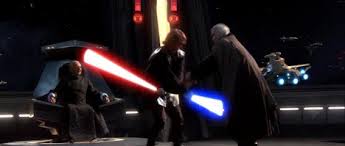
Amidst the cluttered, epic space battle, two Jedi Knights, Obi-Wan Kenobi (Ewan McGregor) and Anakin Skywalker anakin defeats dooku2(Hayden Christensen), take their small fighter ships and infiltrate Grievous’ battlecruiser where Palpatine is being held. The Jedi fight their way to the captive chancellor. They soon confront Dooku and engage in a lightsaber duel where Obi-Wan is knocked unconscious, but they younger Jedi is able to defeat the Sith Lord. At Palpatine’s urging, Anakin beheads a surprised Dooku after some hesitation.

As Anakin tries to escape with Palpatine and Obi-Wan in tow, by this time, the battlecruiser has taken on severe damage from the space battle and is losing orbit. General Grievous manages to escape in a shuttle, leaving Anakin to pilot the battlecruiser and crash land it on the citified planet.

anakin and padmeLater, amidst the celebration among Palpatine and other politicians over Dooku’s death and the war concluding, Anakin steals away to rendezvous with his wife Senator Padmé Amidala (Natalie Portman), whom he secretly married in defiance to Jedi rules that forbids romantic relationships. She reveals that she is pregnant, and although he is excited at first, that night he has dreams where she dies during childbirth, which unsettles him.

General Grievous arrives on the planet Utuapo, his base of operations, and confers via hologram with the Sith Lord Darth Sidious. The cloaked figure orders him to bring other Separatists leaders to the volcanic planet Mustafar and announces that soon he’ll have a younger, more powerful replacement for Dooku.

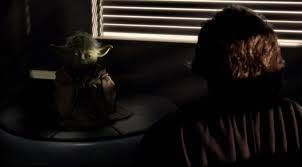
At the Jedi Temple on Coruscant, yoda anakinAnakin confides with Jedi Master Yoda (Frank Oz) about his premonitions. Yoda warns him about being obsessed with his visions and adds “The fear of loss is a path to the dark side.” The wizened Jedi tells Anakin that death is a part of life and those that die become one with the Force and that the living shouldn’t mourn them and to let go of his fears. Anakin is clearly unsatisfied with Yoda’s advice.

Later, Anakin meets with Palpatine, who appoints him to be his representative to the Jedi Council. This is against Jedi procedure since they make such appointments. The young Jedi is happy, thinking that he’ll become a Jedi Master, but is angered later by the Council. The other Jedi state that while they accept the appointment and he can sit in the Council, he won’t be made a Jedi Master. After the Council meeting concludes, Obi-Wan reveals to Anakin that the Council allowed the appointment because they want the young Jedi to report to them about Palpatine’s dealings. They no longer trust the chancellor who is amassing more executive powers and has stayed in office past his term. Anakin is disturbed by this but Obi-Wan reminds him that the Jedi are loyal to the Senate not its leaders and to not to let his friendship with Palpatine cloud his judgment.

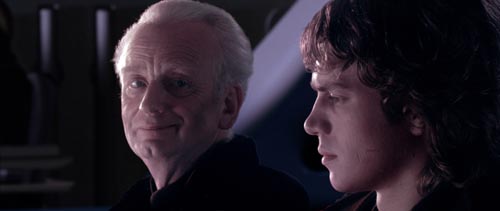
anakin palpatineAt night, Anakin joins Palpatine at an opera and learns of Grievous’ location. The chancellor adds that he distrusts the Jedi and thinks that they want to overthrow him . Anakin admits his faith with the Jedi has been shaken lately. Then they engage in a philosophical discussion about the similarities between the Jedi and the Sith. Palpatine asserts to an intrigued Anakin that both sides crave power, but that the dark side of the Force is more powerful and gives one control over life and death.

Anakin later attends a Council meeting and reports that Grievous is on Utuapo and that Palpatine wants him to capture the cyborg leader. The Council members overrule him and assign Obi-Wan to go instead. Anakin is visibly displeased over their decision, but says nothing. Afterwards, he accompanies Obi-Wan to a space port where the two men reaffirm their friendship and separate on good terms.

obi wan and mount

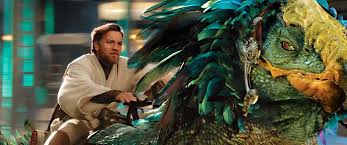
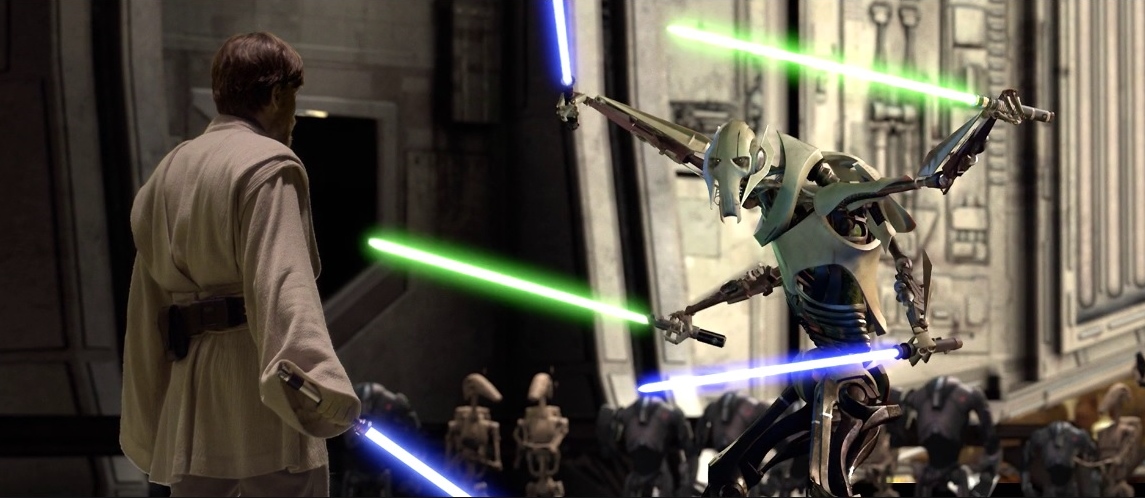
Obi-Wan arrives on Utapau and confronts Grievous. The four-armed cyborg tries intimidating the Jedi with his prowess by wielding four lightsabers simultaneously. Obi-Wan coolly counters Grievous with his adept lightsaber skills. Then a newly arrived clone army attacks the droid army guarding Grievous and the Separatist base. Grievous tries escaping, but is pursued by the Jedi, who catches up to him and the fight ensues. It ends with Obi-Wan shooting the cyborg dead with an “uncivilized” blaster.

obi wan punks g

Anakin reports to Palpatine the news about Obi-Wan’s confrontation. In the conversation, Anakin admits his disillusionment with the Jedi and the chancellor starts manipulating him. He reveals that he is a practicioner of the dark side of the Force and that Anakin could learn so much more if he embraced the dark side. Horrified about the revelation, he leaves and informs Jedi Master Mace Windu (Samuel L. Jackson) about the chancellor’s true nature. Windu tells him to wait in the Council chambers while he and other Jedi leave to confront the Sith Lord.

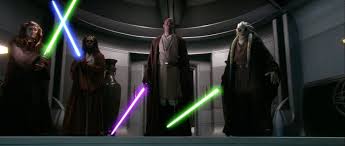
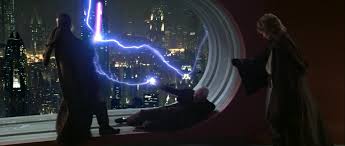
four inept jediWindu and three other Jedi Knights arrive at Palpatine’s office and try to arrest him. But the chancellor is surprisingly fast and kills three of the Jedi with his lightsaber except for Windu. Anakin rushes over to the office in time to see the two men in battle. Windu disarms Palpatine, but the Sith Lord unleashes Force lightning from his fingers at Windu. The Jedi is able to deflect the lightning bolts, which splash back and disfigures Palpatine. palpatine defeats winduWindu realizes that the chancellor is too dangerous and must be killed. Anakin argues that Palpatine should be allowed to live and stand trial. Undeterred, Windu prepares a killing stroke but is stopped by Anakin who dismembers his hand. This gives Palpatine the opportunity to kill Windu with his Force lightning.

Anakin is dismayed at what he’s done. He realizes that he has no place with the Jedi now. Palpatine asks him to become his apprentice and the young man accepts as long he helps him save Padmé. The chancellor agrees and renames him Darth Vader. Palpatine tells him that all the Jedi are enemies of the Republic and must be killed. He orders him to kill the Jedi at the Temple and the remaining Separatist leaders on Mustafar.

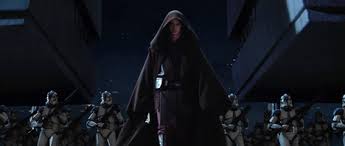
As Anakin, now Darth Vader, leads a clone army into the Jedi Temple, Palpatine broadcasts a special command, Order 66, to every clone trooper spread out throughout the galaxy. The clones mercilessly and abruptly turn on their Jedi commanders and decimate the ancient order. The only ones who escape execution are Obi-Wan on Utapau and Yoda, who is on the Wookie planet Kashyyk leading a battle against droid troops. Yoda is able to flee the planet thanks to the help of loyal Wookies, including Chewbacca (Peter Mayhew).

vader marches

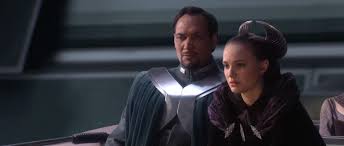
The Jedi Temple is in flames as Vader and the clones kill all the Jedi there, including young children, the sole witness to the atrocity is Senator Bail Organa (Jimmy Smits) who went to the Temple to see what was happening. Organa later sends Obi-Wan a holographic message warning about him the slaughter and to meet with survivors at certain coordinates. Meanwhile, Vader goes home and lies to Padmé that the Jedi tried to overthrow the Republic. Then he leaves her for his mission to go to Mustafar and end the war.

Obi-Wan and Yoda meet at Organa’s ship and end of republicplot to return to the Temple and intercept a broadcast for all surviving Jedi to return to Coruscant. Once they arrive, Obi-Wan is able to change the message into that of a warning. From security footage, they learn that Anakin has betrayed them. At the same time, Organa and Padmé attend a session in the senate where Palpatine denounces the Jedi and that in order to maintain order he has to reorganize the Republic into a Galactic Empire. After viewing the footage, the two Jedi decide to confront Palpatine and Vader. Yoda, the stronger of the two, will face Palpatine, while Obi-Wan will confront his former apprentice. From there, the two Jedi separate to confront their foes in battles that will literally decide the fate of the galaxy.

Continue reading

A Look At Josh Trank’s Chronicle

Josh Trank’s directorial career is in serious jeopardy since Fantastic Four has not only flopped, but has become an infamous failure, thanks in part to his ill-conceived tweet on the eve of the troubled film’s release that disavowed it as not his work. This added fuel to the fire about his professionalism and merits as a filmmaker. These developments have led many to question if he has the right temperament for the business. It’s too early to tell how this will play out, but one thing that can’t be denied is that with his first film Chronicle he displayed promising talent with a movie that mashed the superhero and found-footage genres. Here is a review.

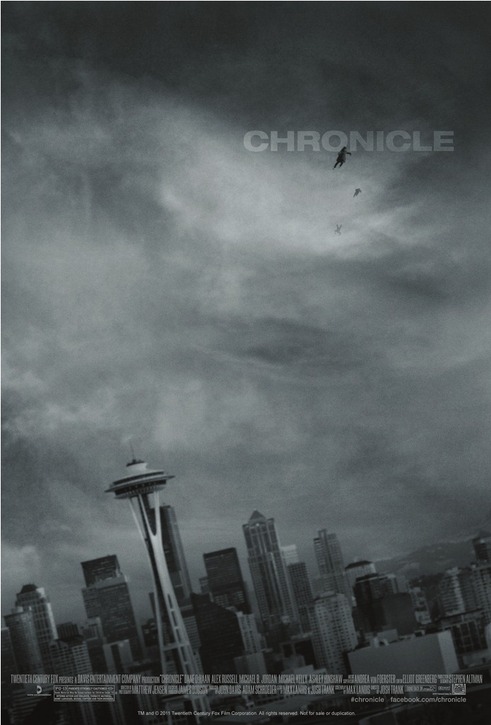
chronicle poster


The “found footage” sub-genre may elicit many groans and complaints from moviegoers. While Chronicle at first didn’t seem all that different from films of this type with its slightly mundane first act when it introduced stereotypical characters, it turned out to be a refreshing viewing experience. Unlike most “found footage” movies, this wasn’t a horror film, but rather about three teenage boys who developed telekinetic powers and how it affected them. Before long the film turned out to be a pleasantly surprising with its plot development and execution.

The main camera used in Chronicle is operated by one of the boys, Andrew Detmer (Dane DeHaan), a shy, emo type who picks up the hobby of videotaping his life. Andrew clearly doesn’t have a happy life in school or at home. He’s shunned and picked on by bullies, his father’s a violent alcoholic and his mother is dying of cancer. At some point, he goes to a rave party with his outgoing cousin Matt Garetty (Alex Russell), and they run into the ultra-popular Steve Montgomery (Michael B. Jordan), who’s running for school president.  The three leave the party and discover a hole in the ground near the party. After hearing strange sounds coming from it they descend into the hole to investigate. Deep down they encounter a crystalline structure of unknown origin that pulses and causes them to have nosebleeds.

The movie jumped ahead in time to where the trio are experimenting with their newly acquired telekinetic powers. They treat it as a fun diversion and bond together while carrying out pranks with their powers. But it soon becomes clear that their powers are increasing and that Andrew’s inner demons causes him to become more and more malicious with his powers.

That was the best twist with the film. We’ve all been expecting to see the lovable shy loser get super powers and then run off to save the world. Sadly, this doesn’t happen with Andrew, he’s clearly not Peter Parker, as he uses his abilities to hurt others. But, the character was so well presented and three dimensional that despite his increasingly violent actions, one can’t help but sympathize with his situation, while fearing him. Andrew thought that the powers would change his life for the better, but they haven’t. He is still unpopular, his father continues berating him and he cannot save his mother.

In the meantime, Matt and Steve defy the popular jock stereotypes and become more sympathetic. Matt soon realizes that they have to be responsible with their powers. This doesn’t mean he wants them to fight crime, only to not use the powers to harm living things. This difference in opinion will ultimately lead to a clash between the two cousins. Kudos goes to the three actors who play the three friends, the bond they share over their secret powers and the joy they have at first is apparent and one can’t help but marvel at their telekinetic displays.

Whereas something as simple as levitating a ball may seem humdrum in an X-Men film, in Chronicle it truly came off as a marvel. With that said the final act of the film was jaw-dropping thanks to its special effects that put more expensive superhero films to shame in the wow factor as a major battle takes place in the skies over Seattle.

Put aside any complaints about Fantastic Four when considering Josh Trank’s debut film. Chronicle is still a well-made production that showed promise and indicated that Josh Trank would have a memorable filmmaking career. Trank should be commended for Chronicle’s execution because the “found footage” technique added to the reality of what moviegoers saw before their eyes. Unfortunately, as terrific as Chronicle was,  Trank suffered the sophomore curse big time with his disjointed Fantastic Four. It is a poorly made film that has clear evidence of studio tampering (as seen by the haphazard third act) and it’s so-called grounded and gritty take of Marvel Comics’ superheroes was misguided from the start. It proves that undertaking a big-scale production was too much for the young director. However, if given another chance to direct a smaller production like Chronicle, Trank might be able to develop his skills and find some redemption.

Lewis T. Grove

The Merits & Flaws Of Past Fantastic Four Films

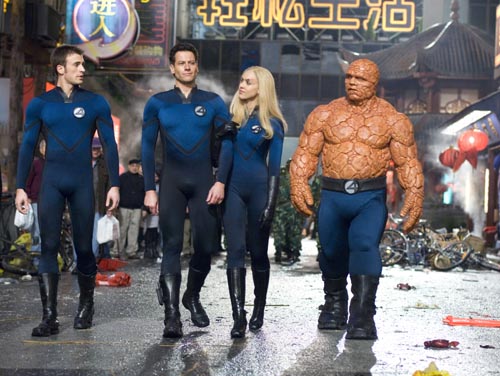
ff cast 2

The Fantastic Four, Marvel Comics’ first superhero team, always had a hard time with its live-action adaptations. The new reboot isn’t an exception. Filmmakers can’t seem to be able to properly translate what worked for this team in the pages of comic books into movies. Still, putting aside what went wrong with the three previous movies, they did get many parts right. It’s just that they missed the mark, sometimes by a mile.

The Fantastic Four (1995)

Bernd Eichinger and his Neue Constantin studio bought the film rights to the Fantastic Four back in the ’80s, but couldn’t raise the funds for the movie. By the next decade in order to prevent losing the rights the studio with Roger Corman’s help produced The Fantastic Four a quick, cheap adaptation.

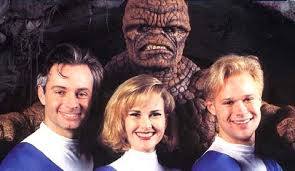
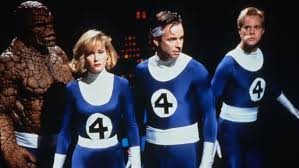
old ff castOh boy, this movie was a mess, it’s on the level of those Godawful monstrosities made by The Asylum. The acting was hysterically bad, particularly Joseph Culp as Doctor Doom. Talk about hamming up the scenes! Then there were the zero-grade special effects. It’s hard to believe that a million dollars was spent on this fiasco when you see that they used animatics during the one scene that the Human Torch (Jay Underwood) used his full powers. Want a guaranteed laugh? Check out the film’s final scene when Mr. Fantastic (Alex Hyde-White) waves goodbye with an obvious fake arm from the sunroof of his wedding limo!

Yet, as terrible as the film was, it had a certain charm. The production nailed down the team’s look right down to the costumes, even The Thing (Michael Bailey Smith) was impressive. This is amazing considering how far off the mark more professional productions were with their versions of The Thing and Dr. Doom. Never mind the acting, at least they looked like their comic book counterparts!

bad ff

Despite their inexperience, you could tell that the actors and production team were trying their best. They honestly believed this was going to be a big deal, but tragically for them it wasn’t. The cast and crew didn’t know that the film was never intended to be released and it wasn’t. Nor did they expect the film to get its infamous reputation as bootleg copies of the film circulated. Still, while it’s a terrible movie, it warrants a viewing for either fans who want to see a more faithful adaptation or drunks needing a good laugh.

Fantastic Four (2005)

When the superhero movie boom started early last decade, it wasn’t long before the FF got their shot at the limelight. 20th Century Fox released Fantastic Four in 2005, which turned out to be a modest hit, but received mixed reactions.

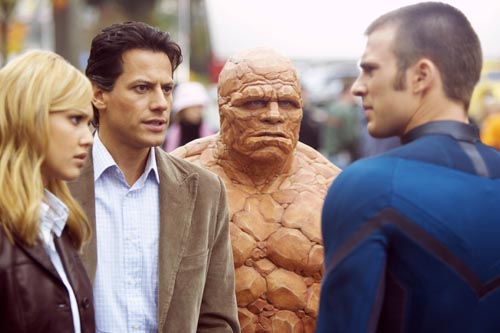
ff cast

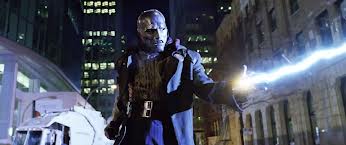
Even though Fantastic Four was a more polished and professional film with a $100 million budget (compared to the reboot’s $122 million) it seemed routine and bland at times. doomWhat was worse was that Fantastic Four was hobbled with a poor villain, a vital component of any superhero film. Dr. Doom (Julian McMahon) was completely wrong from the casting to his backstory. In this version, he was your typical evil CEO who was part metallic and had electric-based powers. Those kind of changes wouldn’t have bothered people so much if the actor was a good fit. But, McMahon just didn’t have the gravitas that Doom requires because he’s a larger-than-life villain.

Ben Grimm/The Thing (Michael Chiklis) was also altered, but with different results. His look didn’t match the comic books’ version because he was human sized and lacked that famous protruding brow line. Also, his story was altered in that he was married, but his wife (briefly played by Laurie Holden of The Walking Dead) left him after she saw how he was disfigured by the accident that gave him his powers. But these changes weren’t too jarring and more importantly, Chiklis and the production captured Ben Grimm’s essence. Like in the comics he was downtrodden and full of self pity. He quarreled with his teammates, especially Johnny Storm (Chris Evans), who loved pulling pranks on him.

real torch

The other highlight was Johnny himself. Evans channeled the nature of this young superhero brilliantly. He reveled in his powers, he was brash, brave and loved life, which is why he was a good foil for the moody Thing. Evans was so convincing as the happy-go-lucky Human Torch that when he was announced to play Captain America, some people doubted he could portray the more mature and grounded hero. He proved them wrong. Continue reading

Back to the Future: Celebrating 30 Years Of The Timeless Classic

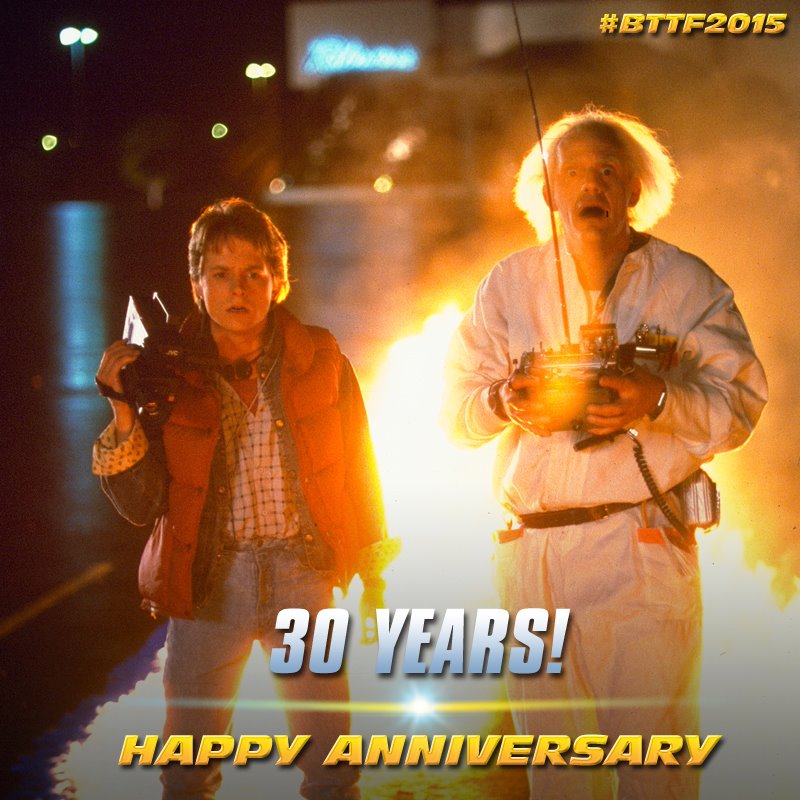
BTTF 30

“Doc, I’m from the future. I came here in a time machine that you invented. Now I need your help to get back to the year 1985.” – Marty McFly

It’s been thirty years since the world was introduced to Back to the Future, the greatest time travel film ever made. For anyone who hasn’t seen it yet, the film is about Marty McFly, your typical modern teenager who accidently time travels to 1955 and meets his then-teenage parents. This created a temporal paradox where Marty was threatened with non-existence so not only must Marty find a way back to his time period, but has to correct his parents’ timeline to ensure he’s eventually born. The instant classic wowed many audiences when it was released and was the biggest box office hit of 1985. Through the years since its initial release Back to the Future has generated many fans who look fondly at the film and for good reason.

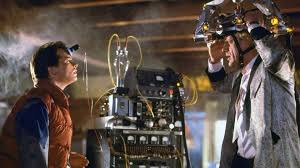
marty and docBack to the Future, the brainchild of director Robert Zemeckis and writer/producer Bob Gale, is a humorous, smart take on time travel that starred Michael J. Fox as Marty McFly and Christopher Lloyd as his best friend Dr. Emmett “Doc” Brown. Both actors made tremendous contributions to the film’s success thanks to their comedic performances and a genuine chemistry between them. Both actors were so well suited for their roles, which made them so endearing to audiences.

Perfectly Timed Casting

It’s amazing this happened because it almost didn’t. As fans know, Michael J. Fox wasn’t the first person original martycast as Marty. It was Eric Stoltz, but as filming commenced Zemeckis realized that Stoltz wasn’t right for the role. To his credit, the director made the right decision to replace him with Fox, who was actually the first choice for the role but was initially unavailable. It all worked out in the end, Fox turned out to be perfect as the distressed but likeable teenagerwho finds himself in an extraordinary situation.

Thanks to his popularity at the time (his sitcom Family Ties was a hit TV show in 1985), Fox helped draw in ticket buyers who normally couldn’t be bothered with a sci-fi comedy about time travel. But Fox had a certain charm that made Marty so appealing to audiences. Through Marty’s eyes, we saw the trepidations of being a teenager and later in the film Marty was able to see that his teenage parents had similar gripes and issues. He witnessed teenagers in the 1950s with timeless problems such as peer pressure, bullying, social awkwardness and self doubt. Marty learned some profound lessons about his parents and himself. Underlying that are simple, yet poignant messages about self confidence and accomplishments. “If you put your mind to it, you can accomplish anything.”

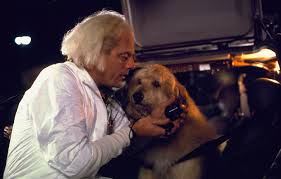
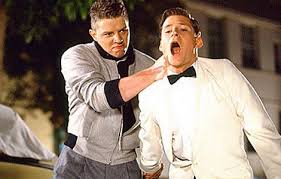
einstein first time travelerFox isn’t the only reason that Back to the Future is so memorable. A large measure of that has to do with the supporting cast as well. Aside from Lloyd (who perfected the daffy, wild-eyed scientist), Lea Thompson as Lorraine Baines, and Thomas F. Wilson as the comical bully Biff Tannen, Crispin Glover nearly steals the film as George McFly, Marty’s nerdy father. While Glover has funny playing the goofy, out-of-touch older father in the 1980s scenes, he really shines in the 1950s scenes where he exemplifies the shy and nervous sci-fi geek. tannen and georgeWhat sci-fi fan can’t identify with his dilemma where he has to choose between going out to a dance or staying home to watch Science Fiction Theater? It’s just unfortunate that Glover didn’t return for the sequels, thus diminishing his character in those films. But we did get to see more of Biff and his relatives later on, who were perfect villains throughout the three Back to the Future films.

Temporal Shock

Underlining the film’s appeal is the accurate representation of the 1950s and the culture shock that followed when Marty first experiences the time period. The film is littered funny and amusing nods to the past and present like Marty ordering a Pepsi Free at a diner and being told he has to pay for it, or Marty being mistaken for an alien creature by farm folks, and Marty disguising himself as Darth Vader. Other nifty touches sprinkled throughout the film include the well-groomed nature of that time period, the archaic but catchy music and how undeveloped but pristine Marty’s hometown of Hill Valley appeared.

arrival

Overall, Marty’s experiences and culture clash were some of the best and funniest fish-out-of-water scenarios done on film. Looking at the film now, a modern-day viewer can also experience a measure of culture shock at the then-contemporary 1980s scenes. The contrast between the clean, bright middle-class lifestyle of the 1950s and the rundown, but modern vista of the 1980s is startling. Instead of making the film dated, the fact that Back to the Future is bookended with the 1980s adds to the rewatchability factor.

Continue reading