Spider-Man’s Greatest Moments, Part III

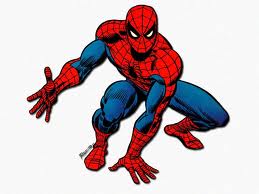
As Marvel celebrates the 50th anniversary or birthday of their greatest superhero Spider-Man, here are some more elements that has best defined everyone’s favorite web-slinging hero. These aspects and many others are the reason why Spider-Man continues to captivate many fans.

A Doubtful Everyman What makes Spider-Man such an endearing hero is the fact that he isn’t the most powerful superhero. He isn’t even the smartest. He gets by with his pluck and determination and sometimes by knowing when to retreat and come back to fight another day.

While he is quite a powerhouse when he puts his mind to it, often he fights more powerful foes or the villains just happen to gain the upper hand. This usually led to bouts of severe doubt. This happened very early in his career in The Amazing Spider-Man # 3, which was the first appearance of his arch nemesis Doctor Octopus. Early in the issue, Spidey easily captured some robbers and he mused to himself that his crimefighting career was too easy. Little did he know that a few pages later he would get a major thumping when he first fought Doctor Octopus. He was so humiliated by his defeat that he considered hanging up his costume until a high school lecture by the Human Torch about not giving up, inspired his alter ego Peter Parker to get back into the fight and eventually defeat Doctor Octopus.
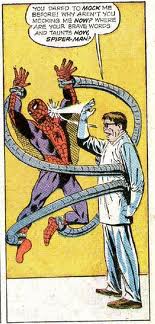
There was another moment when he had to prepare to fight Doctor Octopus in Peter Parker, The Spectacular Spider-Man # 78. Most of that issue dealt with Spidey coming to grips that he might not survive the oncoming battle with Doc Ock and was mentally preparing for the ordeal. It was notable because in that issue, Peter took time to say goodbye in his own way to his loved ones. Of course, readers knew that he would come out the winner but he didn’t and his fears and doubts made him very relatable to readers.

Often Peter winds up berating himself over his choices and the consequences from them. He blames himself for his Uncle Ben’s death, for causing his Aunt May so much stress over his disappearances, and so on. The sad thing is that many times Spidey is correct in blaming himself. One of the more boneheaded things to happen to him is that he failed to graduate college (The Amazing Spider-Man # 185) because he didn’t have the required credits and didn’t notice this due to his superhero activities.
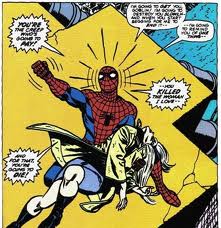
When it comes to his anguish nothing could top the aftermath of his girlfriend Gwen Stacy’s death in The Amazing Spider-Man # 121. In that infamous issue, the Green Goblin kidnapped Gwen to lure Spider-Man to the George Washington Bridge. At one point, the Green Goblin tossed her off the bridge and Spidey snagged her with his webbing. As he pulled her back up, he was congratulating himself on having saved his girlfriend. But what he didn’t realize was that his action actually snapped her neck and killed her. The issues that followed illustrated his rage and grief and to this day, he’s has been shown to be still haunted by her death as would any one of us.

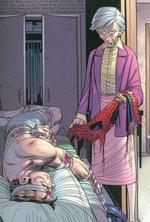
Supporting Cast Unlike many superheroes Spider-Man has been blessed with an excellent supporting cast. Starting with his Aunt May, always on the verge of death until recent writers realized that plot point was used once too often. She first came off as an overbearing mother type, but over time, May Parker learned to let go of Peter and became supportive of him. May had an intriguing development where she learned of her nephew’s secret identity following a brutal battle he had with Morlun (The Amazing Spider-Man # 35, Volume II). However, her knowledge of Peter’s secret identity was undone by the infamous “One More Day” storyline that rebooted the Spider-Man universe.
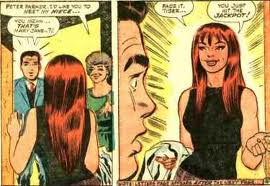
The most glaring casualty of the reboot was the dissolution of Peter’s marriage to Mary Jane Watson. Aside from Gwen Stacy, Mary Jane is Peter’s greatest love and ever since her first full introduction (The Amazing Spider-Man # 42) she rocked his world and won over many readers with her flash and verve. Mary Jane was there to pick up the pieces after Gwen died. Her most shocking revelation came at the end of The Amazing Spider-Man # 257 when she admitted to Peter that she always knew he was Spider-Man. This knowledge was a barrier to their on-again-off again relationship, but they eventually married. Naturally, his Spider-Man activities conflicted with his domestic life to the point that she left him at one point (The Amazing Spider-Man Annual 2001), though they later reconciled. Foolishly, TPTB at Marvel Comics decreed that Spider-Man couldn’t be married because they felt the marriage plot line was stale. Hence the “One More Day” story where Spider-Man made a deal with Mephisto to save his Aunt May at the cost of his marriage. But even though they aren’t married in the new timeline, it was shown in recent issues that they still have feelings for each other, so it may not be over. Continue reading
Spider-Man’s Greatest Moments, Part II

Continuing a look at Spider-Man’s highlight in the past 50 years, there are more aspects of Spider-Man that has made him one of the most endearing and popular superheroes ever created.

Unlikely Savior

Though Spider-Man isn’t the most powerful superhero, his pluck and penchant for being in the wrong place at the right time make for captivating stories. Many times these out-of-his-element tales often took place in the pages of Marvel Team-Up. Other times he was a critical element in some wide-reaching storylines and comic books. For instance, it can be said that he was the heart of the Civil War mini-series. While that story dealt with Captain America and his forces squaring off against Iron Man and his side, Spider-Man was trapped in the middle of the war and both sides. At first, he supported Iron Man’s side about registering superhumans and revealed his secret identity to the world (Civil War # 2). But by the time the mini-series ended, Spidey switched sides and paid a terrible price as he was ostracized and his aunt nearly lost her life.

In other storylines, Spider-Man turned out to be instrumental in taking out an overly powerful enemy. Marvel Two-In-One Annual # 2 had him and the Thing taking on Thanos, who wanted to destroy our sun, and was holding the Avengers prisoner. After the Thing was defeated by Thanos, Spider-Man, as usual, was plagued with self doubt that he was out of his league. However, he overcame his inhibitiosn and freed the Avengers to fight Thanos. That wasn’t all, he alone freed the spirit of Adam Warlock to defeat Thanos, which turned the tide of the battle. Throughout this story, the metaphysical entities Master Order and Lord Chaos claimed that Spider-Man was chosen by them to fulfill his destiny by doing these actions.

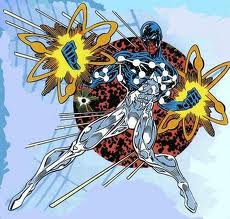
Recent stories have shown Spider-Man taking on a larger role in saving the entire world and more. Who can forget the time that he was endowed with the cosmic powers of Captain Universe? Possessing fantastic powers, he even punched the Hulk into orbit, Spider-Man was given the powers to fight the menace of the Tri-Sentinel (The Amazing Spider-Man # 329). The most recent one occurred in the “Ends Of The Earth” story arc in The Amazing Spider-Man # 682-687, but more memorable stories include those featured in The Amazing Spider-Man # 678-679 (“I Killed Tomorrow”) where Spider-Man time travels in a desperate attempt to prevent New York City’s destruction and in The Amazing Spider-Man # 48, 49 (Volume 2) and The Amazing Spider-Man # 500. That story (“Happy Birthday To Me”) had Spider-Man squaring off against the mystical foe Dormammu.

Spidey’s Deadliest Foes

One of the most remarkable qualities about Spider-Man is his large and colorful rogues gallery. Many villains have been introduced over the years and most of them are quite memorable. They include the Lizard, Mysterio, the Sandman, Electro, the Chameleon, the Shocker and the Kingpin. But two villains vying for the dubious honor as his deadliest foe are Doctor Octopus and the Green Goblin. Introduced waaay back in the early issues of The Amazing Spider-Man (issues # 3 and 14 respectively), these characters were instantly popular. While Doctor Octopus continuously plagues the Wall-Crawler (and has a major role in the upcoming 700th issue of The Amazing Spider-Man) the Green Goblin took the mantle fairly early as his greatest enemy. That was because he discovered Spider-Man’s secret identity (The Amazing Spider-Man # 39, 40). Those two issues revealed that he was Norman Osborn, the wealthy father of Peter’s best friend Harry. Afterwards, Osborn would use that knowledge of Peter’s secret identity to deadly affect over the years. This culminated in his killing Peter’s girlfriend Gwen Stacy in The Amazing Spider-Man # 121. Continue reading

Spider-Man’s Greatest Moments, Part I

Marvel is celebrating the 50th birthday of their flagship superhero Spider-Man. He’s come a long way since appearing on the last issue of a failing science fiction comic book, but the minute he was introduced in Amazing Fantasy # 15, he became a sensation. Helping to usher in the so-called Marvel Age of Comics, Spider-Man was and is still Marvel’s most popular and iconic superhero. Over the years, our favorite Wall-Crawler has seen his highs and lows when it came to his storylines. There are too many to go through here, so let’s just highlight some aspects of them.

Insurmountable Odds

A hallmark of Spider-Man stories are those where he faces incredibly tough situations or foes. What makes them so special is that Spidey isn’t the most powerful superhero, he can’t shoot beams out of his hands, he can’t even fly. This makes him more relatable to us and is one of the reasons why he is so popular. He’s had to go up against villains that clearly outranked him in power and how he perseveres against them gave us some of the most exciting and hand-wringing stories. Who can forget that two-issue battle against the Juggernaut (The Amazing Spider-Man # 229-230)? Spidey fought this desperate battle against someone who could take on the Hulk. The Wall-Crawler tried everything but couldn’t make a dent against Juggernaut. Still, he wouldn’t give up, and somehow he stopped the Juggernaut by luring him into a bed of wet cement. Then there was his battle with the former Galactus herald Firelord (The Amazing Spider-Man # 269-270), where he shocked the late-arriving Avengers with his sheer will power as he managed to knock out Firelord.

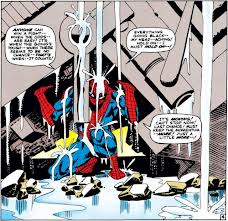
But the best story that showed how determined Spider-Man can be was in the classic comic book The Amazing Spider-Man # 33. In the previous issue, he fought against Doctor Octopus at an underwater base and was left partially buried under tons of rubble and debris with water flooding. Meanwhile, inches away lay a canister containing a cure for his Aunt May’s latest ailment. He spent most of the issue struggling to free himself but failing. He berated himself, resigned to failure. But he couldn’t accept defeat not with his aunt’s life on the line. Spider-Man motivated himself and carefully maneuvered his body to free himself just in time. It was the most dramatic moment seen in a Spider-Man story and copied by others.

Marvelous Team-Ups

Ever since the very first issue of The Amazing Spider-Man, our favorite Web-Head was shown to be an integral part of the Marvel Universe. In the first issue, Spider-Man tried to join the Fantastic Four and ever since, he has butted heads and teamed up with Marvel’s rich roster of superheroes. Some were interesting in that he had unusual pair ups (Howard the Duck, Frankenstein’s Monster, the John Belushi-era Saturday Night Live cast and even Superman in the classic cross-company story Superman Vs. The Amazing Spider-Man) or Spidey was way out of his element (Spider-Man Vs. Wolverine one-shot and Marvel Team-Up # 41-46 where Spidey time travels from the past and into the future).

The most natural friendship he’s had has been with Johnny Storm, the Human Torch. The two heroes tended to behave like college roommates and ranked on each other. Some of their best meetings included the Christmas-themed Marvel Team-Up # 1, Spider-Man/Human Torch #1-5,and most recently with FF # 17. The latter was a hilarious tribute to mismatched buddy comedies like The Odd Couple and Two And A Half Men, where Parker and Storm briefly live together with the expected disastrous results.

But Spidey’s best team-up stories were in J.M. DeMatteis’ run in Marvel Team-Up #111,112, 114-125, 126-133. In those comics, DeMatteis showcased his writing chops with fun, thoughtful, amusing and sometimes poignant yarns that were able to touch a reader’s  soul (Marvel Team-Up #119, 120, 127). The best part is that these issues can be found relatively cheap in comic bins. Continue reading

Remake The Black Hole!

Ever since I spotted that poster from The Black Hole in Tron: Legacy, I can’t stop thinking about that old Disney film.

The Black Hole was one of the earliest films I remember seeing as a kid back in 1979. The movie borrows plot lines from several classic works like Moby Dick and 20,000 Leagues Under The Sea. But the core story is rather simple and effective. The crew of an exploratory spaceship encounter a long-lost spaceship near a black hole in space, but it turns out it’s not abandoned. The commander of the huge derelict craft is obsessed with entering the black hole and finding out its secrets. As these tales go, the commander is insane and won’t let anyone get in his way not even the crew of the would-be rescue ship.

With all these pointless and gratuitous remakes being made (I’m looking at you Total Recall and soon Robocop), The Black Hole is one film that needs a remake or some kind of sequel at least.

Sure it’s got head-scratching flaws and scientifically it doesn’t make sense. For instance, why is it when the ship starts to get closer to the black hole, characters are able to survive outside the space ship without space suits, breathe air and even talk to each other? This is really confounding when earlier in the film, when the same characters are in a huge greenhouse, the structure is compromised, leading to air escaping and freezing temperatures. The robots they were fighting had visible signs of frost, yet the humans get along fine in the melee.

Then there is the ending sequence. It needed to be more spelled out. Is the black hole a gateway to heaven and hell? Then what happens at the very end? I guess it’s supposed to be one of those philosophical endings that can be debated but it throws off the tone of the film which was part mystery, part shoot-em-up.

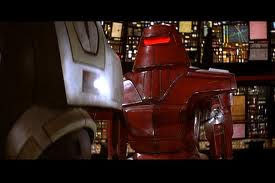
The Black Hole is not the greatest movie ever made but it still fires up my imagination to this day. The special effects were great, it was even nominated for a special effects Oscar.  I really enjoyed the laser battles with the mad scientist’s robots and the film’s rousing score during those battles. It was an obvious swipe of John Williams but most sci-fi films in that era copied the composer. I also liked the characters, even the cute heroic robots. BTW, the head villainous robot, Maximillian, was pretty damn cool especially when he diced his claws into Anthony Perkins’ character. Too bad no blood was shown! Despite my misgivings about the ending, I liked that the filmmakers decided to be ambitious even if it was frustrating to watch.

A remake would have the same plot line: spaceship crew finds a lost spaceship with a nutty scientist bent on exploring a black hole; lives be damned, the gaining of knowledge is more important! But a remade Black Hole would be much more scientifically accurate. In this day and age it would have to be. The elements are right there for any enterprising filmmaker to improve upon the original. Combine that with some spectacular special effects and production design and we could wind up with a remake that surpasses the original.

Waldermann Rivera

Summer Of 1982 Revisited


It’s strange to say but even back in the spring of 1982 many genre fans knew that summer would be special when it came to movies. Unlike previous summers, it seemed as if many film releases were catered to genre fans and that was a correct assumption.

Conventional wisdom has it that the summer season begins with the Memorial Day weekend. While that’s true for many aspects of summer, for the past few years it seemed as if the summer movie season didn’t begin with that holiday but on the first weekend of May. That reputation began with the release of several movies based on Marvel superheroes, which by the way, coincides with Free Comic Book Day. But even back in 1982, the summer movie season began in mid-May with the release of Conan The Barbarian, Arnold Schwarzenegger’s first big hit.

While previous summer movie seasons boasted huge genre hits like The Empire Strikes Back and Alien, often there weren’t many genre films released in that time period. 1982 was the first year that the summer schedule was full of films that would appeal to fans of sci-fi, fantasy and horror. Since 1982, many summers featured a plethora of genre films; some were big hits, others didn’t do well and that continues to this day (case in point, the runaway success of The Avengers and the dismal box office performances of Battleship and Dark Shadows).

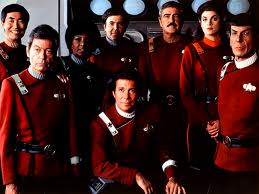
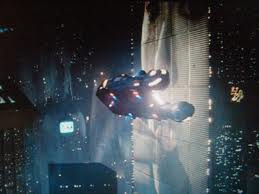
What makes the summer of 1982 so memorable for fans is that not only was it the first time there were many films to choose from but that so many of them are classics. For instance, Star Trek II: The Wrath Of Khan is considered to be the best Star Trek film to this day, then there’s Blade Runner, Ridley Scott’s masterpiece about a human hunting down rogue replicants in a decaying, future Los Angeles. Or there are the two opposing alien visitation films that are as different from each other as night and day, and are both classics, Steven Spielberg’s E.T. The Extra-Terrestrial and director John Carpenter’s remake of The Thing. The sad thing about these two films is the general audience’s reaction to them. While E.T. won universal acclaim and became the biggest box office hit until the mid-90s, The Thing was scorned by critics and audiences. In fact, it made its debut near the bottom of that week’s top ten and disappeared from theaters quickly. It’s unfortunate that people back then weren’t open to a dark and horrifying movie about an alien invader because of the happy feelings they were getting from a stranded, friendly alien and his buddy human boy.

Blade Runner suffered a similar fate, while its opening was better than The Thing’s, many viewers and critics didn’t take to Scott’s moody, future noir tale. With Harrison Ford as the lead, fresh off his breakthrough hit Raiders Of The Lost Ark, many expected a similar rousing adventure film. But both Blade Runner and The Thing had happy endings as many discovered the films on cable and home video, elevating their statures from cult hits to genuine masterpieces (Blade Runner actually made AFI’s list of 100 Years…100 Films, along with E.T.).

Of course, there were a few stinkers and some films that were generally good, but didn’t leave a lasting impression. The most infamous stinker is Megaforce, a poor man’s G.I. Joe directed by Hal Needham (who helmed those awful Burt Reynolds car chase films) and it is laughably bad. Then there’s this terrible Scott Baio comedy called Zapped about a student who gets psychic powers and the less said about it the better. Meanwhile, some underrated genre films worth looking out for are Clint Eastwood’s Firefox (about a fighter pilot who steals an advanced, thought-operated Soviet plane), and Don Bluth’s first animated film The Secret Of NIMH (astonishing, Disneyesque animation highlighted this tale about a wood mouse and rats with advanced intelligence).

While the rest of that year featured some great films like The Dark Crystal, the summer of 1982 will always be fondly remembered and the milestone to compare with other summer movie seasons. The following are some of the more noteworthy films that were released that summer and thrilled fans thirty years ago. If you haven’t seen any of them, check them out.

Conan The Barbarian, Poltergeist, Star Trek II: The Wrath Of Khan, E.T. The Extra-Terrestrial, The Thing, Blade Runner, Tron, The Road Warrior

José Soto

For Dakota