A Princess Of Mars Introduces John Carter, The First Space Hero

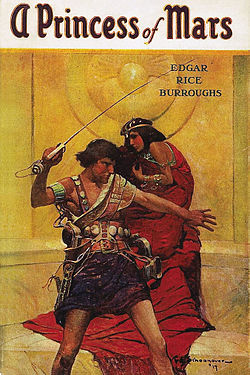
Art by Frank E. Schoonover

Before his famous Tarzan stories Edgar Rice Burroughs first came to the literary scene with his character John Carter of Mars. As the first modern space hero, Carter was introduced in a short story called “Under The Moons Of Mars”, which was published in the magazine The All-Story in 1912. The character returned in serialized stories that were later collected into the 1917 book A Princess Of Mars.

John Carter appeared in several other books detailing his adventures on the red planet and was an excellent example of a pulp fiction hero while being the prototype for the superhero and the space adventurer. Burroughs’ Carter books were filled with action, romance, intrigue and adventure. But to get a good feel of the character and setup start with A Princess Of Mars.

At first the novel reads like a Western due to its setting. As a Civil War veteran who fought for the Confederacy, Carter moves out to Arizona to start anew. Before long, he runs into conflict with an Apache tribe (which parallels his adventures to come). These early parts can be a bit slow for a reader wishing to explore a science fiction world, but be patient. Before long, while seeking refuge from the Apaches, John Carter finds himself transported mysteriously to Mars or rather Barsoom as the natives call the planet.

Then the fun stuff happens. In the Martian desert he encounters the Tharks, a tribe of giant, four-armed, Green Martians who live a barbaric, nomadic existence. He has little regard for their savage ways but he earns their respect thanks to his prowess. It just so happens that the lighter gravity on Mars has granted Carter superhuman strength and agility. So he amazes the Green Martians with his Hulk-like leaps and fighting skills. Carter proves his worth to the Tharks and rises in the ranks by killing off several warlords and surviving ordeals.

Along the way, he earns the friendship of Tars Tarkas, a mighty Thark chief with a hidden sentimental side, Sola, an unusually kind female Green Martian, and Woola, a large guard animal akin to a dog but much larger and meaner.

But the most important relationship he develops is that with Dejah Thoris, the princess from the book’s title.

John Carter first meets her when she is taken prisoner during a raid on her air ship. Dejah Thoris is humanoid, part of a race of Red Martians at odds with the Green Martians and each other. While slightly more civilized than the Green Martians, the Red Martians are the remnants of a once-mighty culture that occupy decaying cities near the planet’s canals.
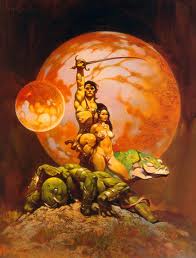
Art by Frank Frazetta

The sparks fly when the two meet. Reading about how fiery and beautiful she was can make any young teenage boy swoon with longing. And the passages detailing their blossoming love are quite well-written and don’t slow the story down at all; which is largely about Carter’s rise as a warlord and his attempts to protect Thoris and win her heart.

The entire fun read is full of swashbuckling antics where duels are settled with “long-swords” rather than ray guns, and dangerous encounter with giant monsters like the great white apes. There are elements of space fantasy and political intrigue. Despite the outdated notions about the Martian ecosystem the fantastic landscape is lovingly detailed and makes one sad knowing that such a world doesn’t exist.

Any astute sci-fi fan will spot the inspirations for the imaginations of literary and celluloid greats like Robert Heinlein, Ray Bradbury, George Lucas and James Cameron. So for those that may wonder who is John Carter (before seeing the film John Carter or afterwards) then A Princess Of Mars is an excellent introduction.

José Soto

Football? Bah! Give Me Some Rollerball!

I didn’t catch the Super Bowl last night. It’s not because I didn’t like the teams playing, but because I don’t enjoy football. I won’t go into how boring the sport is with the constant timeouts, overinflated egos, etc. But there is a sport I would rather watch if it existed. Which one? Why rollerball of course!

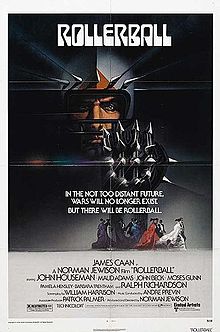
The film Rollerball was released in 1975 and was based on the short story “Roller Ball Murder.” It takes place in 2018 in a liberal’s worst nightmare: a world ruled overtly by faceless corporations. One such organization, the Energy Corp. backs the popular Houston team in the sport of rollerball. It’s a lot like roller derby. Teams in two opposing teams skate around a closed arena (th0ugh some ride around in motorcycles) and are clad with spiked gloves, body armor and helmets. The object of the game is to get possession of a steel ball and score points by slamming it into a cone in the arena. Along the way, the players use violent means to gain possession of the ball and score or to prevent the other team from scoring.

In this future, there isn’t any other sport but rollerball is wildly popular. It’s also supposed to be a sport that emphasizes the work of a team, while diminishing the efforts of the individual. There’s the film’s conflict. Jonathan E (James Cann) is emerging as a popular sports figure but the corporations disapprove of this since they don’t want an individual hero. See, they want to keep the average person down and make him or her feel powerless. That’s because the mantra of “one person making a difference” no longer applies in the new world. Most of the film concerns itself with Jonathan E being persuaded to retire from the sport and his reaction to the effort.

But enough about that, my favorite parts were with the game itself. That thing is wickedly violent, and that’s even before the corporations eliminate penalties halfway through Rollerball! See, they want the game to turn so violent to make Jonathan E want to step down, and things get very desperate for the evil corporate bosses in Rollerball’s last act. At that point, the final game is a no-holds-bar brouhaha with lots of explosions, blood and maimings. But like a true hero, Jonathan E just sucks it in and gets just as violent as the other players, coming off as some kind of futuristic gladiator. What kind of violence is in this film? Lots of bashing across the face and skull with the spiked gloves, players get dragged around the arena, players smashing into each other; it’s easy to see why this sport would placate the masses and their bloodlust.

Now ask yourself, would you see anything like that in football today? Thought so. Supposedly football is popular because of the violence. Please, if you want that go to a boxing match or a good hockey game. The players in those sports wear less body protection. And it’s the closest we’ll ever get to rollerball.

Waldermann Rivera

Dinosaurs On The Small Screen

When I saw the new series Terra Nova on Fox I couldn’t help wondering about how many dinosaur-based TV shows there have been. It turns out there aren’t many, which isn’t surprising for the obvious budgetary reason. Here’s a brief rundown of such shows but for brevity’s sake cartoons, documentaries and shows that only had an episode or two featuring the extinct reptiles won’t be included.

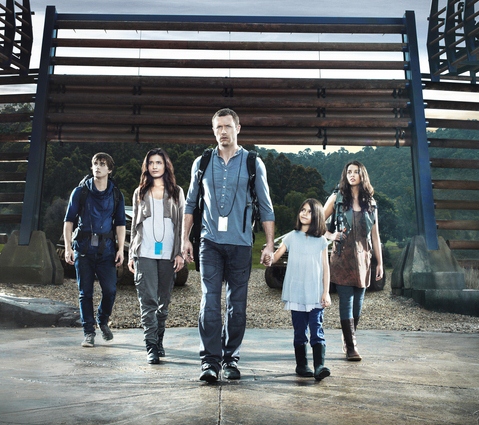
Terra Nova — Currently airing on Fox after numerous delays. The show follows the adventures of a 22nd century family who time travel 85 million years into an alternate past to escape a dying future. They are part of a human colony called Terra Nova and contend with predatory dinosaurs, dumb teenage drama and renegade humans.

Primeval–A BBC program that first aired in 2007 and was recently resurrected. Taking place in Britain, time portals called anomalies appear more and more often throughout the land and deposit confused and rampaging dinosaurs, prehistoric animals and even future animals. The Arc, a research and security facility, is set up with misfits and soldiers who deal with temporal incursions. It was recently announced that a spinoff taking place in Vancouver called Primeval: New World will go into production.

Prehistoric Park–This was a six-part series that aired in 2007 on ITV and Animal Planet was more of a mockumentary that starred Nigel Marvin who played himself. The premise is that a prehistoric wildlife preserve has been set up on an island. Think of it as a successful Jurassic Park. In the show, Nigel time travels to prehistoric periods and rescues animals about to perish and brings them to the present. More often than not he wound bringing unexpected animals.

Dinotopia–Based on the series of books, it was originally a four-hour mini-series that became a show and aired on ABC in 2002. The network pulled the plug after six episodes, which was a mercy killing. In this show, two brothers crash their plane in an uncharted continent where humans and dinosaurs (some are sentient and able to speak) live in harmony.

 Sir Arthur Conan Doyle’s The Lost World–This syndicated show ran for three seasons from 1999 to 2002. Loosely based on Doyle’s classic, it featured Professor Challenger and a group of people who are stranded on a South America plateau that is inhabited by dinosaurs, natives and people in latex makeup. It ended with an unresolved cliffhanger.

Dinosaurs–ABC aired this comedy, produced by Jim Henson Television, from 1991 to 1994. Coming off as a knock off of The Simpsons and The Flintstones, it was your standard nuclear family sitcom complete with the goofball dad, patient mom, wise children and a precocious little baby that kept screaming “Not the momma!” Only these were talking dinosaurs wearing clothes and complaining about humdrum problems. The series ended on a downer as a global catastrophe dooms the dinosaurs.

Land of the LostA personal favorite that first aired on NBC Saturday mornings from 1974 to 1976 and it set the standard. Rick, Will and Holly Marshall are out whitewater rafting and fall through a portal that transports them into an alternate dimension populated by stop-motion and puppet dinosaurs, hairy hominids called Pakuni and evil reptilian Sleestaks. Despite its juvenile trappings and budget the show really shone thanks to high-concept scripts penned by the likes of David Gerrold, Norman Spinrad, Larry Niven and D.C. Fontana. A remake aired in 1991 in syndication for two seasons but it had a lighter tone and wasn’t as memorable. And let’s not get into that Will Ferrell movie.

José Soto

Star Trek At 45

Star Trek, the original show, turned 45 years old this September. Meanwhile the tenth anniversary of the last Trek show Enterprise is also in September. The point is these milestones came and went largely unnoticed or celebrated. So we all wonder why the lack of enthusiasm?

Really, everyone lately is yakking about the Star Wars blu-rays, Back to the Future shoes, new super hero movies, Harry Potter and even a new Avatar attraction for Disney’s Animal Kingdom, but barely a peep out of the world of Trek. I clicked over to the Star Trek website and it seems like a slow week in January. An article reminiscing about Enterprise, IDW comics, Star Trek: The Exhibition coming to St. Louis and upcoming conventions.

You’d think that with all the hoopla over the last Star Trek movie and how it re-energized the franchise and started things fresh that Trek would remain in the public eye. Guess again. Maybe it didn’t help that J.J. Abrams and his crew are taking forever to get a new film going. Then more and more fans are complaining about Abrams’ take on Trek and how it ruined the franchise, nullifying over forty years of Trek lore and made the film seem like a Star Wars wannabe flick.

Another thing that isn’t helping is CBS Studios not wanting to make another Star Trek show while greenlighting junk like Person of Interest and other cop procedurals. For the average Trek fan (I refuse to call myself and fellow fans as trekkies, that’s too demeaning) this is a cause for alarm. In this crowded medium, Trek has to struggle to stay in the public eye. It can’t just rest on its laurels. That attitude of taking fandom and demand for granted is why the later shows declined in quality and ratings putting us in this situation.

No Trek isn’t going away, who knows maybe the new film, whenever they decide to make it, will stir things up. Maybe it will take the fiftieth anniversary when we’ll get the articles and such about how Trek gave us cell phones and tablets (but no holodecks but we’re getting there with the 3D TVs). But Trek is best known for being a TV show, that is its home medium, so a new show has to come out to keep up with the other franchises. Just do a cartoon for now until the right people are found who can put out a quality show. That way Trek stays in the public’s mind. It worked for Star Wars with The Clone Wars cartoon. Here’s an idea do a cartoon about Starfleet Academy. It won’t be that offensive to anyone who hates the thought of Star Trek 90210 since it will more geared toward younger viewers, who in turn may become tomorrow’s fans that keep the dream alive. Just do something already.

Waldermann Rivera

Conquered By The Planet of The Apes

This week marks the premiere of the film Rise of the Planet of the Apes, the latest entry in the Planet of the Apes series. It’s seen by some as a reboot of the series or a prequel but it’s safest to state that the film is actually a remake of Conquest of the Planet of the Apes from 1972, the fourth film in the series.    

The original film takes place in the 1990s. An off-screen plague has wiped out all the dogs and cats and human now rely on apes as both pets and servants. One thing the film doesn’t elaborate on is how modern apes were transformed into nearly human forms and essentially alike. Remember that real-life gorillas are much larger than other apes, orangutans are aboreal and in this film they both are the same size and shape along with chimps. Also by the time the film opens the apes are no longer portrayed as pets but as lower-class slaves.

The arrival of Caesar, an intelligent ape who can speak and the son of Zira and Cornelius from the earlier films brings about a change to the order of things. With the aid of some human allies, Caesar leads the apes into a bloddy revolt and out of their oppression. After the apes win their freedom, he then tells the conquered humans that this act of rebellion will be repeated all over the world and will signal the birth of “The Planet of the Apes.”

Conquest of the Planet of the Apes is one of my favorite films in the series. The premise that apes are mistreated and subjugated by humans and then liberated by an intelligent simian savior was an inspired explanation as to how apes came to dominate the world. The fight sequences between the apes and the police riot squads were very thrilling and effective. Roddy McDowall as Caesar is very convincing, sympathetic and his performance makes Caesar a distinctly different character than Cornelius. Ricardo Montalban as Armando the kind circus owner and Hari Rhodes as McDonald are also excellent as Caesar’s allies.

It will interesting to see if the new film, which star James Franco, can take advantage of the special effects technology and improve upon the source material to provide a modern-day science fiction classic. It seems very promising in that the previews have shown how Caesar was genetically engineered to become intelligent. That’s a plot point that removes any referenes to his time-traveling parents from the original series. At the very least it should make audiences forget the misbegotten film by Tim Burton that came out in 2001. It’s too bad that Burton’s film helped kill any enthusiasm for futher films given how low-key the marketing has been for the new film. Though it’s making its mark now, it pales to the omnipresent marketing push that the 2001 film had. Hopefully if the film delivers, word of mouth may recreate the Ape phenomenon.

Stay tuned

Dr. Botanist