The Star Wars Films Ranked


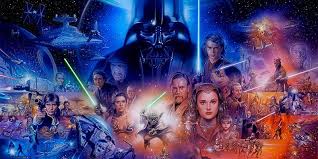
star wars collage

2015 is shaping up to be the year of Star Wars with the continuation of the celebrated sci-fi saga in December with Star Wars: The Force Awakens, Episode VII in the story. Here is a ranking of the previous six live-action films that came before and made movie history in order of personal preference.

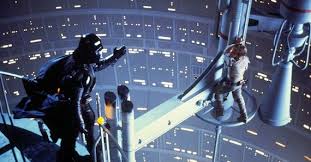
darth and luke

1. The Empire Strikes Back (1980): Commonly considered as the best Star Wars film and in this instance, I agree with that sentiment. The reasons why are varied. It is a film that really explores the mystical side of the Star Wars universe with Jedi Master Yoda instructing Luke Skywalker all about the Force and the consequences of turning to the dark side. It is also a film that does not follow the traditional structure of an adventure film unlike the previous entry. Supporting this is the climatic battle between the Empire and Rebels, which occurs in the first half of the movie. Our heroes are put in constant jeopardy and there is no real resolution on the fate of Han Solo, setting up a cliffhanger ending that is almost jarring in its abruptness.

This was a risky move by George Lucas, since he could have just remade the original film and be done with it, but instead The Empire Strikes Back is an actual second part of an ongoing story and is very well done. It also introduces iconic characters like the aforementioned Yoda, and fan favorite bounty hunter Boba Fett. Plus, there is a wonderfully done lightsaber duel between Luke and Darth Vader that results (SPOILER!) in the shocking revelation by Vader that he is Luke’s father. Combine that with the epic battle of Hoth with snow speeders and AT- AT walkers and this film is a classic in every way.

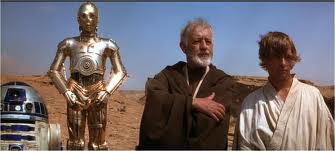
luke ben

2. A New Hope (1977): The movie that changed everything. What more can be said about the original Star Wars? It tells the classic tale of good and evil. It is a fairy tale that is set in outer space and introduced to the world Luke, Han, Leia, Chewbacca, Darth Vader, R2D2 and C-3PO, plus incredible worlds like Tatooine and Yavin with exotic aliens and robots.

Even if someone has never seen it, they know who all of these characters are and how they look like. That is when you know it has crossed from pop culture to something else. I think the simplicity of the tale of the Rebels fighting against an oppressive Galactic Empire with classic archetype character (hero, rogue, princess, wizard, villain, and comical sidekicks) is its biggest strength and the core of its widespread appeal. Iconic fixtures of the saga like the now-famous X-Wings, TIE fighters, lightsabers and the Jedi all started with this film.

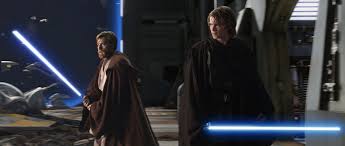
revenge of sith

3. Revenge of the Sith (2005): The best of the prequels, this film is George Lucas’ swan song and one of his best. It begins with a bang hurling viewers into the middle of a great space battle over the gleaming capital planet Coruscant. From there, the story does not let up with the prequel’s heroic Jedi, Anakin Skywalker beginning his descent to the dark side, which culminated in an epic lightsaber duel (one of the best of the whole saga) against his mentor and friend Obi-Wan Kenobi. This was something fans had been waiting to see for years ever since it was revealed that Vader and Kenobi were friends.

Unfortunately, this movie is sometimes attacked since it is a prequel, and there are hardcore original trilogy fans who want nothing to do with them. But despite that, this movie is excellent and belongs with the first two as great Star Wars films. Highlights include showing the widespread destruction of the Clone Wars, Anakin’s cruel actions at the Jedi council, him murdering his wife Padme, and the bringing of the whole saga full circle in the end with infant Luke being brought to Tatooine. These are all of the movie’s major strengths.

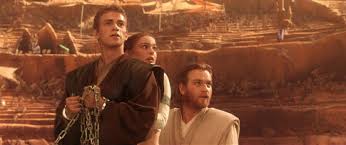
attack of the clones

4. Attack of the Clones (2002): The second of the prequels, this film improves on what was begun in The Phantom Menace. Anakin is shown as a troubled, if somewhat whiny apprentice to Obi-Wan. The film presents the murky beginnings of the infamous stormtroopers with Sith Lord Count Dooku’s shady dealings, and Anakin’s slow turn to evil under Chancellor Palpatine’s sinister influence. Something I like about this movie is its look: the clouds on the capital planet Coruscant in the film’s beginning, the underworld club scene, and the waterworld of Kamino are all striking to look at. The epic ground battle on Geonosis during the film’s climax is also a big highlight along with Yoda’s subsequent lightsaber duel with Dooku.

A problem the film has is the clunky romance between Anakin and Padme Amidala.  It is not done well and is somewhat of a drag thanks to wooden dialogue. Despite that, the movie is still a good effort by George Lucas.

end of return of jedi

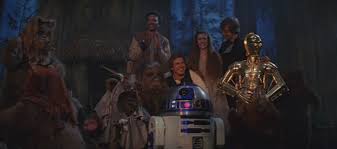
5. Return of the Jedi (1983): As the last film in the original trilogy, it may not be as good as the first two movies, but is still a good Star Wars adventure. The fantastic Battle of Endor is still the best space battle ever seen more than 30 years later. Luke’s final clash with his father Darth Vader is also one of the best moments in the saga.

An issue with the movie is the fact that the plot is somewhat of a repeat of A New Hope with its start on Tatooine and having another Death Star to destroy. Another is that the cuddly Ewok characters somehow and unbelievably make Imperial stormtroopers seem like the Keystone Cops.  However, Return of the Jedi Is still lots of fun and the final celebration with our heroes is always great to see.

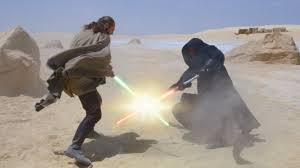
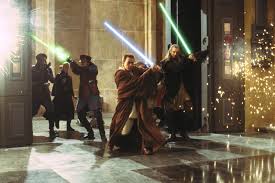
maul vs jedi

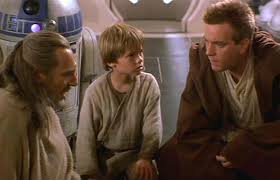
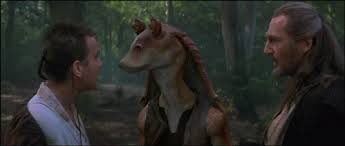
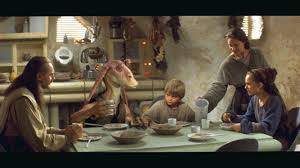
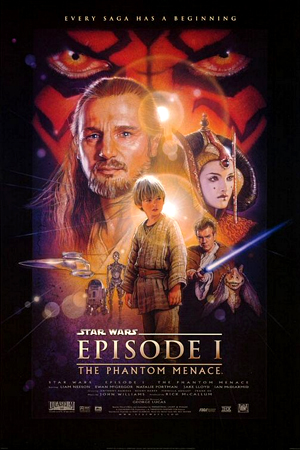
6. The Phantom Menace (1999): Let’s be blunt, the first prequel, chronologically the first part of the saga, is the most polarizing Star Wars film by far.

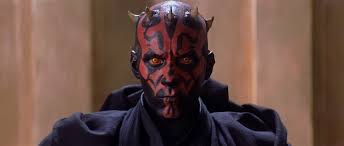
This movie had huge expectations coming in after a very long wait since Return of the Jedi and many fans were not happy with it. They complained about Lucas’ rusty directing, over-reliance on CG, and the film’s pace. I myself like this flick and while it does have some problems, namely the somewhat childish humor with Jar Jar Binks and the slow middle portion on Coruscant, there are many things about it that I really enjoy. Just seeing old Ben Kenobi as a young Jedi cutting up battle droids was a big thrill. The multiple battles on Naboo in the end and the appearance of Darth Maul (one of Star Wars’ best villains) are all highlights and bring back good memories.

We’ll find out this December if The Force Awakens will also generate memorable viewing moments and where it ranks with the other films.

C.S. Link

Chappie Displays Heart Despite Its Harshness

chappie poster

Director Neill Blomkamp’s latest film Chappie is engaging and emotive as it evokes other movies about robots like WALL-E.

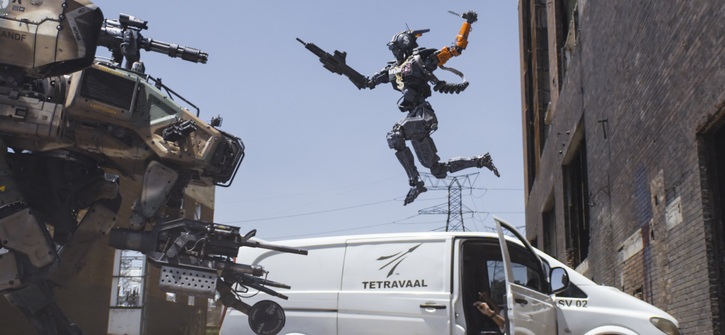
Chappie is based on Blomkamp’s 2004 short film Tetra Vaal and stars Sharlto Copley, who voices the eponymous character and does motion capture for Chappie as well. It takes place in Johannesburg in the near future and robots have replaced humans as the city’s police force. These humanoid robots are built by a weapons company and are the brainchild of Deon Wilson (Dev Patel), a young genius engineer who is trying to create a true artificial intelligence. His success rubs his engineering rival, Vincent Moore (Hugh Jackman), the wrong way. That is because Moore’s own robotic enforcer, the MOOSE, has been rejected by the company’s CEO (Sigourney Weaver), since the Wilson-designed robots are highly effective.

?????????????????

Despite his success, Wilson is unable to get approval to develop his AI program and he decides to continue working independently using a deactivated robot that is due for the scrap heap. Concurrent to this storyline, the film showcases the downtrodden lives of a trio of gangsters (Yo-Landi Visser, Watkin Tudor Jones and José Pablo Cantillo), who have to pull off high-paying heists to pay off their debts. They concoct a plan to kidnap Wilson so they can get him a way to deactivate the robotic police force, thus clearing their ability to rob and steal.

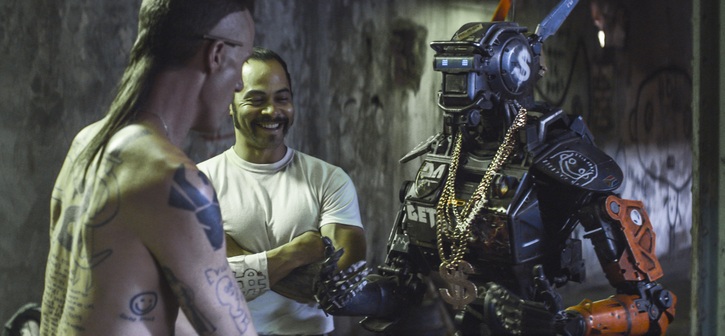
When they do kidnap Wilson in his van, his vehicle happens to carry the discarded robot and the AI software. In their lair and under the threat of his life, Wilson downloads the program to the robot who is reactivated. At first, the robot displays an innocent and timid child-like demeanor. Showing signs of sentience, Chappie (as he is named by Yolandi, the gangster that he considers his “mommy”) ?????????????????starts learning about the world and bonding with the thugs and Wilson. Unfortunately, Chappie is subjected to cruelty by the head gangster, Ninja (Jones), who only sees him as way to garner money. Insisting he is Chappie’s father, Ninja begins imprinting a gangster ethic into Chappie and before long the robot is bopping along , swearing like a mechanical ghetto thug and committing crimes. Yet, the emotional Chappie develops a sense of morality thanks to Wilson, who he dubs “the Maker”. This helps endear him to his human compatriots and allows him deal with the vicious nature of the gangster world and later Moore. That is because as Chappie undergoes his life lessons, Moore devises a sinister plot to discredit the robotic police and promote his MOOSE. Eventually, both plots collide as Chappie handles the unpleasant nature of humanity.

?????????????????

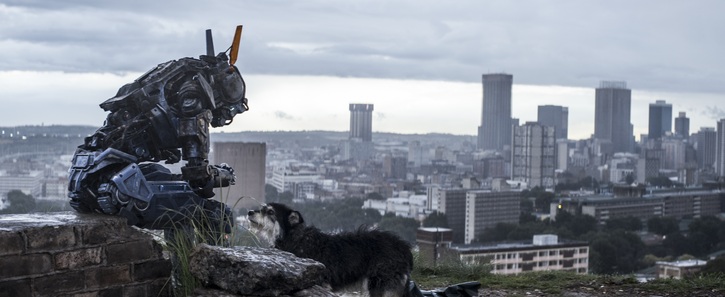
Watching Chappie is at times a disheartening experience. That is because Chappie is clearly a child, he delights in reading children’s books and art, yet he is thrust into a nasty environment. Imagine WALL-E or Number Five from Short Circuit having to deal with the criminals from The Wire, ?????????????????who think nothing about attacking him without remorse and engaging in criminal behavior. Chappie is essentially corrupted and manipulated by these criminals that generate little empathy with viewers. They’re largely heartless and cruel, except for Yolandi, who bonds with the robot and considers Chappie to be a surrogate son. It’s hard to feel any kinship with these unrepentant characters, which adds to the empathy for Chappie. In a way, Chappie is a metaphor for gangster youth. All children are born innocent, but some become tainted by their environment and commit criminal acts. This is what happens with Chappie, only we the audiences feel more sympathy towards this robot than with a normal human juvenile delinquent. But despite these hardships, Chappie is able to grow, learn and most of all show a profound, curious nature that questions the nature of humanity, hatred, family and mortality.

For that reason, Chappie is less predictable than other films about robots and androids who gain sentience. He isn’t nurtured by his creator and on the run from evil military types who want to use him as a weapon or destroy him. The twist is that Chappie’s moral being has been distorted by bad influences, but he doesn’t become the Terminator. Chappie isn’t evil, just naive and easily misled and he does have redeeming qualities such as his love for “Mommy” and “the Maker”, and a sense of forgiveness. He is a gentle soul and it breaks one heart to see him stuck in a vicious, unkind environment. That is why he is someone to root for, especially in the last part of the film when he faces off against the MOOSE, who is like a bigger, better armed version of ED-209.

?????????????????

After faltering with Elysium, Blomkamp has bounced back with Chappie. It’s not as good as District 9 because of some plot holes, namely the lacking security in the weapons factory that allows Wilson and Moore to carry out their schemes. Another fault is the editing that allowed some characters to disappear for long stretches. Finally, the gangsters are so unpleasant that it’s difficult to care about them and they’re the primary characters along with Chappie. Nonetheless, Chappie is still a solid addition to his filmography.

Lewis T. Grove

12 Monkeys Is A Worthwhile TV Adaptation

12 monkeys

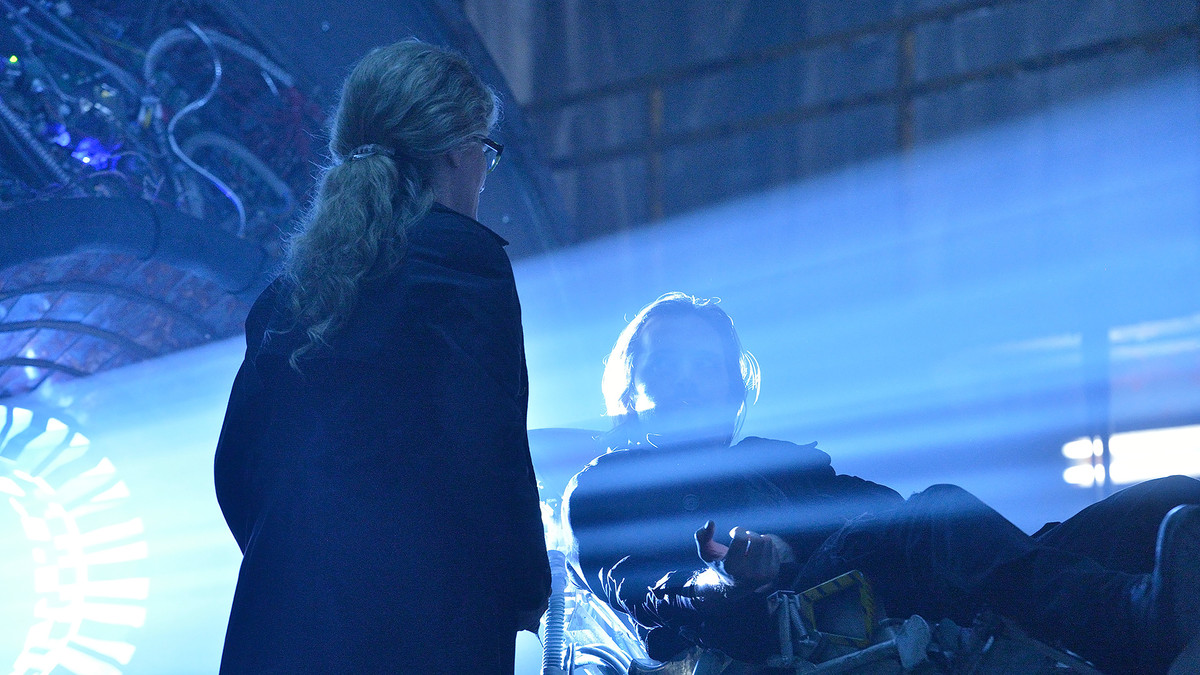
12 Monkeys is the latest sci-fi TV show from Syfy and an adaptation of the classic Terry Gilliam time travel classic film from 1995 (which itself was a remake of an obscure French short film called La jetée).

The TV show follows the same premise as the original film. Mankind has been driven nearly to extinction by a deadly virus that begins in the near future and a few decades from now, scientists send back in time a lone man to learn how the calamity started so that it can be undone. But there are many differences, many of which were done to fit a serialized TV format.

pallid man torturesThe time traveler, James Cole (Aaron Stanford), isn’t a prisoner forced to volunteer, but a drifter willingly recruited by a scientific group to undergo the temporal jumps. In the original film, when he voyaged to contemporary times the film had us guessing if he was insane. Not so here. In fact, he is quickly able to convince his present-day comrade, virologist Dr. Cassandra Railly (Amanda Schull) that he is a time traveler. In the course of the series, Cole and Cassandra track a doomsday cult called the Army of the Twelve Monkeys, who are responsible for unleashing the virus. That differs significantly from the film and as with these TV shows finding the cause of the virus and stopping it isn’t accomplished within two hours like in a film.

time traveler

In each episode, Cole uncovers an important facet of the virus or the army and goes back to 2043 to report his findings. Of course, this hampers the TV show because if he is successful then the virus is stopped, humanity is saved, his timeline is erased and the show ends. However, to its credit 12 Monkeys has explored the headaches of time travel and it impacts on future timeline for better or for worse. For this reason, scenes that take place in the present aren’t nearly as interesting as those set in the future. It’s a well realized post-apocalyptic future with barren and broken buildings and roving armies of scavengers. One of the best episodes to date called “Atari” largely took place in the future and explored Cole’s tortured past.

2043

The piecemeal revelation that Cole wasn’t exactly a good person in the past is a good twist and makes him a more interesting character. It’s fascinating to see some of his morally questionable acts and why he decided to help change the future in the episodes. A lot of that has to do with his close friend in 2043, Ramse (Kirk Acevedo), who acts as Cole’s conscious. Ramse is so well played by Acevedo that we have to wonder why he wasn’t chosen to play Cole. After all, with his bald head he looks more like Cole as portrayed by Bruce Willis in the original film and is a better actor to boot.

going backThe other characters are hit or miss. Jennifer Goines (Emily Hampshire), an insane math whiz whose father is believed responsible for the virus, is overdone with her Hollywood crazy method acting. Meanwhile, Katarina Jones (Barbara Sukowa), the enigmatic creator of the time machine, is a mysterious, though sympathetic character that is quietly desperate to change time.

On the whole, 12 Monkeys seems at times to be your standard time travel show, but it is still generally entertaining despite its faults. It’s not in any way up to the level of the original film, but it’s a worthwhile adaptation.

Lewis T. Grove

The Flash Streaks Ahead Of DC’s TV Invasion

flash1Out of the four current TV shows based on a DC Comic, The Flash is the one that sticks closest to its comic book roots.

Airing on The CW network, The Flash stars Grant Gustin as the Flash or Barry Allen. He was introduced in a couple of episodes of Arrow in its second season, which set up his origin. The pilot episode of The Flash embellished the Flash’s origin and opened up Allen’s world. When he was young, his mother was killed by a mysterious figure in a vortex. Unfortunately, his father (played by the original Flash John Wesley Shipp) was sent to prison for her murder and Barry’s been looking for the killer ever since.

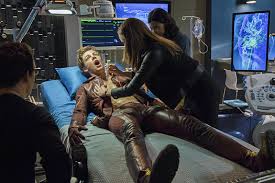
In the pilot (and the Arrow episode “Three Ghosts”), Barry was hit by lightning and fell onto chemicals at his lab in Central City when a nearby particle accelerator exploded. star labsThat accelerator was part of S.T.A.R. Labs headed by Harrison Wells (Tom Cavanagh) and the accident made him a pariah and a paraplegic. What’s revealed in the pilot and several episodes is that Wells is only pretending to be a paraplegic and that he has nefarious and deceitful intentions. After the lightning bolt knocks Barry into a coma, he later awakens in Wells’ lab and soon discovers he has superhuman speed. This was caused by the accelerator, the storm it created and the chemicals that splashed over him when he was struck. The accelerator also unleashed a type of radiation that randomly gave some people in Central City superhuman powers, turning them into supervillains of the week.

Now Barry, when not doing his job as a dorky crime scene investigator, spends his spare time at S.T.A.R. Labs where Wells and his assistants run tests on Barry and help him catch the new supervillains that have sprung up from the explosion.

strealAs a show, The Flash is generally entertaining. It’s not deep, and a bit too lightweight and clunky, but it captures the breezy spirit of the comic book with fast-moving stories and Barry’s superfast antics. They’re among the highlights of the show and are very inventive. In the episode “Plastique”, he used his powers to blur his face and reverberate his vocal chords to hide his identity and it was as much fun to watch as seeing him run across water.

One thing the show did right when compared to most comic-book-based shows is that it jumped right into the mythos of the superhero and showcased the Flash’s famous rogues gallery. Captain Cold (Wentworth Miller) has already made his appearance, as has nods to Gorilla Grodd and Professor Zoom. But the most interesting villain is Wells himself. The pilot revealed that he has knowledge of the future and seems to be using all means, including murder, to guide Barry into fulfilling his superhero destiny.

It would all be more palatable if the acting were better. Gustin is OK as Barry, but earlier on, he emoted allenPeter Parker too much, which wasn’t in line with his character. But he’s toned down the nerdy act in recent episodes. The other actors are fine, if not exceptional, except for Carlos Valdes, who plays Cisco Ramon, an overeager and annoying lab assistant. It seems like he is trying to emulate the quirky Felicity Smoak character from Arrow but he cannot pull it off and the result is that his scenes are irritating. Then there is the situation with the love of his life Iris West (Candice Patton). In the show, they have it that the two grew up together in the same home after Barry’s father went to jail. Essentially, Barry was a foster child in Iris’ home…so that means they’re really foster siblings. If that is so, then the unrequited attraction he has for her is uncomfortable to watch.

Putting that aside, The Flash is still young and finding its legs, but it’s better done than some of the other superhero shows. To date, the show is worth watching and hopefully will become much more captivating once the kinks are worked out.

Waldermann Rivera

Interstellar & Its Emotional Core

interstellar poster

Interstellar may be director Christopher Nolan’s most ambitious work to date. Is it his best? Maybe, it truly depends on any viewer’s taste. Regardless of one’s viewpoint, Interstellar is probably Nolan’s most emotional film rivaling The Dark Knight.

One criticism of Christopher Nolan as a director is that sometimes his films feel emotionally distant even though he tries very hard to connect audiences with his characters. This time, Nolan is able to make that connection thanks in large part to Matthew McConaughy’s sincere performance. Playing Cooper, a former astronaut turned corn farmer, McConaughy’s work is gripping and deep and he is able to keep his scenes from being too kitschy. The emotions he displays strike a perfect note.


INTERSTELLARIn an unspecified future, the Earth is slowly dying. Various crops like wheat and okra have gone extinct as pervasive dust strangles the world. As crops die off, humanity spirals towards extinction with dust invading everything. Dreams are long gone, replaced by a practical need to grow more food and to just survive. As a widowed farmer, Cooper longs for the days when humanity strived for the stars and a sense of adventure.

Eventually he meets an old colleague, Prof. Brand (Michael Caine) and his daughter Amelia (Anne Hathaway). They are part of the remnants of NASA and a secret mission to return INTERSTELLARto the stars. Fifty years earlier, a wormhole appeared near Saturn and several manned missions were sent into the wormhole since the wormhole leads to other habitable worlds. Brand hopes that these worlds can be colonized in order to save humanity. Cooper is recruited to join Amelia and other astronauts to voyage through the wormhole and follow up on data provided by earlier explorers on three potential worlds for colonization.

In the run up to Cooper leaving Earth and his children, Interstellar is the typical well-plotted-though-a bit-distant Nolan film. Yes, there are the teary scenes from his daughter Murphy (Mackenzie Foy) and subtle disparaging remarks from his father-in-law (John Lithgow) about Cooper leaving his children behind without a guarantee of returning. These scenes do work but one has to wonder how Steven Spielberg (who was attached to the film originally) would’ve handled them. They probably would’ve had more emotional punch or they might’ve been overly sentimental.

INTERSTELLAR

Interstellar does pick up in leaps and bounds the moment Cooper and the crew of the spaceship Endurance first plunge into the wormhole. These moments are gasp inducing and afterwards a sense of danger and wonder is felt throughout the rest of the film. Nolan is also able to inject a feeling of moroseness and loss, especially when the effects of time dilation are noticed. Even more ominous are the moments when the Endurance crew explore two worlds. They seem genuinely alien and uninviting, and add a feeling of foreboding and lost time. Meanwhile, in the short time that he’s exploring, Cooper’s children have grown into adulthood and Murphy (now played by Jessica Chastain) has joined the project by assisting Prof. Brand as the old man struggles with a gravitational equation to allow humanity to leave Earth. As this is going on, the film engages the viewers even more and more.  Moments of high tension and eye-popping wonder fill the theater screen. The only drawbacks to Interstellar at this point are some pacing and narrative issues, as well as expository dialogue that flies by quickly. It dares audiences to keep up with  verbal examinations of quantum physics and other modern scientific concepts. The payoff though is huge.

black holeThat is because final part of Interstellar is unforgettable and daringly thought-provoking with mind-twisting moments. Nolan skillfully presents some far out concepts of physics and the nature of time and other dimensions that calls to mind Kubrick’s work in 2001: A Space Odyssey. But Nolan departs from Kubrick in that while he is as analytical as Kubrick, the core of this film isn’t stark nor cold. Rather, Interstellar embraces human emotion as it rails against the cold, harsh nature of science and physics. Not only that, the film goes beyond and explores some ethical and philosophical concepts about species survival, love and the human connection. As a sci-fi epic, Interstellar is a sweeping, magnificent, though flawed, endeavor that pushes boundaries.

José Soto