Season Three Of The Walking Dead Concludes, Part I

Editor’s Note: For those of you who haven’t visited our other site Deadloggers, here’s a brief recap of the second half of the third season of The Walking Dead

daryl-merle

Brothers In Arms

Episode Nine: The pre-credits scene of episode nine of The Walking Dead, “The Suicide King”, opens in the fights arena as the bandaged Governor (David Morrisey) leaves Merle Dixon (Michael Rooker) and his captured brother Daryl (Norman Reedus) to slug it out to the death. The crowd, hungry for action, spurs them on. The Governor’s thugs hover around the arena with harnessed walkers –part of the sport – as Merle pulverizes his younger brother, calling out his declarations of loyalty to Woodbury. Unbeknownst to the crowd, Merle instructs Daryl to follow his lead in escaping as the two turn on the surrounding walkers. Suddenly, Rick Grimes (Andrew Lincoln) and the rescue team raid the arena, throwing smoke bombs and firing shots as they enable Daryl and Merle to slip out …

governorPost-credits, Merle leads the rescue team out of Woodbury, curiously leaving an open hole in the fence. They meet up with Glenn (Steven Yeun), Maggie (Lauren Cohan), and Michonne (Danai Gurira) on the outskirts. Both Michonne and Glenn are incensed that Merle has joined them and both need to be restrained due to their anger. Merle, however, seizes the opportunity to jibe Michonne, sneering a variety of politically incorrect taunts until Rick knocks him unconscious. Heading back to the prison, an argument ensues. Daryl vehemently wants his brother in the group – claiming they need the muscle against the Governor  – but is against Michonne’s presence.  Glenn – his face still red and bruised from Merle’s beating – is opposed to Merle but wants Michonne to stay. Rick, meanwhile opposes the presence of both. Daryl understands Rick’s thinking, and declares that Merle and him will leave the group and fend for themselves. Grabbing his gear, he joins his brother – now awake – and they disappear into the forest. Rick, meanwhile, snaps at Michonne, warning her that the moment she is patched up she is on her own…

Please click on the link to Deadloggers to continue reading about Episode Nine.

rick-walkers

Increasing Tensions

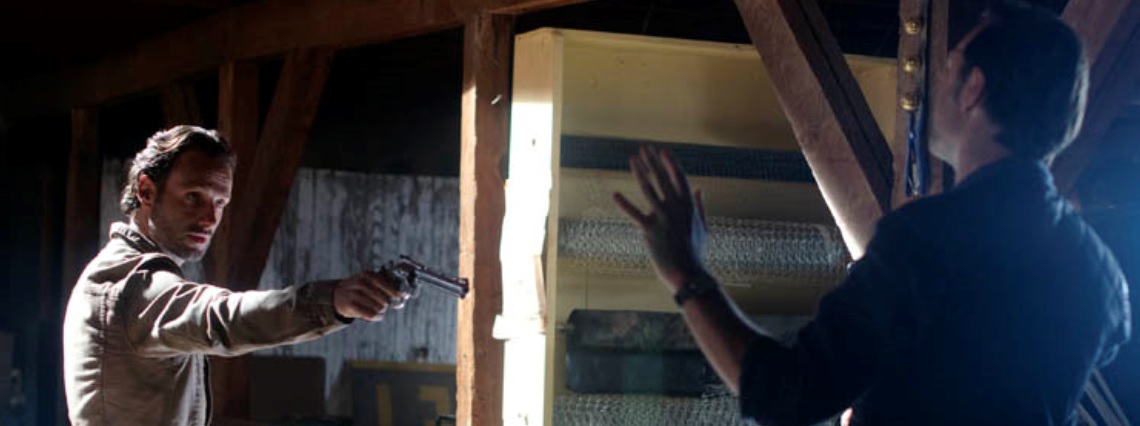
Episode Ten: In the pre-credits scene of the episode “Home”, former sheriff’s deputy Rick Grimes takes a break from manning the prison barricades in order to scope the perimeter. Using his binoculars, he spots a few stray walkers, but then discovers an odd sight: his dead wife Lori (Sarah Wayne Callies), her back turned, standing over hers and T-Dog’s graves in the prison yard. Dressed in white, she stands erect, radiating a spectral, ethereal beauty. Rick grabs his rifle and feverishly heads out to confront her only to find her gone, having re-appeared outside the prison gates. Drenched in sweat and consumed with longing, he finally reaches her. Lori strokes his cheek as they gaze at one another, face-to-face. Michonne, alerted to this curiosity, closes the gate behind him and watches, shocked, as she realizes Rick is deep inside a powerful hallucination…

Post-credits, Andrea (Laurie Holden) visits the Governor in his Woodbury apartment and finds him apologetic and insecure over his eroding leadership skills. Complimenting her over her impromptu speech to the citizens (in the previous episode, “Made to Suffer”), he declares his plans to abdicate and offers to make her his successor. Andrea, stunned at the revelation, is speechless…

Outside the prison, the now-independent Merle and Daryl Dixon are hiking through the forest. Unsuccessful at finding food, there is growing tension and a general lack of agreement between the brothers. Daryl wants to return to the prison, although Merle assures him that the Governor has already annihilated the survivors, leaving Daryl in somewhat of a funk…

merle-daryl

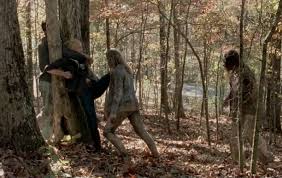
Continuing on, sweaty and gasping for air in the thick humidity, Merle continues taking shots at Daryl, this time over what he perceives are his poor navigational skills. Alerted by noises that shatter the morning calm, Merle laughs it off as animals getting intimate although Daryl recognizes it as a baby crying. Hurrying in the noise’s direction, they spot a horrifying sight: a desperate Hispanic family is trapped on a bridge, surrounded by a herd of walkers moving in for the kill. Daryl races in to help, while Merle remains behind, mocking his brother’s valiant tendencies and yelling after him to “stay put”…

Please click on the link to Deadloggers to continue reading about Episode Ten. Continue reading

The Star Trek Movies Ranked, Part II

Continuing this ranking of Star Trek films, we go from the undeniable classics to the lesser entries in the Star Trek film series. They range from being just okay to junk best seen on Mystery Science Theater 3000. As explained in the previous article, tier three films have their flaws but also boast some admirable qualities about them. Meanwhile, the tier four flicks are absolute junk that should only be seen by hardcore fans or the morbidly curious who want sleep aids.

Tier Three

7. Star Trek III: The Search For Spock (1984): The second Star Trek sequel has so many elements going for it, but for some reason it doesn’t search for spocktake off. After the triumph of Star Trek II, this direct sequel is a huge letdown. Trying to follow up Star Trek II is a difficult task and try as it did, Star Trek III couldn’t equal it, much less top it. For me, it’s hard to pinpoint why this film is a misfire, but for all the important plot developments it doesn’t have much passion.

In this sequel, James T. Kirk (William Shatner) and his core Enterprise crew risk everything, including their careers, to retrieve Spock’s (Leonard Nimoy) body from the Genesis Planet. Once there, they discover that he’s resurrected and now have to save him. There are many pivotal events in this movie; the Enterprise is destroyed, someone close to Kirk is killed, while his best friend comes back to life, and careers are jeopardized. Yet, most of these events feel ho-hum. One thing will happen, the characters reflect about it, then it’s on to the next development.

enterprise blows up

On the other hand, Star Trek III is not to be missed, not just because of what happens in the movie, but for its merits. The character interactions are fantastic and the actors all turn in solid performances. The villain of Star Trek III, a Klingon commander (Christopher Lloyd) is quite menacing and Lloyd plays him more nuanced than your typical Klingon, which was refreshing. The final battle between him and Kirk was also satisfying to watch. Production wise, Star Trek III hits the right marks and this is the movie that introduces the ubiquitous and iconic Klingon bird-of-prey ship and the Excelsior-class starship. Compared to the other films, Star Trek III is a good, but not an outstanding entry in this series.

crew8. Star Trek: The Motion Picture (1979): I’ll be frank and say this movie is boring in many parts. Yet, there is so much that I like about it. It is the one film that stays truest to creator Gene Roddenberry’s vision for Star Trek and humanity in the future. Out of all the films, this one is the most cerebral and takes its influence from pre-Star Wars films like 2001: A Space Odyssey, and it does so to a fault.

In the first Star Trek movie, an enormous, destructive energy cloud is headed towards Earth and a newly refitted Enterprise is dispatched to confront it. The lead up to encountering the cloud was pretty good. Remember, when the film came out, we hadn’t seen the original crew in anything since the series ended in 1969. So, the film reveled in re-introducing Star Trek’s many iconic characters like James T. Kirk, Spock and McCoy (DeForest Kelley). That reunion aspect worked very well thanks to Jerry Goldsmith’s majestic and triumphant score, special effects that still hold up today and the cast’s acting prowess–they’re clearly comfortable in their familiar roles.

Well, we’re building up to when the Enterprise confronts the energy cloud. The movie is self-indulgent at parts, enterprise refitbut it’s moving along. Then midway through it, the film comes to a snoozing halt after the first encounter reveals that the cloud is hiding an immense artificial entity that is seeking its creator. Overly long scenes of people staring at special effects plague the movie. They’re pretty to look at, but after a few minutes, it becomes overkill and enough is enough! There is a lot of pondering throughout, in fact, there’s too much of it. But in spite of its faults, Star Trek: The Motion Picture has an ethereal, contemplative quality that is hard to dismiss.

9. Star Trek: Nemesis (2002): This is probably the most underrated Star Trek film in the batch, which is unfortunate. Due to its dismal reception at the box office and with fans, this would turn out to be the last film to feature The Next Generation crew. It does have major faults, such as its by-the-numbers execution and that it outright cannibalizes plot elements from the TV show Star Trek: The Next Generation and Star Trek II. At one point, it was the best ripoff of the first Star Trek sequel until Star Trek Into Darkness came along.

s3Captain Jean-Luc Picard (Patrick Stewart) is ordered to take the Enterprise-E to the enemy Romulan homeworld and meet that empire’s new leader in a peace initiative. This leader turns out to be Shinzon (Tom Hardy), a young clone of Picard and he has a major beef with Picard and the Federation. Shinzon’s unclear motives are one of the weakest elements about Star Trek: Nemesis and that is vital since this film’s premise hangs on the villain. He just lacks the gravitas to be an effective foil for Picard. What’s worse is his lack of reason for wanting to attack the Federation. All Shinzon does is spout corny lines about being Picard’s opposite. It’s probably the film’s clumsy attempt at addressing the theme of duality. Adding to that theme is a redundant sub plot involving the android Data (Brent Spiner) and his duplicate, which already happened n the TV series. The action is unexpectedly flaccid considering that the director (Stuart Baird) was known for helming action films.

Still, this film has some merits. It features interesting character scenes and it exudes an atmosphere of impending change. The scene where the Enterprise-E is rammed enterprise fightsagainst Shinzon’s warship is pretty cool though, but a major character’s death doesn’t generate much of a reaction from me. It felt forced and trite since it tried to evoke Spock’s death in Star Trek II. With all that, somehow, it serves as a decent wrap up for films featuring The Next Generation crew.  At the very least, the film isn’t dull and has superb special effects and the last score done by composer Jerry Goldsmith. Continue reading

The Star Trek Movies Ranked, Part I

Star Trek movies have been with us since the late ’70s and have received very mixed reactions. Some are revered as the very best of sci-fi films, while others received vicious barbs from fans and critics alike. Now that there is an even dozen films, it’s time to rank them in order.

The way my rankings work are basically four tiers. The first tier includes genuine classics that still hold up today and are iconic; the second tier features films that are undeniably enjoyable and worth watching, though they have their faults; the third tier is filled with flawed but noteworthy movies that have some good qualities and are sometimes underrated; the fourth tier, naturally is littered with the bottom-dwelling movies that are just terrible with little to recommend about them.

Tier One

1. Star Trek IV: The Voyage Home (1986): I know this may shock most fans who expected Star Trek II to be the number pick. Choosing the trek 4 sfvery best Star Trek film was quite difficult and honestly, it’s more of a tie between the two films. To those that would argue that Star Trek II is the best one, you won’t get an argument from me, but time and time again I keep going to the fourth film in the franchise.

Why? To me this one showed the original cast and filmmakers at the top of their game. Everything was top notch with this film: production values, special effects, acting, and the story. The movie which was about the original Enterprise crew time traveling to San Francisco in the late 20th century to find whales was a great example of a fish-out-of-water yarn. We got to see the crew out of their element, yet persevering in the strange environment of the past. The movie presented a lighter, more comedic side but it was still exciting and engaging. It also showed that a Star Trek film didn’t need a scene-chewing villain to carry a film.

klingon ship

Finally, this film allowed all of the cast members to have their moment in the sun. They contributed to the story and had many outstanding scenes. Still, William Shatner, Leonard Nimoy and DeForest Kelley were the highlights, especially Shatner. His James T. Kirk wasn’t morose as in previous films, he was more confident, surprisingly funny and showed off his famous romantic, charming demeanor. By the film’s end, you feel completely satisfied. The crew had a new ship, Kirk was doing what he was meant to do and there was the promise of new beginnings as the Enterprise-A headed out to the unknown.

2. Star Trek II: The Wrath Of Khan (1982): On a different day I might’ve ranked this as so many do, as the best Star Trek film ever made. trek 2This is still the most important film in the franchise because it’s the one that saved it in its infancy. After the wooden and pedestrian debut film, there was doubt another expensive Star Trek film would ever be made. The filmmakers’ challenge was to put out an exciting, edge-of-your-seat thriller that would leave people talking about it for a long time to come. And they succeeded.

One of Kirk’s enemies from the original show, Khan (Ricardo Montalban), commandeers a Starfleet ship and goes on a warpath against Kirk. He blames our hero for marooning him on a desolate planet and wants Kirk to suffer as he did. And boy khandoes he give it to Kirk. The battle of wits between the two adversaries became famous thanks in part to the performances from both actors. This is Shatner’s best performance as a Kirk, who finally faces middle age, while Montalban clearly relishes his role as the battered but regal Khan. His character is undeniably one of the best movie villains of all time.

Even though the special effects and Nicholas Meyer’s direction are exemplary, what makes the film endure is its focus on the characters and its themes about dealing with your past, the destructiveness of vengeance and facing the future with dignity. So why isn’t this my favorite Star Trek film? Well, it nearly is and on some days I’ll admit it. But the film feels a bit ponderous and pompous at times. The script tends to go overboard with its constant quoting from classic literature. Then there’s Spock’s (Nimoy) death, while it’s eloquent and heartfelt, given that the character returns in later films, the death feels a bit empty. Those are just minor quibbles though and this movie is a must-see classic for everyone.

picard borg queen3. Star Trek: First Contact (1996): It’s not only the best Star Trek film that features The Next Generation cast but one of the franchise’s very best efforts. Director Jonathan Frakes (who also plays Riker) and the production team hit all the right marks in this great Star Trek film. Its success started with this well-written time travel/alien invasion saga.

Capt. Jean-Luc Picard (Patrick Stewart) and his Enterprise-E crew time travel to Earth’s mid-21st century to prevent the evil cybernetic Borg from conquering the planet. Successfully incorporating action and horror elements, Star Trek: First Contact was both exciting and suspenseful with a morality tale about obsession and dealing with destiny. This film is full of so many cool moments. One of the best was when the experimental warp ship the Phoenix launches from a missile silo as its pilot, Zefram Cochrane (James Cromwell) blasts Steppenwolf’s “Magic Carpet Ride”. Another was Picard’s histrionic ranting about the Borg, which forced him to look within himself. The Borg themselves are presented as the fearful, unrelenting force they were meant to be. The movie’s main villain, the Borg Queen (Alice Krige), is one of the more interesting and unique foes. She isn’t some revenge-minded madwoman but is cold, calculating, and with a strange allure.

borg battle

As with the better films, this one showcased many of the supporting characters and featured smile-inducing nods and cameos from the other Star Trek shows. The best one had to be the cameo of Star Trek: Voyager’s EMH (Robert Picardo) who appears as the Enterprise-E’s own EMH. One of his lines is also a nice tribute to Dr. McCoy. After falling short with the previous entry Star Trek Generations, the filmmakers had to get the franchise back on track and succeeded with this one. Everyone involved is to be lauded, from the actors, to the composer, to the production team and, of course, the director, who like Nimoy understood Star Trek. Continue reading

Dark Horse Presents George Lucas’ Original Vision For The Star Wars

the star wars coverThis past week, Dark Horse Comics released their latest Star Wars comic book mini-series simply titled The Star Wars. The comic is based on George Lucas’ original 1974 draft treatment for the first Star Wars film.

Looking through the first issue in this mini-series it becomes very clear that the first version of the monumental epic bears little resemblance to what wound up on screen three years later. Superficially, it’s the same basic premise: out in a distant galaxy a young Jedi fights for freedom against an evil empire. Only this young Jedi (or Jedi-Bendu as is the order’s rightful name) is called Annikin Starkiller. By the end of the first issue he comes under the tutelage of General Luke Skywalker, who in this version is more akin to the older Obi-Wan Kenobi seen in Episode IV, except he’s a revered military leader and not an old hermit.

The other important Star Wars character, Darth Vader, while dressed in black, doesn’t wear a helmet, though he still looks malicious. Thanks for that goes to the mini-series’ artist Mike Mayhew. Actually, Mayhew and writer J. W. Rinzler should be credited for presenting this intriguing alternate take on the famous Star Wars franchise. The Star Wars seems more like an updated version of the pulpy Flash Gordon or Buck Rogers newspaper strips. It really isn’t surprising considering that Lucas was inspired by those strips and, in fact, originally intended to direct a Flash Gordon movie.

The story is about an evil Empire, whose skywalkercapitol is in Alderaan, that wants to conquer the last remaining free world Aquilae, which is where the nearly extinct Jedi are located. General Skywalker has to convince the ruling king in Aquilae to marshal forces to fight the Empire. Along the way, readers are introduced to a portly Bail Antilles, a teenage Princess Leia, and Skywalker’s old friend, Kane Starkiller, who is Annikin’s father.

The Star Wars can be daunting even for someone familiar with the Star Wars lore because it’s very complex. Actually, the comic does the same thing that the original Star Wars did for audiences back in 1977, which is to throw readers into the middle of a story taking place in unfamiliar territory and we have to learn about that universe along the way.

It can be offsetting for fans because it can be the blueprint for a reboot somewhere down the line that would be more controversial than the recent Star Trek reboot. This version of Star Wars could set fandom on fire just for its different take on the universe and characters.

But for now, fans can enjoy this new, radical take of Star Wars and ponder what might’ve been.

Lewis T. Grove

Elysium Is Neill Blomkamp’s Uneven Second Effort

elysium posterDirector Neill Blomkamp has returned after his triumphant debut film District 9 with his sophomore effort Elysium.

The film takes place in the year 2154 in Los Angeles and a giant orbital space habitat called Elysium. Earth is overpopulated and overpolluted, it’s a literal hellhole. Think of Brazilian favelos, mixed with dusty shantytowns and that is life on the planet. There’s little vegetation, rubble is everywhere and the landscape is overrun with desperate people. Meanwhile, life is idyllic up in Elysium. The habitat is a luxurious refuge for Earth’s richest elite with beautiful mansions, perfectly tended yards and gardens, and the best that money can buy. Including the best health systems that can rebuild damaged bodies and cure cancer. As expected, not everyone can afford to live in Elysium, even though everyone on the ruined Earth want nothing more than to go to the habitat.

????????????????

Elysium stars Matt Damon as Max Da Costa, a former criminal who wants to eke out an honest living as a laborer at a robotics factory. His ultimate dream is to be able to afford a ticket to Elysium. It takes an industrial accident to accelerate that ambition. Max is dying of radiation poisoning and like everyone  living on Earth, there is little that can be done to help him. Max’s only hope is to somehow make it to Elysium and its miraculous medical services.

In a desperate move, he offers his services to a local crime boss that he once worked for named Spider (Wagner Moura). One of Spider’s illegal activities is to try to ferry Earth citizens onto Elysium.  Usually, these efforts fail, thanks to the diligence of Elysium’s defense secretary Delacourt (Jodie Foster).  ????????????????She is willing to go to extremes to keep out riff raff from Earth, which includes having illegal shuttles shot out of Elysium’s skies. After the latest round of shuttles are destroyed, killing dozens of people, the president of Elysium (Faran Tahir) warns her that her job is in danger. Angered by the politician, Delacourt arranges for a coup to replace him by having the habitat’s computer system rebooted. She enlists the services of John Carlyle (Willaim Fichtner), the CEO of Max’s company, to develop a software program to carry out her coup. This program, along with other valuable data like bank codes, are stored in Carlyle’s brain.

Enter Max. Spider wants him to steal software information from any high-level executive’s brain to get rich. He has an exoskeleton and cybernetic implants surgically attached to Max, who targets Carlyle because he blames him for his dire situation. After shooting down Carlyle’s shuttle, Max is able to download Carlyle’s data, but winds up being targeted by Delacourt’s favored mercenary, a nutjob called Kruger (Sharlto Copley). This merc is a true sociopath, who reeks of barbaric lunacy. There hasn’t been a villain this insane or vicious on film since the Joker in The Dark Knight. Continue reading