New Battlestar Web Show Has Blood & Guts

The new web-based show Battlestar Galactica: Blood & Chrome was actually a two-hour pilot commissioned by the Syfy channel for a possible TV series. Sadly, the network decided not to greenlight the show and one has to wonder why because this pilot truly captures the feel of the late Battlestar Galactica.

Battlestar Galactica: Blood & Chrome is a prequel to the remake ofBattlestar Galactica but a sequel of sorts to Caprica. It takes place during the oft-mentioned Cylon War that was fought between humanity and the cybernetic Cylons that they created in the Caprica show.

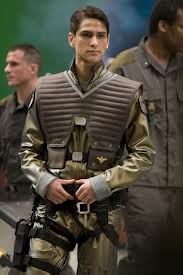
The main character is a young William “Husker” Adama (Luke Pasqualino), an idealistic, eager rookie pilot who is out to win the ten-year war against the Cylons. Seeing Adama as a hotshot, brash pilot is a startling contrast to the grizzled commander we’ve seen in the Battlestar Galactica remake. This presentation is very novel. We’ve could’ve been given a similar Adama who while still young would have many of the older Adama’s traits. But the character is refreshingly shown as being an idealist who by the time he’s commander of the Galactica has grown weary.

After a brief intro that shows various colonial cities across the Twelve Colonies under Cylon attack, Adama is shown excelling at a simulator viper fighter program. Later he’s assigned to the Battlestar Galactica; at this time, the ship isn’t an aging relic but considered one of the best ships in the colonial fleet. Expecting to be given a top-of-the line viper, Adama is disappointed that instead he’s tasked to pilot a rundown, workhorse raptor ship with cynical co-pilot Coker Fasjovik (Ben Cotton). It’s from Coker that we see the older Adama’s characteristics; bitter and disgruntled about the year, Coker is a short-timer who just wants to coast through his remaining few weeks left of service. Naturally, we get a strong feeling that he won’t live long enough to complete his tour but Coker is a likeable character nonetheless. And of course, the two butt heads over their natural differences. Still they have a mutual, grudging admiration for each other.

They are given a mission to transport Dr. Beka Kelly (Lili Bordan), formerly a Graystone Industries employee, who has vital information about the Cylons, to a rendezvous point with a colonial ship. Upon arriving, they discover the ship has  been destroyed by Cylons. After destroying some Cylon raiders (styled after the old raiders seen in the original show), they proceed to a set of coordinates and encounter a fleet of supposedly lost and destroyed colonial ships. Once they drop off Kelly, Adama volunteers himself and Coker to transport Kelly to her objective; to meet up with a contingent of marines on a frozen moon deep in Cylon territory.

Blood & Chrome is an exciting and thrilling joy to watch that is engaging and well produced. Each ten-minute segment ends in a nail-biting cliffhanger that leaves one wanting to find out what happens next. True, there are many of the standard war plot devices and characters (the routine mission that goes wildly wrong, grizzled vets, gung ho recruits, etc.) in this web show but they work well. The presentation has a gritty feel that feels exactly like the remake.  It also has some nods to Caprica and serves as a solid bridge between the two shows. The special effects and production design are simply superb and top notch.. This isn’t a cheap, digital knock-off. It looks just like it could fit in as a companion piece to the remake. It’s truly amazing considering that Blood & Chrome was actually filmed using digital sets.

Battlestar Galactica: Blood & Chrome is so good that one doesn’t mind watching this on a computer or mobile device as opposed to the comfort of a couch and TV. But for those that can wait for traditional viewing methods, the pilot will air complete on Syfy in February and be released on DVD, Blu-ray and download in the same month. Hopefully the reaction to this pilot will be strong enough for the commissioning of at least more web episodes or maybe even a series.

Waldermann Rivera

Deadly Turning Points On The Walking Dead, Parts I & II

PART I:

The measure of a man is what he does with power.” Plato

 “Compromise our safety, destroy our community – I’ll die before I let that happen” the Governor

The pre-credits scene of episode three of The Walking Dead, “Walk With Me”, shows an army helicopter flying over rural countryside. Suddenly beset by technical problems, it crashes into the forest below. Watching from afar are Andrea (Laurie Holden) and Michonne (Danai Gurira).


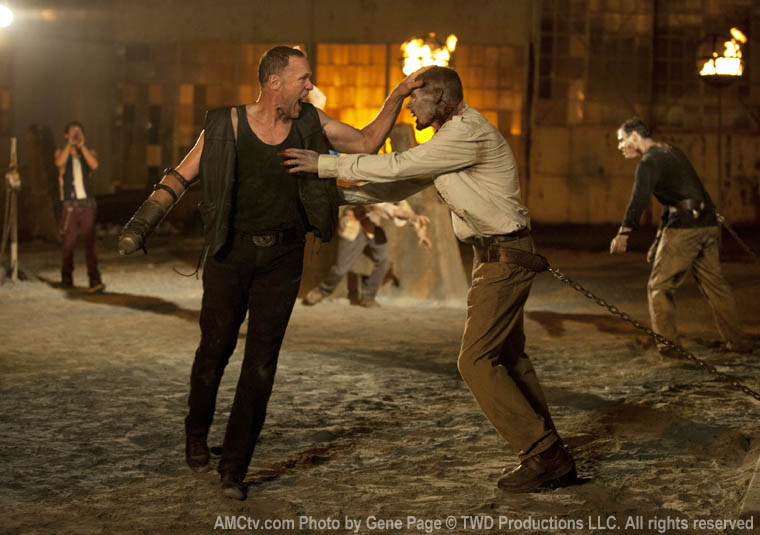
Post-credits, the blanketed Andrea, still recovering from her fever, and the grim Michonne, pulling her armless and jawless pet walkers like a grotesque version of pack mules, slowly hike in to investigate. Viewing the horrific crash site, Michonne chains the walkers to a tree, unsheathes her katana and moves in for a closer look just as a couple of vehicles speed in. A group of tough-looking, armed men emerge; they fan out and carefully survey the site. Their leader, the Governor (David Morrissey), orders the men to conserve their ammo where possible (instead using baseball bats and bows and arrows), as they kill all approaching walkers. The pilot (Julio Cedillo) is found barely alive, and taken for medical care. As Michonne’s gurgling pet walkers reveal their presence, she’s forced to decapitate them. However, it’s too late; they are found moments later by none other than Merle Dixon (Michael Rooker), the seedy redneck racist not seen since the first season of The Walking Dead when he was handcuffed to a roof by the survivors and cut off his own hand to escape. As he recognizes Andrea, we see that in place of his hand is a bizarre prosthetic contraption. Andrea faints.

Blindfolded, Andrea and Michonne are stripped of their weapons and taken to the group’s compound, the town of Woodbury. Although given medical care, their requests to leave are denied on grounds that it’s dark and they aren’t well enough. Their questions receive vague answers, and they are heavily guarded. They are later interrogated by Merle, evidently now a high-ranking assistant to the Governor. Merle is initially cordial and asks about the survivors, including his brother Daryl (Norman Reedus), but is bitter about being left for the dead. When Merle leaves, the women are briefly introduced to the Governor, who listens to their request. Explaining that they can leave the following morning, he first shows them Woodbury’s tightly-guarded perimeter (his men quickly and efficiently pick off some approaching walkers, which they call “creepers”).  Additionally, the Governor enforces a strict curfew where no one is allowed out after dark. Although Michonne is suspicious, the Governor convinces them to stay awhile.  He shows them to their lodgings, a pleasant, spacious room with spare clothes, hot showers, and food.

In the morning, Andrea and Michonne stroll around Woodbury with an official escort, and for the first time, see the town. They gape at the trim lawns and men, women, and children walking casually though the neat streets and lounging on park benches.

Meanwhile, the surviving helicopter pilot recounts the final events before the fatal flight. As National Guardsmen, they were fleeing a refugee camp overrun with walkers; the Governor asks for the location so he can rescue the survivors. Later visiting a laboratory, we learn that his scientist/partner, Milton (Dallas Roberts) was commissioned by the Governor to experiment on walkers. In a gruesome display, we see Michonne’s beheaded walkers with their eyes rolling, still showing animation. The scientist explains that walkers act as repellant to other walkers (hence why Michonne kept them), or as the Governor puts it, as camouflage.

The next morning, the Governor and Milton join Andrea and Michonne for breakfast. Making charming conversation, the Governor extols the virtues of Woodbury and its people. Although Andrea chats away freely, Michonne remains mostly silent. In a post-breakfast stroll, the two women lay it on the line; Andrea wants to stay another “day or two” while Michonne wants out.

In a trip out of Woodbury, the Governor tracks down the surviving soldiers; although looking a bit shabby, the Guardsmen are suspicious, armed, and alert. Waving the white flag of truce, the Governor offers to help but instead ambushes them, and together with his hidden crew kill all the Guardsmen, and plunder their supplies.

Returning from the ambush, the Governor immediately gathers the townspeople in the town square. Lying to them, he gives a heroic speech about how they arrived too late to save the soldiers, and that the people of Woodbury should honor their sacrifice and give thanks for what they have. Michonne cynically listens nearby.

Later, the Governor enjoys a relaxing, late-evening drink in his mansion. Passing by his sleeping concubine, he retires to his den, where we glimpse a pre-apocalypse family portrait. Removing a key from around his neck, he enters a locked room off to the side. Then relaxing on a comfortable chair with his drink, he stares at the wall opposite him, covered wall-to-wall by a grisly aquarium full of decapitated walkers’ heads, including that of the pilot.

 “Walk with Me”is an odd duck of an episode for The Walking Dead; however, coming from a series where freakish and nightmarish scenarios pop up like mushrooms after the rain, that’s not bad at all. Eschewing the slam-bang action of the season’s first two episodes, “Walk With Me” alternates between surprises and character development, mainly the slow and methodical introduction of the crafty, sadistic Governor and his fiefdom, the town of Woodbury. Ultimately, it waves the true flag of serial TV by leaving more questions than it answers. Who is the Governor? What did Merle do to acquire such a high and trusted position with him? Will Andrea and Michonne stay? What will they discover? Why is Milton so fascinated with walkers’ possible memories? What is the true nature of Woodbury? Is it a ruse to lull newcomers (notice no one entered any of the “stores”), or a Prisoner-style village where everyone is treated well but forbidden to leave?

 In any case, due to the Governor’s increasingly pointed interest in the survivors, we can expect an eventual showdown with Rick Grimes; as with other movies or comics where two badasses lock horns, it will be a true “clash of the titans”. One thing is for sure, I wouldn’t want to be there when it happens. Continue reading

Prison Life In The Walking Dead

To survive it is often necessary to fight and to fight you have to dirty yourself.

-George Orwell

 Do whatever you gotta do to keep this group safe…and do it with a clear conscience.

-Lori Grimes, to her husband Rick

The pre-credits scene of episode two of The Walking Dead, “Sick” opens where episode one left off; as Rick Grimes (Andrew Lincoln) and the survivors in the walker-infested prison are amputating Hershel’s (Scott Wilson) leg, the survivors are surprised by a group of five prisoners who emerge from a side room. Removing the barricades from the door, the survivors kill the approaching walkers and race against time, wheeling Hershel to safety.

Back in the survivors’ safe cell block, while the group struggles in providing Hershel with medical attention, the prisoners followed the survivors and arrive at the cell block’s entrance. In a tense, armed standoff, the two groups communicate for the first time. The dominant prisoner, Tomas (Nick Gomez) – a Latino gangster– demands rights to the survivors’ cell block (“C”); the survivors flatly refuse. Rick, although suspicious, tries to diffuse the tension but learns that the prisoners have been shut away for ten months, and while aware of walkers, they are unaware that society has collapsed (no phones, computers, police, etc.). To make his point, Rick leads the prisoners outside to the yard to view the walkers – both animated and dead. Emerging into the sunlight, the two groups strike an uneasy deal; Rick and the survivors will help the prisoners clear out the prisoners’ cell block from walkers in exchange for half the prisoners’ stored food; in return, the prisoners will stay to themselves and avoid all interactions with the survivors. As Rick, T-Dog (IronE Singleton), and Daryl (Norman Reedus) return with heaping boxes of canned goods, the women struggle without medical supplies in tending to the unconscious and barely alive Hershel. Rick wisely takes no chances; in the event that Hershel dies and is re-animated as a walker, he orders Glenn (Steven Yuen) to handcuff him to his bed.

Off to the side, in a chilling conversation, Rick updates his wife Lori (Sarah Wayne Callies). Admitting to her that the prisoners’ pose a possible threat, he calmly reveals he may need to kill them. Lori reacts with approval.

Later, Rick and the others return to the prisoners’ cell block as agreed upon. Rick briefly instructs them on battle tactics (maintain formation, head shots only), but when the action starts, the prisoners, armed with pipes and crowbars, break ranks and go berserk in what can only be described as “prison freestyle”. After Daryl corrects their wild techniques, they kill more efficiently; but one hulking prisoner, Big Tiny (Theodus Crane), edges to safety at a side room and is scratched by walkers. Afterwards, both groups consider what to do before Tomas suddenly bludgeons him to death. Continue reading

Seed Of The Walking Dead

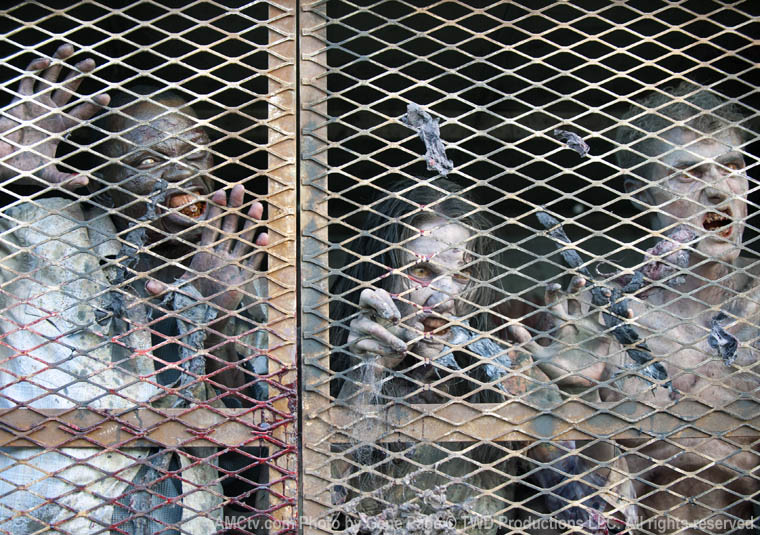
AMC’s The Walking Dead, now in its third season, centers on Rick Grimes (Andrew Lincoln), a former deputy sheriff from Georgia leading a small band of survivors to safety in the aftermath of devastating zombie apocalypse. Called walkers (they roam endlessly and never tire), the moaning, decaying, zombies are a deadly lot, as they shuffle in wandering herds, seeking live flesh. The first two seasons, a ratings and critical smash, showed Rick and a diverse band of survivors seeking safe refuge while fighting walkers, other survivors, and each other. The Walking Dead is loosely based on the comics of the same name, and uses it as a springboard rather than adhere to it faithfully; this approach enables plenty of twists, surprises, new characters, and red herrings.

Law-and-order man Rick Grimes has the heart of a lion, a classic good guy so pure in his outlook and valiant in his mission he’s more like a knight from a medieval tale or a hero from a Greek myth. Joining Rick are his pretty wife Lori (Sarah Wayne Callies), his pre-teen son Carl (Chandler Riggs); Daryl (Norman Reedus), a redneck archer/tracker/outdoorsman and Rick’s wingman; Glenn (Steven Yeun), a Korean delivery boy turned resourceful street rat; T-Dog (Irone Singleton), a tough, stocky black guy; Carol (Melissa McBride), a gentle widow, having lost her husband and daughter in seasons one and two; elderly Hershel (Scott Wilson), an upright, religious country vet in whose farm the survivors sought refuge; Hershel’s two daughters Maggie (Lauren Cohan), romantically linked with Glenn, and the emotionally-troubled Beth (Emily Kinney); Andrea (Laurie Holden), a former lawyer, whose character developed over the first two seasons from a jangled bundle of nerves to a straight shooter; and the newest addition, the mysterious katana-wielding Michonne (Danai Gurira).

In last season’s exciting finale, “Beside The Dying Fire”, the walkers overran Hershel’s farm, killing his daughter and son-in law, and exiling the hapless survivors. Separated from the group, Andrea is saved by the laconic Michonne, while Rick asserted his indisputable leadership (or “Rick-tatorship”, as fans are calling it).

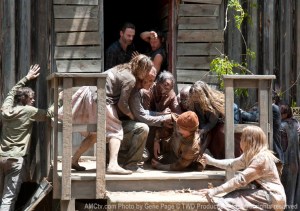
In season three’s premiere, “Seed”, the slam-bang pre-credits sequence opens with a twisted mockup of Lost, where the camera spirals away from a walker’s eye – cold, reptilian, lifeless. Seeking refuge, Rick and the survivors burst into a simple country house. Fanning out like a well-oiled SWAT unit (including Carl), they secure the house by killing that walker and other undead inhabitants. Just as they settle in, T-Dog spots a herd of walkers converging on the house. The survivors grab their gear and flee…

Later on, while hunting food, Rick and Daryl spy the prison shown in last season’s “Besides The Dying Fire”. Realizing its potential for refuge, Rick devises a plan with the group to clear the yard of walkers and break into the prison (the second time this episode where we see the survivors work brilliantly as a team). Reveling in the safety of the prison yard, they whoop and holler with joy at the open space. In the morning, they clear out a ravaged, overturned cell block and settle in.

Meanwhile, we get our first glimpse of Michonne since her brief introduction last season. Entering a dilapidated pharmacy in a small town, she coolly beheads walkers while finding aspirin for Andrea, who is sick and resting safely in a nearby meat locker. Andrea urges Michonne to abandon her, but Michonne refuses. Then the two women along with Michonne’s two chained, pet-like, armless and jawless walkers set out.

Back in the prison, the survivors find an ammunition stash and prepare to clear out the rest of the prison, in hopes of finding the cafeteria and infirmary. Armed and ready, they light the way through the unlit, ghoulish cell block by flashlight, stepping over bloody and decaying corpses while Glenn marks their trail with spray paint. At the far end of the block, they stumble into walkers; in the ensuing chaos, Glenn and Maggie separate from the others; Hershel backs up to locate them and is bitten in the leg by a walker. Reuniting, the group quickly finds safety, where Rick, in an attempt to halt the spreading infection, unsheathes a hatchet and amputates Hershel’s leg below the knee. Hearing noises, they look up, and realize they are not alone; they are being watched by live prisoners… Continue reading

A Revolution Comes To TV

In the new NBC series Revolution, viewers are presented a world fifteen years from now that is in a new Dark Age. In the opening scenes of Revolution’s pilot, the electricity throughout the world abruptly fails. Moments before this event happened Ben Matheson (Tim Guinee) races to his home and warns  his wife Rachel (Elizabeth Mitchell) and their two children about what will happen. He also manages to phone his brother Miles (Billy Burke) about it just as the lights go out everywhere in the world. Viewers got a quick glimpse of the immediate impact of this blackout as airplanes fell out of the sky and cities plunged into darkness. Revolution jumps ahead fifteen years later to a radically changed world. Without electricity, governments collapsed and militias took over as everyone struggled to survive with the bare necessities. Ben is now living in a small, rustic community in Illinois with his teenage children Charlie (Tracy Spiridakos) and Danny (Graham Rogers) and a new lover Maggie Foster (Anna Lise Phillips).

Their humble existence is interrupted with a visit by militia men, led by Captain Tom Neville (Giancarlo Esposito), belonging to a local tyrannical power called the Monroe Republic. Neville was sent by the Republic’s despot General Sebastian Monroe (David Lyons) to conscript Ben. During a melee Ben is killed and Danny is taken prisoner by the militia. Before Ben died he entrusted an amulet to Maggie and his friend Aaron Pittman (Zak Orth), which is capable of generating small amounts of electricity. What this means has not been revealed nor what caused the blackout. On Ben’s dying advice Charlie, Maggie and Aaron travel by foot to the decaying city of Chicago and recruit Miles for help in liberating Danny.

As the series progresses, viewers learn bits and pieces about the world and the characters. It was revealed that Miles was once friends with Monroe and was, in fact, a founder of the Monroe Republic. Now Miles has broken ties with Monroe and exists as a cynical Han Solo type until dragged into the limelight by Charlie and company. Monroe wants to have the power restored to spread his reign and he knows that Ben had knowledge about what caused the blackout. A plot development revealed that Rachel is still alive and Monroe’s prisoner. He intends to use her captured son as leverage to get her to reveal what she knows about the blackout. Also in reference to the show’s title, it turns out that there is a revolutionary movement among some people the main characters encounter to restore the United States. Peppered throughout the episodes are interesting flashbacks that show the immediate aftermath of the blackout, taking place days, even months after the event. The most touching one featured Maggie, who is British. In her story it’s revealed that she is cut off from her children in England and she tried for years to get back to England before giving up. Despondent and suicidal, she was found by Ben and his children sometime after Rachel was taken prisoner and Maggie became part of the family. At times, these flashbacks are the most interesting scenes in an episode.

Admittedly, Revolution has constant plot developments but the show is not overwhelming and things are kept at a fast pace that moves the overall story along. Many character have intriguing backgrounds and developments such as the revelation that Miles helped form the Monroe Republic and is hated and feared by many. The show took a daring step by unexpectedly killing off one of the main characters, a victim of a knife wound. This showed that the greatest dangers in this new Dark Age can come from fairly mundane and presently treatable ailments. The production design is very excellent and illustrates a world where nature is reclaiming the land as vegetation engulfs cities and towns. The credit for Revolution’s well presentation should go to series creator Eric Kripke (who created Supernatural), who serves as executive producer along with Iron Man’s director Jon Favreau and J. J. Abrams.

However, Revolution does have flaws. Sometimes Charlie is annoying, and how is it that Aaron (formerly a Google executive) is still overweight and seems to have no clue on how to survive in a post-apocalyptic environment? One would think that in the years since the blackout the characters would’ve been hardened and learned some survival skills. Drinking games can be made to how many times the roguish Miles threatens to leave the group or Danny’s many failed escape attempts. Why not keep that teenager shackled up in chains? But these seem to be the typical growing pains that every series goes through and the show seems to be getting stronger with each passing episode.

At first glance Revolution seems to borrow heavily from popular post-apocalyptic yarns like The Postman and obviously S. M. Stirling’s Emberverse books. But the series is setting its own fascinating mythology that hopefully the network will allow to play out to a satisfactory conclusion.

José Soto