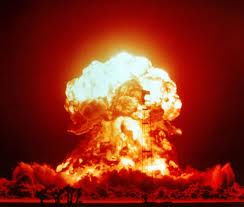
In many ways, the idea of a total annihilation of our civilization due to war is the most terrifying doomsday scenario. Imagine the horror of the initial nuclear strikes that will destroy entire cities, wipe out millions if not billions of people in mere seconds and leave behind an unlivable radioactive wasteland. What probably makes this scenario so chilling is that the possibility of this happening is very real. Sure the Cold War ended but the threat of an all-out nuclear war still exists.
Doomsday Scenario No. 9: Nuclear Armageddon and Aftermaths
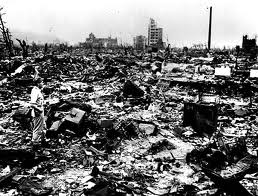
 We all fear using nuclear weapons because of the effects of just two atomic bombs used in Japan at the end of World War II. The horrific sights and looming radiation made many realize how devastating these weapons were. Many have come to the conclusion that a full-scale nuclear war would destroy our civilization and way of life. But there are some who think that a nuclear war would be survivable and winnable, though what kind of life is there to live after that event? Is it worth surviving?
The Nuclear Dawn
Since the dawn of the nuclear age, countless books, films and TV shows have explored the post-apocalyptic world left after the nuclear mushrooms have dissipated. There have been somber, intellectual works and outrageous parodies that covered this concept. With the former early notable films include Five, The World, The Flesh And The Devil,  and On The Beach. These early works naturally got many details incorrect. For instance, with The World, The Flesh And The Devil, our hero (played by Harry Belafonte) is the sole survivor of World War III (at least for the first half of the film) and winds up in an abandoned New York City where all the buildings are intact and there aren’t any bodies anywhere. The film tried to explain it away with a silly line about radioactive isotopes that dissipated after five days. Despite its scientific inaccuracies, the film was an interesting look at how a person would cope after surviving the apocalypse. At least in the movie Five the dangers of radiation are shown, the same with On The Beach. The
 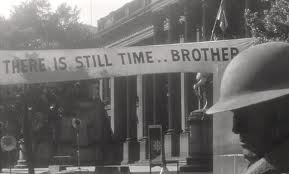 latter was more of a character study about how we would face our untimely end (the film and book took place in Australia where an American submarine crew took refuge from the fallout of World War III but radioactive winds will soon reach the continent, dooming everyone living there), while Five showed how we can try to carry on emotionally after a traumatic event. The TV series The Twilight Zone had several episodes dedicated to nuclear war, some of the better known ones included “Time Enough At Last ,” “Two,” “The Shelter,” and “The Old Man In The Cave.”
The Day After Wars
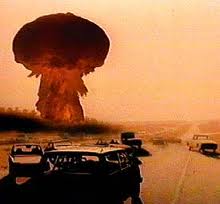 As we studied more the concept of nuclear war and film/TV effects budgets increased more graphic and accurate depictions came about. Probably the most famous one is the TV film The Day After. It started off with the typical daily routines among Kansas City residents then midway through it, the world was jarringly torn asunder as the city was reduced to rubble with corpses everywhere, people succumbing to radiation and civilization collapsing.
The Day After was one of many emotionally draining presentations. Some of the best ones were Threads (a British film that also graphically depicted World War III and the end of humanity), When The  Wind Blows (an animated piece about an old couple eventually dying from radiation following nuclear war) and Testament. Taking place in a small suburb outside of San Francisco, in Testament, its residents aren’t hit with any nukes but are affected by the radiation and being cut off from the outside world. It’s particularly gut wrenching to watch the main character-played by Jane Alexander-tenderly nurture her dying children.
Opposite The Day After and Testament, there some ludicrous presentations. They include Invasion U.S.A. This Is Not A Test and Panic In Year Zero. Wildly inaccurate and poorly executed these films from the ’50s and ’60s couldn’t convey what would really happen if the unthinkable happened. Two more recent efforts include a “comedy” that aired on Fox called Whoops! about nuclear war survivors and Jericho which aired on CBS. So much of what happens in the show is unbelievable. Here are a couple of examples: townspeople put out an open-air picnic after a radioactive rainfall (!); a spoiled rich girl throws a party because her parents are out of town and won’t give up her generator to the police-who stand idly by as she parties! In reality, the authorities would’ve taken the generator by gunpoint.
Aftermath
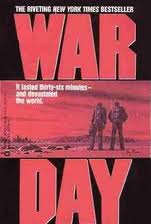
 Then there are the films, books and stories that take place either shortly or long after a nuclear war. Too numerous to name here, these are just a sampling of books: The World Set Free by H.G. Wells (written in 1914, it correctly predicted the use of atomic weapons during war), Alas, Babylon by Pat Frank, A Canticle For Leibowitz by Walter M. Miller, Jr., The Long, Loud Silence by Wilson Tucker, The Last Ship by William Brinkley, The Postman (also made into a film starring Kevin Costner) by David Brin, Swan Song by Robert McCammon, Warday and Resurrection Day. With Warday, Whitley
  Strieber writes about a United States that has been crippled economically and spiritually by a “limited” nuclear exchange with the Soviets. Partly a travelogue, the main character goes around America that is struggling to recover years after a war. The same thing happens with Resurrection Day by Brendon DuBois, the twist is that it’s an alternate history novel that follows the U.S. a decade after the Cuban Missile Crisis led to war.
For movies as with books there are too many to list. They include Damnation Alley (based on a Roger Zelazny book and is complete with giant killer roaches!), Def-Con 4, the Mad Max films, Radioactive Dreams, the 1960 film version of The Time Machine (it featured London destroyed by atomic bombs) and Peace On Earth-an MGM animated short release in 1939 featuring a world devoid of humans, who killed themselves off in a final war.
At The Precipice
Everyone knows about how close we came to war with the Cuban Missile Crisis and are now finding out about accidental close calls and near wars that happened before and since that crisis. As recently as 1995, Russia mistakenly believed a rocket launch by the U.S. was the beginning of a pre-emptive strike and almost retaliated. In 2001, India and Pakistan nearly went to war with each other and were prepared to use their nuclear stockpiles against each other.
Today we lose sleep over rogue nations like Iran developing nuclear bombs. It seems as if we are at the dawn of a new arms race where everyone seems to want to have their own nuclear stockpiles. Then of course there is the specter of terrorist groups and nut jobs getting their hands on a nuclear weapon. One thing that prevented all-out war between the U.S. and the Soviet Union was the concept of M.A.D. (Mutually Assured Destruction) which kept generals and leaders from losing their cool and automatically launching missiles for any reason. It’s unlikely many of these nations and terrorists will hesitate to use a nuclear weapon.

What is disturbing about this scenario isn’t the possibility of it happening but that it’s something that can be prevented. Some point out that nuclear weapons have to date kept the world out of full-scale wars like the First and Second World Wars. In a way they are right, the devastating nature of these weapons reminded world leaders not to brazenly use them…to date. But the reality is that the genie is out of the bottle. Trying to wish away nuclear weapons and reduce stockpiles may be a pipe dream. The capacity for war will exist within us for a very long time and so is the will to develop deadlier weapons. Perhaps one day, when humanity has matured past the point of war will it be feasible to put aside this nightmare.

 Today, we all lost a true hero and pioneer from the Space Age. Neil Armstrong, the first human to step on the moon, died at the age of 82.
 Armstrong nearly lost his life during training maneuvers. He was piloting a prototype of the Eagle lander. During a test, the lander malfunctioned and Armstrong was able to jettison away at the last second before it crashed. His cool nerves and fast reaction illustrate that NASA picked the right man to be the commander of the Apollo 11.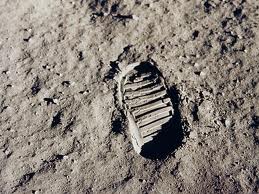











 Starloggers