Farscape, the sci-fi TV show from the late ’90s that aired on the Sci-Fi Channel, has received some attention lately and it’s quite warranted. It’s undeniably one of the very best sci-fi TV shows ever made. Created by Rockne S. O’Bannon and produced by Jim Henson Productions and Hallmark Entertainment, Farscape rivals such classics like Star Trek, Babylon 5 and Battlestar Galactica thanks to the way it presented truly alien characters and worlds and more importantly well-written scripts with complex, nuanced characters. Though it was cancelled in 2003, the show has come back to the limelight with its availability on Netflix, daily airings on the cable channel Pivot and with recent news that one of the show’s writers (Justin Monjo) is penning a screenplay for a Farscape film.
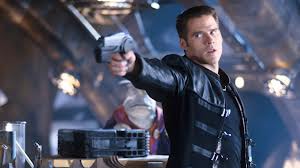
The show starred Ben Browder who played John Crichton, an American astronaut who was testing an experimental mini-space shuttle called Farscape One. While in space, his shuttle gets sucked into a wormhole and Crichton wound up on the other side of the universe. Once there, he inadvertently joined a band of escaped alien prisoners on a prison ship they commandeered called Moya that is actually alive. This gets him into trouble with the prisoners’ pursuers, the Peacekeepers, a militaristic power, who ironically enough look human. Think of them as xenophobic, intergalactic Nazis. One of them, Aeryn Sun (Claudia Black) also wound up in cahoots with Crichton and the prisoners even though she’d just as soon throw them back in their cells. For most of the show’s run, Crichton and his eclectic group evaded the Peacekeepers and other foes, while he looked for a way to create a wormhole to return home. During his experiences he bonded with his reluctant alien allies, including Sun.
No Ordinary Space Hero
From the start, Farscape had an offbeat vibe to it and it started with the main character John Crichton. He easily could’ve been the typical stoic and rugged hero, but thanks to Browder’s acting chops and comedic skills, Crichton was much more than your standard space hero. He often referenced pop culture; specifically genre fare. At every opportunity he mentioned Star Wars, Star Trek, Looney Tunes and other genre classics. Actually an animated version of Star Trek’s Enterprise ship appeared in one episode as part of a hallucination he was experiencing!
It was all part of the way he dealt with the bizarreness that he experienced during his travels. Many of these references and his sometimes erratic behavior were downright hysterical and lessened the tension during many nail biting sequences. Rather than being the straight man, Crichton was the comedian who was able to see the absurdity of many situations he was stuck in.
Yet, he was heroic and often the voice of reason amongst the crew of Moya. Despite his bravery Crichton sometimes made bad calls out of good intentions. More often than not he just charged into a situation and improvised on the fly. Certainly that got him and his friends into more trouble, but he accepted responsibility and tried to make amends. These faults made him more fallible and relatable. And when it came down to it, these characteristics made Crichton someone to root for whenever he made a humorous quip and fired away with his beloved pulse pistol affectionately called Winona.
But this didn’t mean that Crichton lacked a serious side. It was clear the humor he exhibited was to alleviate the stress he was undergoing. Crichton was obviously homesick at the start of the series and he knew returning to Earth was an impossibility, yet like a modern-day Quixote he continued looked for ways to do this. Later in the series, he realized that going home would lead to more problems and it conflicted with the life and deep relationships he established with his comrades. Often, he found himself making sacrifices for others and was rewarded with deep emotional bonds, both good and bad. Continue reading →
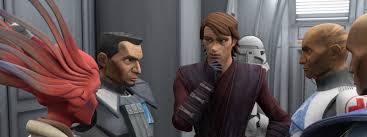
The sixth and last season of Star Wars: The Clone Wars, entitled “The Lost Missions”, just premiered on Netflix. As the final season of the excellent series it’s a shortened one with 13 episodes as opposed to the usual 22. The purchase by Disney brought about the cancellation of the series and the creative team led by Dave Filoni has moved onto the upcoming series called Star Wars Rebels.
This sixth season has four story arcs which begin with a very interesting storyline about a clone trooper named Tup that suddenly attacks and kills his commanding Jedi general. His fellow clone trooper named Fives (Dee Bradley Baker) investigates what caused this violent behavior and uncovers a conspiracy going back to the creation of the clone army in their birthplace planet Kamino and the Sith Lord Darth Sidious (Tim Curry). This story, as well as others in this season, lead directly to events in Star Wars Episode III: Revenge Of the Sith, which makes this season a very good send off for the show.
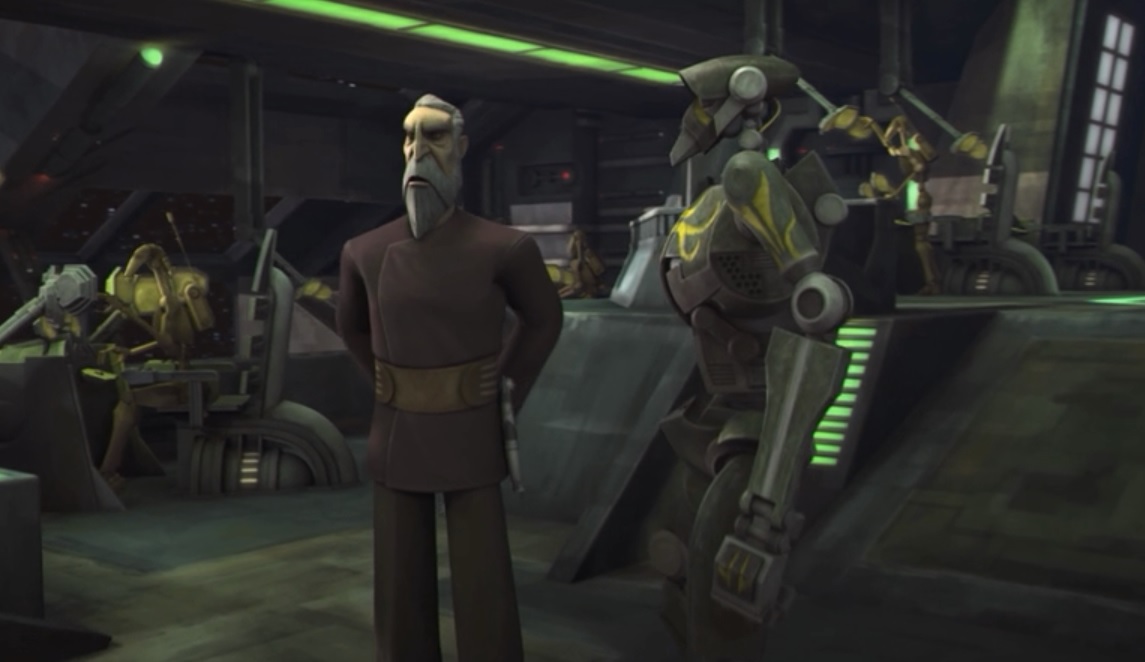
The next story arc involves Senator Padme Amidala (Catherine Taber) and an old flame named Clovis who gets involved with political intrigue involving the Banking Clan as well as Sith Lords Sidious and Count Dooku (Corey Burton). While this may not sound very exciting, these episodes actually show how Palpatine further consolidated his control over the Republic and also have both Anakin Skywalker (Matt Lanter) and Padme questioning the nature of their secret marriage.
The third story arc features everyone’s favorite Gungan Jar Jar Binks (Ahmed Best) and Jedi Knight Mace Windu (Terence ‘T.C.’ Carson) trying to solve a mystery involving a planet where its spiritual leaders are disappearing and dealing with a prophecy about darkness taking over the galaxy. These two episodes were good although not quite as significant to the overall story of the Clone Wars as compared to the other arcs.
The last batch of episodes deals with the Jedi trying to find out about the murdered Jedi Sifo-Dyas and Yoda (Tom Kane) being contacted from beyond the grave by Qui-Gon Jinn (Liam Neeson), who shows him how he can continue to exist after death. Qui-Gon has him travel to a world that is the origin of the Force itself and face his worst fears. This references a scene in Revenge of the Sith where Yoda tells Obi-Wan Kenobi that he has discovered the secret of existing in the Force after death. It is a great way for Star Wars: The Clone Wars to end, with Yoda knowing that while the Clone Wars may end badly, there will be a way for the Jedi to continue on.
Star Wars: The Clone Wars was in the middle of production when it was cancelled, but the last season is one of the strongest in the series. The quality of these episodes shows that even at the end the writers still came up with very interesting ideas and perhaps the shortened run prevented any weaker episodes from coming up. Overall, Star Wars: The Clone Wars will go down as first rate Star Wars action and drama that did justice to its cinematic counterparts. Hopefully the upcoming Star Wars Rebels series will continue this trend.
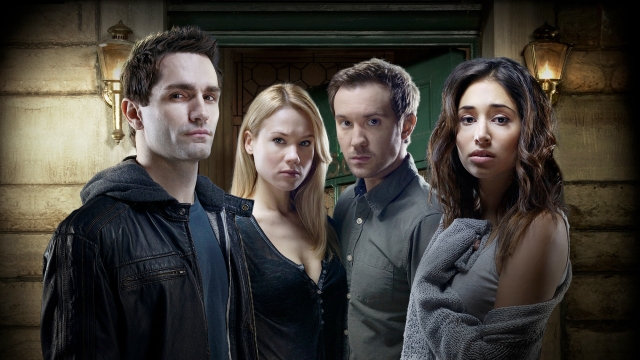
Syfy’s Being Human was cancelled a couple of weeks ago after a four-year run. I didn’t find out about it until the other day and when I did it saddened me greatly. I never expected that kind of reaction and it made me realize how much I’ve come to enjoy this remake of the cult BBC hit of the same name.
The original version of Being Human is quite excellent and worth seeking out. When I first heard that Syfy was doing a U.S./Canadian version of the program I was very skeptical. How could they recreate the charm, quirkiness and chemistry that the original actors had? For anyone who hasn’t seen either TV show, Being Human is about a vampire, werewolf and ghost sharing a place of residence. Yes, it sounds like a joke in the vein of “a priest and a rabbi walked into a bar” but Being Human had this sincere quality that made it endearing.
The show focused on the characters, they were the most important thing on Being Human. This emphasis helped flesh out the characters and did so by having them deal with the mundane things so they were very relatable. We cared about them when they were in trouble or going through an emotional crisis. Their dilemmas and how they dealt with them was one of the tenets of Being Human. In the show, the supernatural characters tried to hang on to a semblance of normalcy and their humanity. They didn’t relish being who they were, they wanted to be as human as possible, though in the end that was ultimately impossible. But they emulated the best parts of what makes us human–our compassion and empathy.
So I really doubted the American version of Being Human would successfully emulate those aspects.
After watching a few episodes, I have to admit I was very glad to be wrong.
Of course, the new version of Being Human couldn’t quite replicate that core essence of the original; at least at first. The first season of the show largely followed the storylines of the first season of the original show and it was kind of clunky because it had a longer season (13 episodes as opposed to six episodes in the original season). Still it was well acted and written enough to keep me watching.
Things became very interesting for me during its second season. Being Human branched off in different directions plot wise from the original show. This meant that the new version became unpredictable and fresh. The characters explored new territories and had unique personal arcs.
Take the ghost in the trio. In the original version, the ghost Annie Sawyer (Lenora Crichlow) remained a ghost for that show’s run and became a powerful poltergeist able to interact with the material world. In the new incarnation, the ghost now named Sally Malik (Meaghan Rath) was resurrected last season but turned into a flesh-craving ghoul as her flesh deteriorated. This season she returned to her ghostly state but with a witch’s powers.
Aiden Waite (Sam Witwer), the vampire character in the new version of Being Human has had to contend with a vampire virus that wiped out most of the world’s vampire population, a reunion with his supposedly long-dead wife, and mentoring a new leader of the remaining vampires. John Mitchell (Aiden Turner), the UK version, hasn’t had to deal with those issues during that show’s run.
When it came to the werewolf of the group, Josh Levison (Sam Huntington), the character’s arc followed a similar path as the original werewolf, George Sands (Russell Tovey). Both turned their future wives (Kristen Hager and Sinead Keenan) into werewolves and got them pregnant. The major difference is that the American couple lost their child through miscarriage, while the UK couple didn’t. Also, Josh has tried to come to terms with the werewolf within him and had a curse earlier this season where he remained a werewolf long after a full moon passed.
All these differences really helped to make the current version of Being Human stand out from the original. It wasn’t a rethread and its unpredictable nature kept me tuned in. This doesn’t mean that the original is flawed only that this version of the show wisely went into an alternate path. Sometimes I wondered if both versions of the characters somehow existed in the same universe and it’s too bad there weren’t any kind of crossovers or cameos by the original actors.
When the new show’s production team strove to make this version of Being Human different they still kept what made the original so endearing. The focus on characters and their struggles with their souls and the perfect balancing act of being wry and dramatic. It never went into histrionics and events and character reactions felt so natural and genuine. It’s a testament to the acting abilities of the main actors, kudos go to all of them. They didn’t have an easy job, but they pulled it off, they made many people, including me, forget about the original actors. It was all these elements that made the U.S. version of Being Human heartfelt and special. Unlike many of these supernatural TV shows on the air now, it’s human quality made it stand out from the rest.
Babylon 5, the classic sci-fi TV show from the ’90s, celebrates its twentieth anniversary this year. It all started with an obscure TV movie pilot called Babylon 5: The Gathering, which was about an orbital space station that served as a common meeting ground for several alien races including humans. Created by J. Michael Straczynski, Babylon 5 steadily built up a core fan base thanks to its epic plotlines and complex characters. These are the best episodes from its five-year run. * WARNING: Some major spoilers lie below.
20. “Day Of The Dead” An alien festival held in the station during the show’s fifth season (written by Neil Gaiman) brings about visions of deceased people to many main characters.
19. “Comes The Inquisitor” Captain John Sheridan (Bruce Boxleitner) and Mimbari Ambassador Delenn (Mira Furlan) are held captive and tortured by a mysterious human (Wayne Alexander) sent by the enigmatic alien Vorlons to see if they are worthy for a coming struggle–namely the Shadow War.
18. “Z’ha’dum” This third-season ender featured Sheridan’s supposedly dead wife (Melissa Gilbert) coming to Babylon 5 as an envoy for the evil, spider-like Shadows and tries to recruit him to their side in the Shadow War.
17. “And Now For A Word” A news crew visits the station during the Narn-Centauri War in the second season. The episode is shot mostly in a documentary format, as viewers see various characters being interviewed, learn their viewpoints and witness a battle in the war.
16. “Shadow Dancing” As Sheridan stages his forces for a battle against the Shadows, the station’s doctor Stephen Franklin (Richard Biggs) is seriously wounded while on a self-imposed sabbatical.
15. “Babylon Squared” This intriguing first-season episode hints at the show’s epic scale when Babylon 4, the station’s predecessor, mysteriously reappears after it went missing years ago. Investigations reveal that Babylon 4 is unstuck in time and tantalizing clues for what lies ahead for the show are unveiled. Some of the revelations are truly jaw dropping.
14. ” Point Of No Return” The station is placed under martial law the paramilitary organization the Nightwatch and station personnel must grapple with their loyalty to Earth or defying their government by confronting the Gestapo-like Nightwatch officers.
13. “No Surrender, No Retreat” In this fourth season episode, Sheridan decides to free the Earth colony Proxima 3 from the tyrannical Earth Alliance rule and provokes a showdown between his fleet and that of the Earth Alliance forces.
12. “In The Shadow of Z’ha’dum” More information about the Shadows and the mysterious Vorlons are unveiled as Sheridan faces difficult choices after learning that his wife was killed by the Shadows years earlier and that the mysterious Mr. Morden (Ed Wasser) is an associate of the Shadows.
11. “Chrysalis” This stunning first-season finale marked the last time Jeffrey Sinclair (Michael O’Hare) was the show’s main lead as the Earth Alliance president is assassinated and Security Chief Michael Garibaldi (Jerry Doyle) is critically shot while uncovering the conspiracy to kill the president. Meanwhile, the Minbari ambassador Delenn decides to undergo a metamorphosis.
10. “Believers” Dr. Franklin must contend with alien parents whose religious beliefs won’t allow him to operate on their fatally ill son. The ethical dilemma faced by the doctor was well presented as were the aliens’ beliefs that clashed with his Hippocratic oath. The ending was a horrific shocker that illustrated how extreme both sides were about following their values.
9. “Endgame” At last! What fans have been waiting for since the start of the series. Sheridan’s forces finally arrive on Earth to free it from the tyranny of the Earth Alliance. This conclusion of the Earth Civil War had been building up for years in Babylon 5 and was emotionally satisfying to watch as both sides orchestrated final, fateful maneuvers.
8. “The Deconstruction Of Falling Stars” This unusual fourth-season ender examines the impact that Babylon 5 and its crew has on humanity way into the far future. Originally the episode “Sleeping In Light” was to be the finale when the show was prematurely cancelled. But a last-minute reprieve meant that the series finale had to be delayed and this episode was hastily produced and aired instead. The captivating story culminates in humanity’s fate a million years from now.
7. “The Fall Of Night”Babylon 5 had many memorable season finales but this was the best one. Nagging questions were answered while new ones arose to keep fans talking in between seasons. The biggest reveal was that Kosh, the mysterious ambassador of the enigmatic Vorlon race finally shows what he looks like and it’s a stunner. Meanwhile, Sheridan and the station crew find themselves on their way to confronting the Shadows and the despotic Earth Alliance.
6. “The Long, Twilight Struggle” The Narn-Centauri War comes to a bitter end as the losing Narn fight a valiant struggle against the Centauri, who were secretly helped by the Shadows. Meanwhile, Sheridan gains important allies for the coming Shadow War. The performances by the two rival ambassadors of each race G’Kar (Andreas Katsulas) and Londo Molari (Peter Jurassik) were gripping and arresting, as were many haunting images of the war itself.
5. “Sleeping In Light”Babylon 5’s series finale was one of the best ones ever done for any series. Taking place twenty years after the pivotal events in the show (the Shadow War, Earth’s liberation), surviving characters reunite on the eve of both Sheridan’s pending death and the decommissioning of Babylon 5before its scuttled. Aside from the poignancy of seeing the station one last time, the episode intrigues viewers with its revelations of what the now-old characters have been up to since Babylon 5 ended.
4. “And The Sky Full Of Stars” War veteran Sinclair is kidnapped and forced to relive through a simulation his time during the final battle in the Earth-Minibari War when he was captured by the Minbari. His kidnappers are convinced he is a traitor and push him via the simulations to admit his crimes. The episode effectively tantalized viewers about its mysteries, especially those about Sinclair’s memory gap during his capture and as to why the clearly superior Minbari forces surrendered to Earth on the eve of conquering humanity.
3. “War Without End, Parts One and Two” Many mysteries regarding Babylon 4, the MInbari and Sinclair are finally revealed in this two-part third-season episode. Sinclair, now leading the warrior Rangers against the Shadows, returns to Babylon 5 with an important mission for many characters. It leads to Sheridan time traveling into the future as other characters wind up a few years in the past to right before Babylon 4 disappeared, which was shown in the episode “Babylon Squared”. Aside from showing what happened to Babylon 4, Sinclair’s ultimate…and stunning fate is revealed.
2. “The Coming Of Shadows” This pivotal episode won the Hugo Award for Best Dramatic Presentation as the evil, spider-like Shadows secretly instigate the disastrous Narn-Centauri War. Meanwhile, Garibaldi gets a message from an old friend, former Babylon 5 commander Sinclair, who is now working against the coming “terrible darkness” and enlists his allegiance. Sinclair’s appearance was a genuine surprise and, along with the Shadows’ machinations, pushed the show and its characters into a bold, new direction.
1. “Severed Dreams” This third-season episode of Babylon 5 served as a cathartic release of sorts. Sheridan and his crew had been dealing with the increasingly totalitarian rule of Earth Alliance President Clark, who had the previous president killed in the first season finale. Sheridan reaches a point where the only way to save their democratic way of life is to rebel against his government. Following his declaration that Babylon 5 is seceding from the Earth Alliance a vicious battle ensues between the station and Earth warships, along with a vicious firefight inside Babylon 5 when its boarded. By the episode’s end Sheridan is now committed to a new path and must follow it to its conclusion.
Honorable Mentions:” Between The Darkness And The Light”, “Divided Loyalties”, “The Fall Of Centauri Prime”, “The Hour Of The Wolf”, “Interludes And Examinations”, “Intersections In Real Time”, “Objects At Rest”, “Signs And Portents”, and ” Walkabout”.
“It was the dawn of the third age of mankind”– Commander Jeffrey Sinclair, opening monologue during the first season opening credits of Babylon 5
What made Babylon 5 so great was its epic scope. It had a long-running storyline with conflicted characters and bizarre aliens who weren’t just actors with bumps on their faces. Unlike many sci-fi TV shows before it, Babylon 5 genuinely set out to present a mature story with engaging characters and it succeeded. When conceiving the show, Starczynski wanted to do a grand, epic sci-fi show and was inspired by Dune, The Lord Of The Rings and the Lensmen and Foundation series. Also emulating TV shows like Hill Street Blues, he wanted Babylon 5 to be taken seriously without robots or kids running around. Instead complex storylines were the order of the day; events had consequences in later episodes. Characters, even the heroic ones, were deeply flawed and suffered from addiction, greed, insecurities and other foibles. The show didn’t present some kind of utopian future, yet it wasn’t a moody, post-apocalyptic saga. At the end, the show was about hope and striving for a better tomorrow, which was best seen in its fourth season finale “The Deconstruction Of Falling Stars” and its final episode “Sleeping In Light”.
Evolving Situations & Complex Characters
Babylon 5 takes place in the mid 23 century on Babylon 5, a space station. It served as neutral ground for various space powers to work out their differences peacefully and as a port-of-call. At first, the station functioned as a futuristic U.N. and in the opening credit’s narration in the early seasons it was called the “last peace hope for peace.” But by the third season, intergalactic war was raging and the station then changed into the “last best hope for victory.” As can be inferred by the change in narration, Babylon 5 was very dynamic. Events, political situations and people were always in flux. It wasn’t static like many TV shows and careful viewers had to keep up with what was happening in the show.
Follow this example. There were five super space powers that had representatives on board the station; the Minbari Federation, the Earth Alliance, the Narn Regime, the Vorlon Empire and the Centauri Republic. The latter one was once a major, imperial power in the known galaxy. The B5 representative was Londo Mollari (Peter Jurasik), who was characterized by his outlandish hair that stood up in the back like peacock feathers and his boisterous personality. He came off at first as a bickering buffoon, who liked to verbally spar with his rival G’Kar (Andreas Katsulas). Now G’Kar represented the Narn, which was once ruled by the Centauri. He liked to antagonize Londo about the supposed superiority of the Narn and the fact that the Centauri were a declining power. It was very clear that Londo wished for his people to become a great power again.
Early in the show’s run, he met a mysterious person, Morden (Ed Wasser) who offered him a Faustian deal to return the Centauri to greatness. Afterwards, the Narn and Centauri went to war and the Narn were being defeated by an unknown power aiding the Centauri. At first, Londo was ecstatic over the supposed Centauri victories, but over time he learned that his people were aligned with the evil Shadows, an ancient power that returned to the known galaxy to conquer everyone. Londo came to realize the true cost of his deal, which was his soul and his people’s subjugation. So during the course of the show, Londo underwent a wide personality shift. Once seen as comedic relief, Londo assumed an adversarial role until consumed by guilt, he earned a measure of redemption when he finally turned against the Shadows and helped G’Kar and his people.
That was just one story arc. There were many other intricate plot lines that involved not just the show’s leads but supporting characters as well. People would suddenly die or leave the station, even the main character. In its first season, the lead was Commander Jeffrey Sinclair (Michael O’Hare), who was a calm, stoic leader, but was quietly suffering from his ordeals during a previous war. The show’s producers shocked fans after the first season when they announced that O’Hare wouldn’t be returning to the show. He was replaced by Bruce Boxleitner as Captain John Sheridan, a self-assured and brash commander who echoed James T. Kirk. It all may have been daunting for the average viewer who just tuned in for an episode or two, but in the end it was largely rewarding for a dedicated watcher. Continue reading →

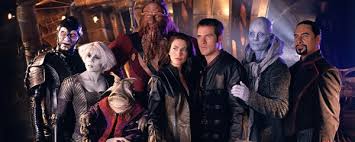 Farscape, the sci-fi TV show from the late ’90s that aired on the Sci-Fi Channel, has received some attention lately and it’s quite warranted. It’s undeniably one of the very best sci-fi TV shows ever made. Created by Rockne S. O’Bannon and produced by Jim Henson Productions and Hallmark Entertainment, Farscape rivals such classics like Star Trek, Babylon 5 and Battlestar Galactica thanks to the way it presented truly alien characters and worlds and more importantly well-written scripts with complex, nuanced characters. Though it was cancelled in 2003, the show has come back to the limelight with its availability on Netflix, daily airings on the cable channel Pivot and with recent news that one of the show’s writers (Justin Monjo) is penning a screenplay for a Farscape film.
 escaped alien prisoners on a prison ship they commandeered called Moya that is actually alive. This gets him into trouble with the prisoners’ pursuers, the Peacekeepers, a militaristic power, who ironically enough look human. Think of them as xenophobic, intergalactic Nazis. One of them, Aeryn Sun (Claudia Black) also wound up in cahoots with Crichton and the prisoners even though she’d just as soon throw them back in their cells. For most of the show’s run, Crichton and his eclectic group evaded the Peacekeepers and other foes, while he looked for a way to create a wormhole to return home. During his experiences he bonded with his reluctant alien allies, including Sun.