Seed Of The Walking Dead

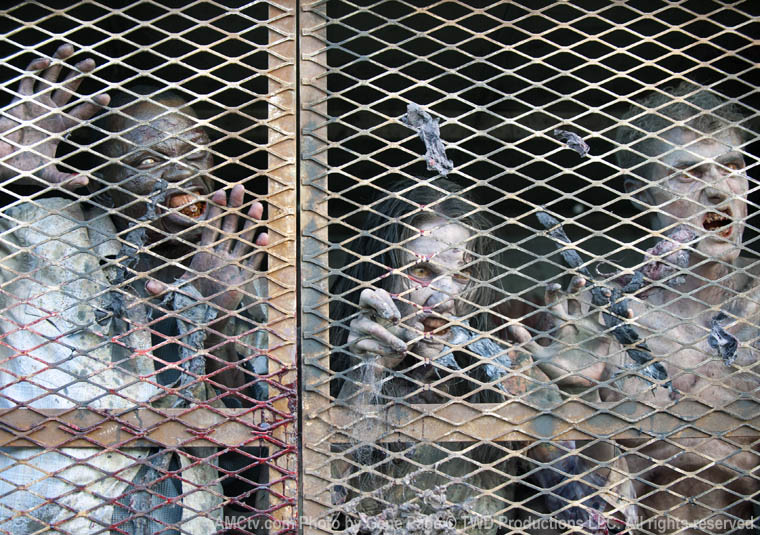
AMC’s The Walking Dead, now in its third season, centers on Rick Grimes (Andrew Lincoln), a former deputy sheriff from Georgia leading a small band of survivors to safety in the aftermath of devastating zombie apocalypse. Called walkers (they roam endlessly and never tire), the moaning, decaying, zombies are a deadly lot, as they shuffle in wandering herds, seeking live flesh. The first two seasons, a ratings and critical smash, showed Rick and a diverse band of survivors seeking safe refuge while fighting walkers, other survivors, and each other. The Walking Dead is loosely based on the comics of the same name, and uses it as a springboard rather than adhere to it faithfully; this approach enables plenty of twists, surprises, new characters, and red herrings.

Law-and-order man Rick Grimes has the heart of a lion, a classic good guy so pure in his outlook and valiant in his mission he’s more like a knight from a medieval tale or a hero from a Greek myth. Joining Rick are his pretty wife Lori (Sarah Wayne Callies), his pre-teen son Carl (Chandler Riggs); Daryl (Norman Reedus), a redneck archer/tracker/outdoorsman and Rick’s wingman; Glenn (Steven Yeun), a Korean delivery boy turned resourceful street rat; T-Dog (Irone Singleton), a tough, stocky black guy; Carol (Melissa McBride), a gentle widow, having lost her husband and daughter in seasons one and two; elderly Hershel (Scott Wilson), an upright, religious country vet in whose farm the survivors sought refuge; Hershel’s two daughters Maggie (Lauren Cohan), romantically linked with Glenn, and the emotionally-troubled Beth (Emily Kinney); Andrea (Laurie Holden), a former lawyer, whose character developed over the first two seasons from a jangled bundle of nerves to a straight shooter; and the newest addition, the mysterious katana-wielding Michonne (Danai Gurira).

In last season’s exciting finale, “Beside The Dying Fire”, the walkers overran Hershel’s farm, killing his daughter and son-in law, and exiling the hapless survivors. Separated from the group, Andrea is saved by the laconic Michonne, while Rick asserted his indisputable leadership (or “Rick-tatorship”, as fans are calling it).

In season three’s premiere, “Seed”, the slam-bang pre-credits sequence opens with a twisted mockup of Lost, where the camera spirals away from a walker’s eye – cold, reptilian, lifeless. Seeking refuge, Rick and the survivors burst into a simple country house. Fanning out like a well-oiled SWAT unit (including Carl), they secure the house by killing that walker and other undead inhabitants. Just as they settle in, T-Dog spots a herd of walkers converging on the house. The survivors grab their gear and flee…

Later on, while hunting food, Rick and Daryl spy the prison shown in last season’s “Besides The Dying Fire”. Realizing its potential for refuge, Rick devises a plan with the group to clear the yard of walkers and break into the prison (the second time this episode where we see the survivors work brilliantly as a team). Reveling in the safety of the prison yard, they whoop and holler with joy at the open space. In the morning, they clear out a ravaged, overturned cell block and settle in.

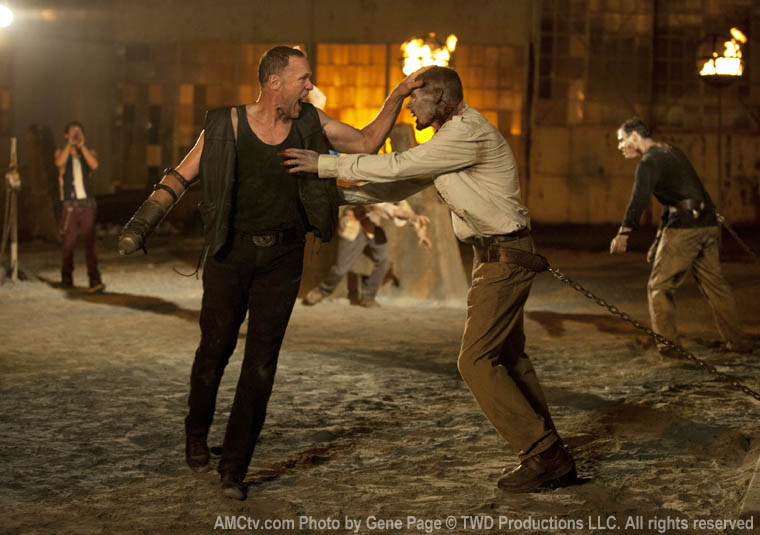
Meanwhile, we get our first glimpse of Michonne since her brief introduction last season. Entering a dilapidated pharmacy in a small town, she coolly beheads walkers while finding aspirin for Andrea, who is sick and resting safely in a nearby meat locker. Andrea urges Michonne to abandon her, but Michonne refuses. Then the two women along with Michonne’s two chained, pet-like, armless and jawless walkers set out.

Back in the prison, the survivors find an ammunition stash and prepare to clear out the rest of the prison, in hopes of finding the cafeteria and infirmary. Armed and ready, they light the way through the unlit, ghoulish cell block by flashlight, stepping over bloody and decaying corpses while Glenn marks their trail with spray paint. At the far end of the block, they stumble into walkers; in the ensuing chaos, Glenn and Maggie separate from the others; Hershel backs up to locate them and is bitten in the leg by a walker. Reuniting, the group quickly finds safety, where Rick, in an attempt to halt the spreading infection, unsheathes a hatchet and amputates Hershel’s leg below the knee. Hearing noises, they look up, and realize they are not alone; they are being watched by live prisoners… Continue reading

A Revolution Comes To TV

In the new NBC series Revolution, viewers are presented a world fifteen years from now that is in a new Dark Age. In the opening scenes of Revolution’s pilot, the electricity throughout the world abruptly fails. Moments before this event happened Ben Matheson (Tim Guinee) races to his home and warns  his wife Rachel (Elizabeth Mitchell) and their two children about what will happen. He also manages to phone his brother Miles (Billy Burke) about it just as the lights go out everywhere in the world. Viewers got a quick glimpse of the immediate impact of this blackout as airplanes fell out of the sky and cities plunged into darkness. Revolution jumps ahead fifteen years later to a radically changed world. Without electricity, governments collapsed and militias took over as everyone struggled to survive with the bare necessities. Ben is now living in a small, rustic community in Illinois with his teenage children Charlie (Tracy Spiridakos) and Danny (Graham Rogers) and a new lover Maggie Foster (Anna Lise Phillips).

Their humble existence is interrupted with a visit by militia men, led by Captain Tom Neville (Giancarlo Esposito), belonging to a local tyrannical power called the Monroe Republic. Neville was sent by the Republic’s despot General Sebastian Monroe (David Lyons) to conscript Ben. During a melee Ben is killed and Danny is taken prisoner by the militia. Before Ben died he entrusted an amulet to Maggie and his friend Aaron Pittman (Zak Orth), which is capable of generating small amounts of electricity. What this means has not been revealed nor what caused the blackout. On Ben’s dying advice Charlie, Maggie and Aaron travel by foot to the decaying city of Chicago and recruit Miles for help in liberating Danny.

As the series progresses, viewers learn bits and pieces about the world and the characters. It was revealed that Miles was once friends with Monroe and was, in fact, a founder of the Monroe Republic. Now Miles has broken ties with Monroe and exists as a cynical Han Solo type until dragged into the limelight by Charlie and company. Monroe wants to have the power restored to spread his reign and he knows that Ben had knowledge about what caused the blackout. A plot development revealed that Rachel is still alive and Monroe’s prisoner. He intends to use her captured son as leverage to get her to reveal what she knows about the blackout. Also in reference to the show’s title, it turns out that there is a revolutionary movement among some people the main characters encounter to restore the United States. Peppered throughout the episodes are interesting flashbacks that show the immediate aftermath of the blackout, taking place days, even months after the event. The most touching one featured Maggie, who is British. In her story it’s revealed that she is cut off from her children in England and she tried for years to get back to England before giving up. Despondent and suicidal, she was found by Ben and his children sometime after Rachel was taken prisoner and Maggie became part of the family. At times, these flashbacks are the most interesting scenes in an episode.

Admittedly, Revolution has constant plot developments but the show is not overwhelming and things are kept at a fast pace that moves the overall story along. Many character have intriguing backgrounds and developments such as the revelation that Miles helped form the Monroe Republic and is hated and feared by many. The show took a daring step by unexpectedly killing off one of the main characters, a victim of a knife wound. This showed that the greatest dangers in this new Dark Age can come from fairly mundane and presently treatable ailments. The production design is very excellent and illustrates a world where nature is reclaiming the land as vegetation engulfs cities and towns. The credit for Revolution’s well presentation should go to series creator Eric Kripke (who created Supernatural), who serves as executive producer along with Iron Man’s director Jon Favreau and J. J. Abrams.

However, Revolution does have flaws. Sometimes Charlie is annoying, and how is it that Aaron (formerly a Google executive) is still overweight and seems to have no clue on how to survive in a post-apocalyptic environment? One would think that in the years since the blackout the characters would’ve been hardened and learned some survival skills. Drinking games can be made to how many times the roguish Miles threatens to leave the group or Danny’s many failed escape attempts. Why not keep that teenager shackled up in chains? But these seem to be the typical growing pains that every series goes through and the show seems to be getting stronger with each passing episode.

At first glance Revolution seems to borrow heavily from popular post-apocalyptic yarns like The Postman and obviously S. M. Stirling’s Emberverse books. But the series is setting its own fascinating mythology that hopefully the network will allow to play out to a satisfactory conclusion.

José Soto

Recast Daredevil


Bit by bit, Marvel Entertainment is reclaiming its film properties under their own Marvel Studios. The latest acquisition is the blind superhero Daredevil. As recently as this summer Fox, who had the rights to the Daredevil property, tried to greenlight a Daredevil reboot but were unable to pull it off.

Whether or not Marvel Studios will launch their own reboot remains to be seen, but it seems likely given Daredevil’s popularity. Obviously Ben Affleck and the original cast won’t reprise their roles so who would be the best choices to play Daredevil and his gritty supporting cast? These are some possibilities:

 Ben Urich: The hard-nosed Daily Bugle reporter and Daredevil ally needs to be portrayed by someone who exudes integrity and intelligence. Tony Shalhoub should be offered the role in a Daredevil reboot.

 Stick: Daredevil’s blind mentor and sensei who taught him how to fight and use his extraordinary senses was a genuine old bad ass. Many online fans have opined that Scott Glenn would make a great Stick and frankly they are correct.

Bullseye/”Benjamin Pointdexter”: The mysterious master assassin and skilled marksmen is Daredevil’s deadliest adversary. The best actor for Bullseye has to give off a psychotic, vicious presence. He is someone who can be terrifying with his nihilistic demeanor and ability to make anything into a weapon. Jackie Earl Haley, who played a rebooted Freddie Krueger and Rorschach in Watchmen, makes a perfect Bullseye.

 Kingpin/Wilson Fisk: Daredevil’s greatest and most insidious enemy is a rotund powerhouse and master crime lord. Michael Clarke Duncan was an excellent Kingpin in Daredevil, sadly he’s no longer with us so he cannot reprise the role in a Daredevil reboot. Among the many other choices left to play the Kingpin, Philip Seymour Hoffman is the top pick (assuming he’s willing to shave his head or at least wear a bald cap), the actor is large and can do menacing villains, plus he’s one of the best actors around.

 Elektra Natchios: As a master assassin and Daredevil’s conflicted lover, Elektra needs to be played by someone who is strikingly beautiful and athletic. The wrong choice will doom the character from the start. That is one reason many say the original Daredevil didn’t work. There are plenty of superb candidates out there but Olivia Wilde is a dead ringer for Elektra. Tron: Legacy showcased her talents, looks and athletic prowess so she can do the role in her sleep.

 Karen Page: At first seen as a traditional secretary who later became Matt Murdock’s girlfriend, Karen Page has had a tortured history in the comic books. She eventually fell from grace, became a junkie who sold out Murdock’s secret identity before finally being killed off. She’s a tortured soul who needs to be portrayed by an actress who is beautiful and can do pathos. Emilie de Ravin, as seen on Lost, can break ground by bringing Karen Page to life on the big screen for the first time.

 Foggy Nelson: Matt Murdock’s law partner and best friend, Foggy seemed like the comic relief sorely needed by the grim comic book. But the slightly overweight lawyer was written as a complex, sympathetic person and one of Murdock’s strongest allies, who was often there for him when times were tough. Foggy Nelson shouldn’t be played strictly for laughs; check out the extended cut of the original Daredevil to get an idea of how he should be portrayed. For that reason, fan favorite Greg Grunberg seen in Alias and Heroes is an excellent pick for Foggy Nelson.

 Daredevil/Matt Murdock: Casting the blind superhero isn’t an easy task. Directors can’t just go with any stud actor. The person to take over the role of Matt Murdock from Ben Affleck needs to present viewers with a man possessing inner toughness, while having a conflicted nature. At the same time, this actor has to be able to pull off the lawyer act, in other words, he needs to be believably smart and convicted. At one point, one of the assigned directors of Fox’s failed reboot was interested in Tron: Legacy’s Garrett Hedlund. Although he’d be fine as Murdock, a better choice would be James Badge Dale. For comparison check out his roles in 24 (he played Jack Bauer’s junior partner in season three), The Pacific and Lexicon. Dale has all the qualities needed to play Matt Murdock and Daredevil.

The following enemies while not as prominent as say Bullseye would still make interesting secondary foes in a Daredevil reboot. The right casting and writing would make them very memorable. Also, the evil ninja group The Hand must make an appearance at some point in a reboot.

The Gladiator/Melvin Potter: Dwayne Johnson

Mister Fear/Larry Cranston, Alan Fagan: Bob Odenkirk

The Owl/Leland Owlsley: Oliver Platt

The Purple Man/Zebediah Killgrave: Robert Knepper

Typhoid Mary/Mary Walker: Milla Jovovich

José Soto

Humanity Vs. Vampires: Our Advantages, Their Weaknesses

In many forms of media, vampires have been feared by humans and for good reasons. But one frightening element about them is their physical superiority to mere humans. Vampires in most stories possess superhuman strength, speed and reflexes. They’re also semi-telepathic and can fly, not to mention are nearly immortal. Recent tales have vampires living in complex secret societies and only tolerate humans who they consider to be glorified cattle.

So if it came down to it, how would humanity fare if vampires decided to take over? Well it wouldn’t be an automatic victory for vampires.

Think about it, sure vampires have all these fantastic powers but they have a severe weakness­­ ­— they’re vulnerable to sunlight. At best, as in the original Dracula novel, vampires while able to survive in the daytime are very weak. At worst, see an episode of True Blood or Being Human were vampires literally burst into flame when exposed to sunlight. If they were to actually exist that could be why they haven’t come out and conquered us. If there were an open war between humans and vampires, humans only need to wait until dawn to open coffins containing the vampires and expose them to direct sunlight. One thing that sunlight contains is ultraviolet radiation. Perhaps that radiation can be weaponized for night battles.

They have other weaknesses as well. Traditionally, they’re sensitive to garlic, holy water and religious symbols like crosses. Modern vampire tales like those written by Anne Rice have it that those so-called weapons are useless and have no effect on vampires. In Stephen King’s Salem’s Lot, it’s stated that for a cross to work, the human bearing it must have religious faith. However, vampires in modern tales are still vulnerable to wooden stakes and sometimes silver (as seen in True Blood where the metal is used to incapacitate the night creatures).

Aside from sunlight and wooden stakes, a good beheading is a guaranteed way to kill vampires. Just ask the Winchester Brothers in Supernatural. In that TV show, beheadings are the only way to kill vampires, which early in the show’s run were considered an endangered species.

Movies like Blade and The Lost Boys feature heroes who come up with unique and clever adaptations of vampire weaknesses. For instance, the young heroes in The Lost Boys filled up ordinary water guns with holy water. Let’s not get into how formidable Blade was with his weapons. He was a bonafide one-man army against the undead with all the stabbing weapons and guns. In True Blood and the books the show is based on (known as The Southern Vampire Mysteries by Charlaine Harris) vampires openly exist alongside humans, so police and militia groups routinely use wooden bullets against vampires along with silver. In one of the recent episodes when the Vampire Authority began to run amok, a human general threatened them. He revealed that humanity’s armies had already devised weapons to be used in the event of a war with the undead. Viewers got a taste of what a war would look like in second season episodes of True Blood where a radical, armed religious group threatened to wipe out vampires.

So if a state of war were to occur, humanity though physically outmatched has many aces up its collective sleeves. It’s been implied in many modern stories that humans far outnumber vampires which is one reason why they haven’t tried to conquer the planet. In the case of war, the huge numbers of humans will be a decided advantage and don’t forget that time and time again, we have shown an ability to adapt and refine battle tactics.

Probably the only way that vampires can counter humanity is in the form of a fast spreading virus. There are many page-turning books about a world overrun by vampires. The most famous one is Richard Mathesen’s I Am Legend, which was adapted three times into film. In I Am Legend, a pandemic is responsible for turning Earth’s population into vampire-like creatures. Other recent books that explore this theme of a virus transforming people into vampires are Justin Cronin’s The Passage and The Strain by Guillermo Del Toro and Chuck Hogan.

The recent film Daybreakers is also about a world where a virus transforms humans into vampires. The outbreak was so severe that in the space of a few years, vampires had overrun human civilization, reducing the few humans left into cattle.

But unless a virus  quickly devastates humanity in the same way as shown in I Am Legend, don’t be so sure to count out humanity if war broke out against vampires. Sure one on one, a human probably cannot beat a vampire but it’s being demonstrated in these tales that a vampire can lose.

Waldermann Rivera

The Final Chapter Of Fringe Is A Bold Departure

The fifth and final season of the TV show Fringe premiered this past weekend and it’s a radical departure from the previous four seasons.

In last season’s episode “Letters Of Transit”, the show deviated from its normal format, which is normally about a federal team that investigated bizarre science phenomena. Instead “Letters Of Transit” jumped ahead to the year 2036 and presented a world taken over by the enigmatic Observers. These unusual, telepathic, bald-headed men in black suits have appeared in every single episode of the show, often in the background unnoticed. It was eventually explained that they were humanity’s descendents from a far future where the Earth had become uninhabitable. This was why they arrived in 2015 and conquered our society as was shown in a dream sequence at the beginning of the fifth-season premiere episode “Transilience Thought Unifier Model-11”.

It seemed as if “Letters Of Transit” might’ve been a special one-off episode but by the end it was clear that many questions were unanswered and there weren’t any resolutions. Clearly Fringe‘s producers intended to continue the story, which was a huge risk because at that time the show was nearly cancelled. Luckily, the gamble paid off and Fringe was renewed to conclude the storyline.

However, from looking at “Transilience Thought Unifier Model-11” it is apparent that the rest of the show will take place in the future. Though the head-spinning cases that the Fringe Team worked on may be gone and their agenda has drastically changed, the beloved characters are still around. Daffy Walter Bishop (John Noble), his son Peter (Joshua Jackson), and FBI Agents Olivia Dunham (Anna Torv) and Astrid Farnsworth (Jasika Nicole) were kept in suspended animation and thawed out to speak to help save the world from the Observers.

Regarding the Fringe Team, viewers were still treated to its quirky nature and saw new nuances to their characters. Walter Bishop still calls Astrid by various nicknames and continues to be absent minded. Meanwhile, Peter and Olivia wrestle with guilt over not being able to stop the Observer’s invasion back in 2015 and losing their daughter during that time. Now reunited and aided by Peter and Olivia’s grown-up daughter Henrietta (Georgina Haig), the team is forced to work in the dystopic New York underground and come up with a way to defeat the Observers.

The world they come into isn’t brave but new and disturbing. The Observers are everywhere and maintain an iron grip on the world with their advanced technology. Expression and free will are discouraged as humanity is slowly being ground under in a police state. Many aspects of the world (represented by New York City) seem the same but with more advanced technology and a feeling of decay setting into civilization. One startling image was that of New York’s Central Park, which has been paved over and turned into a huge processing plant to pump carbon monoxide into the atmosphere. It turns out our air is too oxygen-rich for the Observers.

It was intriguing to see in these two future episodes how things change in the future. Whereas before, Fringe presented a parallel Earth in some episodes for fans to wonder over that world’s differences from ours, this time we learn about our future. If the Fringe Team manages to defeat the Observers, and they probably will, one can only imagine what will be shown as Fringe concludes. Even though the show now takes place in 2036, hopefully more flashbacks to the modern era will be shown. This bold departure in the show’s format is a bit startling but very welcome and illustrates Fringe‘s dynamic nature.

Lewis T. Grove