Grieving & Lost Hope On The Walking Dead

beth-walker-by-russell-kaye

The pre-credits scene of episode eight of The Walking Dead, “Nebraska,” picks up at the previous episode’s conclusion. Ex-sheriff’s deputy Rick Grimes (Andrew Lincoln) lowers his gun after shooting the young Sophia (Madison Lintz) -who, unbeknownst to the survivors – was a walker and locked up in Hershel’s (Scott Wilson) barn with the other undead. As Carol (Melissa McBride) sobs over her daughter, the survivors stare in shock at the girl’s crumpled body. Shane Walsh (Jon Bernthal) – who busted open the barn door to free the walkers – is initially speechless but snaps out of it, boiling inside. Shane vents his anger on Hershel, who he blames for knowing about Sophia but staying silent about it, which in turn a) prolonged the survivors’ stay on the farm, and b) caused them to go on needless, dangerous searches, such as the ones that almost got Daryl Dixon (Norman Reedus), Shane, and Andrea (Laurie Holden) killed. Hershel denies the allegations and evicts the survivors.

Post-credits, it turns out that Shane isn’t alone in his suspicions: Glen (Steven Yuen) confronts Hershel’s daughter Maggie (Lauren Cohan), who responds with fumbling half-answers; Glen leaves it as it is. Daryl tries to comfort the silent and grieving Carol.

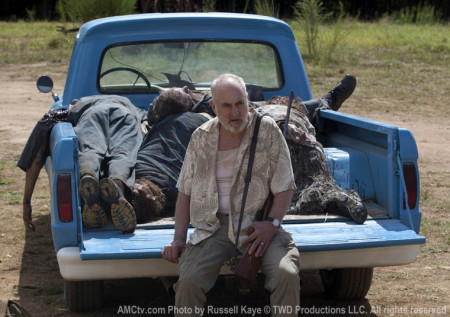
episode-8-dale-and-dead-walkers-russell-kayeThe survivors agree to dig graves for Sophia and Hershel’s wife and stepson, and burn the rest, a herculean task. As everyone gets to work, grumbling over this disgusting job (body parts keep falling off the terminated walkers), Rick broods over his failure to protect the girl. Dale (Jeffrey DeMunn) coldly eyeballs Shane with a knowing stare, causing Shane to explode and launch into an angry rant comparing each one’s contribution to the group.

Hershel presides over the funeral service, and takes it seriously, dressing in a suit and a tie, but not without staring longingly at his flask. Noticeably absent from the service is Carol, telling Lori Grimes (Sarah Wayne Callies) that the thing in the barn wasn’t her daughter but a different creature.

Hershel’s other daughter, Beth (Emily Kinney), in the meantime has taken ill, and is somewhat catatonic, but even odder is that the tee-totaling Hershel left his flask on his dresser and disappeared; the survivors presume he is at the town bar. Rick sets out with Glenn to find him and bring him back to check on Beth…

Please click on the link to Deadloggers to continue reading about Episode Eight

Evan Rothfeld

2012 Doomsday Scenarios: Month Two

We’re in the middle of the cold and flu season but the next big pandemic is just around the corner. In fact, many doctors and scientists say we’re overdue for one.

Doomsday Scenario No. 11: The Killers Within
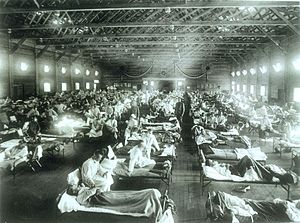
The idea of a pandemic is terrifying and in recent years we’ve dodged the bullet with the onset of AIDS, Ebola, SARS and recently with the H1N1 virus. The last really major pandemic that humanity faced was the Spanish Flu that occurred during World War I in 1918 and killed roughly 50 to 100 million people worldwide. The disease was so widespread and lethal to soldiers that many feel that the disease helped end the war. It is still considered to be the worst modern pandemic to strike humanity. The other horrible pandemic that threatened humanity further back in history was the Black Plague that wiped out a third of Europe’s population in the middle ages. But history is littered with waves of pandemics from assorted diseases like smallpox, typhus and many flu variants. Due to medical advances, we as a whole have been lulled into complacency until very recently. But recent events show that we are still vulnerable. Many fear that soon our antibiotics and other medicines will fail and we’ll be vulnerable to mass death just as our ancestors were.

Add to this fear is the specter of biological terrorism. This threat is all too real as seen with the anthrax terror attacks in 2001. It’s very feasible that some nut can obtain a rare flu strain or a manufactured disease and find a way to spread it to the populace.

Quarantines and Breakdowns

It’s all too easy for our society to fall apart in the wake of a deadly pandemic if a cure or treatment isn’t quickly found. With modern transportation, diseases can spread rapidly and before the medical community is fully mobilized, the contagion could have manifested everywhere.

Social norms will be frayed as the disease spreads. People will demand quarantines and closed borders but that won’t do anything to stop the disease. Nevertheless, fear and distrust will worsen with the new migrations of those wanting to avoid contracting the disease. Unfortunately, many of these refugees will be carriers themselves. Additionally governments will try to futilely treat victims and provide adequate health services. It’s easy to imagine hospitals and care centers guarded by mobilized soldiers, who would also enforce curfews and quarantines. But eventually public services will shut down as the death toll climbs. With fewer and fewer guards, cops and soldiers to enforce the law, anarchy follows and thugs will gain control. Once the disease has run its course, there won’t be much of anything left. Humanity will be forced to rebuild.

Fictional Examples Of The Aftermaths
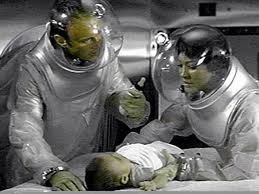
Such fears have been the basis of many science fiction films, books and shows that postulate on the impact of a true pandemic today and the aftermath. The basic storyline usually goes like this: a disease wipes out 99% of the human (and sometimes animal) population. A handful of survivors then struggle to rebuild civilization. Other times, the story is about the valiant efforts to contain an exotic disease before it spreads.

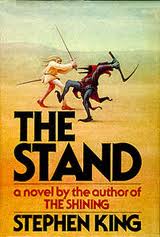
Some popular books that deal with this include Stephen King’s epic The Stand,  Michael Crichton’s The Andromeda Strain, Richard Matheson’s I Am Legend, Max Brooks’ World War Z , George R. Stewart’s Earth Abides, and most recently with Clemens P. Suter’s Two Journeys.

There are many films that deal with this subject. For example there are three adaptations of I Am Legend (the first being The Last Man On Earth and most recently the 2007 Will Smith version), which is about a plague that turns most of humanity into vampire-like creatures. In 28 Days Later (and its sequel) a man-made virus is accidently released that turns its victims in the U.K. into savage, zombie-like killers. Then there is George Romero’s film The Crazies about a bio-weapon that induces homicidal madness. The Andromeda Strain, about a scientific team trying to eradicate a supposedly extra-terrestrial disease, was made into a film released in 1971 and a recent mini-series. A similar approach was utilized with the 1995 film Outbreak but the disease was less exotic in origin but just as deadly. The Stand was made into a well-received mini-series in 1994 and there are efforts to have a remake done. Twelve Monkeys shows us a future where a disease has decimated the world and the protagonist time travels back to modern times to discover how the disease started. The most recent film about pandemics was Steven Soderbergh’s Contagion, which covers in dismaying detail how our society unravels with the onset of a killer virus.
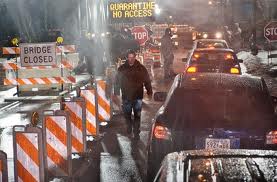
With television there are few examples of a modern pandemic wiping out humanity. Two that come to mind are Jeremiah, which is based on a Belgian comic book, and starred Luke Perry as the title character. In Jeremiah, a plague has killed off most adults in the world and it picks up a generation later when the surviving children have now reached adulthood. The other one is BBC’s Survivors, a remake of a series produced in the 1970s, and the premise was about the usual plague survivors finding a way to work together and rebuild society. UPN’s The Burning Zone wasn’t about a post-apocalyptic world but rather about a team of bio-agents who dealt with deadly, unusual diseases including some engineered by a mysterious group who considered humanity to be vermin that needed to be eradicated by diseases.

Like many doomsday scenarios there isn’t any way to anticipate the onset of the catastrophe.  A pandemic could arrive tomorrow or in a few years, but it will happen. So it pays to be alert and safe though and to wash your hands often.

Sci-Fi Oscar Bias

On Sunday the Academy Awards will be presented and I really don’t care which film wins for best picture because I haven’t seen any of the nominated films. I’ll eventually watch some of the nominees on cable though. But looking at the list, I realize that as usual there isn’t a science fiction film nominated for best picture. Well, The Three Of Life features scenes of the Earth being set afire from our sun going supernova billions of years from now, but that film doesn’t dwell on those described moments. Then there’s Hugo, which has some arguably slight sci-fi elements, namely the dramatization of Georges Melies and his silent film Voyage To The Moon, but Hugo is more of a fantasy film and an ode to early filmmaking.

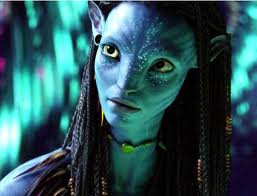
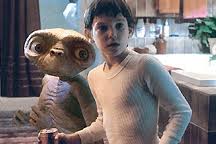
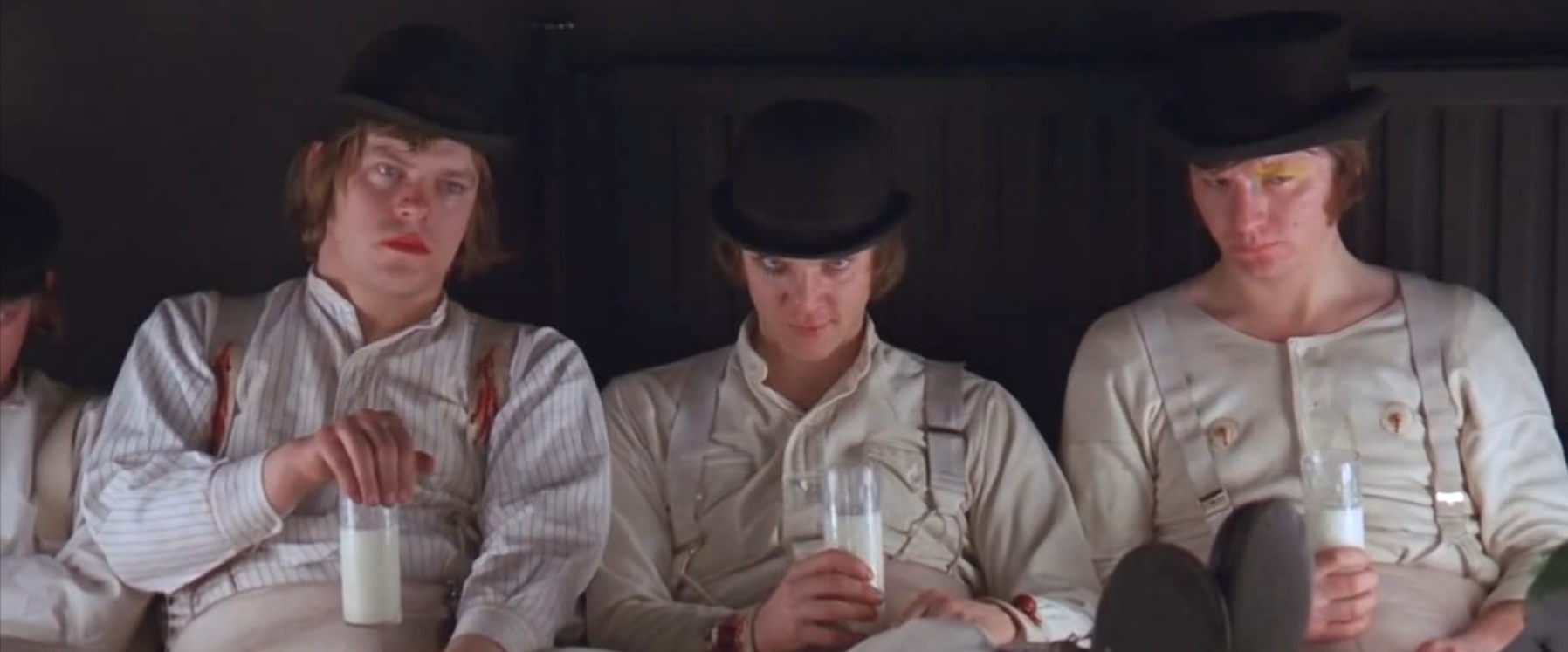
Some research reveals that in the entire history of the Oscars only six science fiction films have been nominated for best film. They are A Clockwork Orange, the original Star Wars, E.T. The Extraterrestrial, Avatar, District 9, and Inception. (On a side note, Inglourious Basterds is considered by some to be science fiction only because its ending establishes the film to be about alternate history.) Sure sci-fi films dominate the technical categories such as special effects and sound, but that’s about it when it comes to recognition from the Oscars.

Films like Blade Runner and 2001: A Space Odyssey have made the top 100 list from the prestigious American Film Institute’s AFI’s 100 Years…100 Movies, yet weren’t nominated for best film in the year they were released. Many other sci-fi films have stood the test of time, while some best picture nominees and winners have been forgotten by today’s audiences. For instance, we continue to talk about The Empire Strikes Back and Back To The Future, yet the movies that won for best picture in the years these sci-fi classics came out are largely ignored (1980’s Ordinary People-IMO, for the record, Raging Bull should’ve won that year; and 1985’s Out Of Africa-not even sure what that movie was about). How about the sci-fi films that were nominated? Does anyone actually believe that Annie Hall is a better film than Star Wars? Sure maybe a bunch of elitist snobs do but despite what George Lucas has done with the saga, the original film has stood the test of time and is a popular as ever. In the case of Avatar, there were stories of many Academy members having an axe to grind with James Cameron and had a rapid disdain for Avatar because of all the computer animation. For my money District 9 was a better film than either Avatar or the winning film, The Hurt Locker. With E.T., it was a better film than Gandhi, but by the time the awards came out there was an obvious backlash against Steven Spielberg’s film.  You can thank the marketing departments that plastered E.T.’s mug on everything at that time. Plus Gandhi was considered more respectable, mainstream and IMPORTANT.

It’s vital to realize that the Oscars are really just popularity/political contests and marketing campaigns among Hollywood insiders who award the statues to sentimental favorites and buddies. The Academy Awards are awash with tales of snubs and cronyism and outright dumb selections which goes beyond sci-fi films. Take the pick of Crash in 2005 over the more popular and more controversial Brokeback Mountain. Or the trite comedy Shakespeare In Love over Spielberg’s classic Saving Private Ryan. That oversight was primarily due to a massive marketing campaign by the former’s executive producers.

Oddly this bias doesn’t extend to fantasy movies because those types of films have received best picture nominations since the 1930s (1937’s Lost Horizon and 1939’s The Wizard Of Oz were the first fantasy films nominated for best picture) right up to this year. One even grabbed the Oscar for best picture nine years ago; that was The Lord Of The Rings: The Return Of The King, which many fans felt was the weakest in Peter Jackson’s trilogy. It should be noted that the bias against animated films is even worse, but that’s another story.

The hostility against sci-fi films by the Oscars is clearly evident and will continue for the foreseeable future.  It’s a shame really, since so many past sci-fi films are considered classics not just by fans but by mainstream viewers and critics. This prejudice may have begun with science fiction’s B-movie origins. But as anyone can tell you, sci-fi films have become more sophisticated and true pieces of cinematic art. Shockingly if you go to online sci-fi forums there are many members who put down sci-fi films and don’t consider them worthy of being nominated. So the bias even permeates among many so-called fans who just can’t see these films past their settings. The bottom line is that the Academy has to get over this bias and join the rest of the crowd. Until then we can only root for an occasional acting nomination or the reliable special effects category. Either that or wait for the Saturn or Scream Awards.

José Soto

Hey Hasbro, Make These Star Wars Toys!


Here’s GEO’s Cool Pick of the Week. Vintage World War II-era Star Wars toys! I came across this website while searching online for  Adam Hughes’ art (BTW I just found out that some of my fellow Starloggers’ articles are popping up on the first page of a Google search, way to go!) and these toys just captivated me.

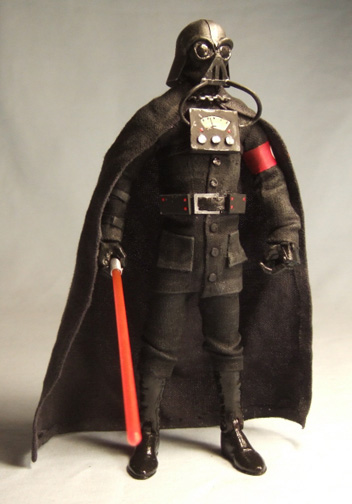
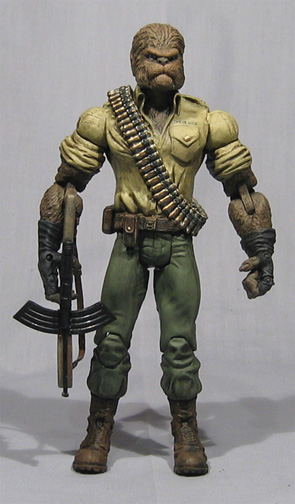
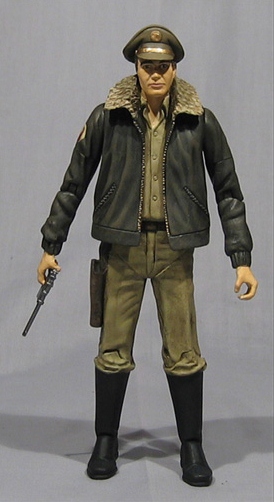
I am really intrigued by this concept created by a toy enthusiast known only as Sillof. These toys are mockups from other toys that are remade into our favorite Star Wars characters as World War II/1930s-era figures. They’re really cool and a retcon of George Lucas’ saga. See much of Star Wars was inspired by the old pulp movie serials like Flash Gordon that played during the 1930s. But naturally, he updated the look of the characters to be more appealing to today’s audiences and it worked.

With these toys, any fan can see the influences much more easily and it is a truly imaginative concept. What if Star Wars had been a movie serial from that era?

My favorite character in this line is Han Solo with his bomber jacket because this toy figure keeps the essence of Han Solo and easily transplants him into the era. I thought the Darth Vader re-imagining was perfect with his stylized gas mask and his chest piece is just awesome. As for Chewbacca, while he looks more human it does illustrate how the wookie would’ve been executed by Hollywood in those days. Chewbacca reminded me of the Wolf Man makeup as worn by Lon Chaney, Jr.

The website links to Sillof’s website where other creative figures are showcased such as Star Wars re-imagined as a western and a medieval fantasy. They’re worth a look and made this fan, who’s a bit burned out on the regular Star Wars toy line , take notice. They’re not on sale but Hasbro and Lucasfilm should seriously consider commissioning a line like this, at least on a trial basis. I’ll bet they would be very popular.

GEO

Abraham Lincoln: Vampire Hunter Has One Whacky Trailer!

Hoo boy, I’ve seen some outrageous trailers and heard of outlandish premises but Abraham Lincoln: Vampire Hunter sets the bar for the bizarre. Based on the mashup novel by Seth Grahame-Smith, it’s produced by Tim Burton and directed by Timur Bekmambetov (director of the kinetic Wanted, a pretty decent adaptation of the comic book mini-series). I’ll be frank and admit I haven’t read the book so I don’t know if it’s a comedy, I hear it isn’t. But this trailer had me peeing in my pants! This was one big WTF!

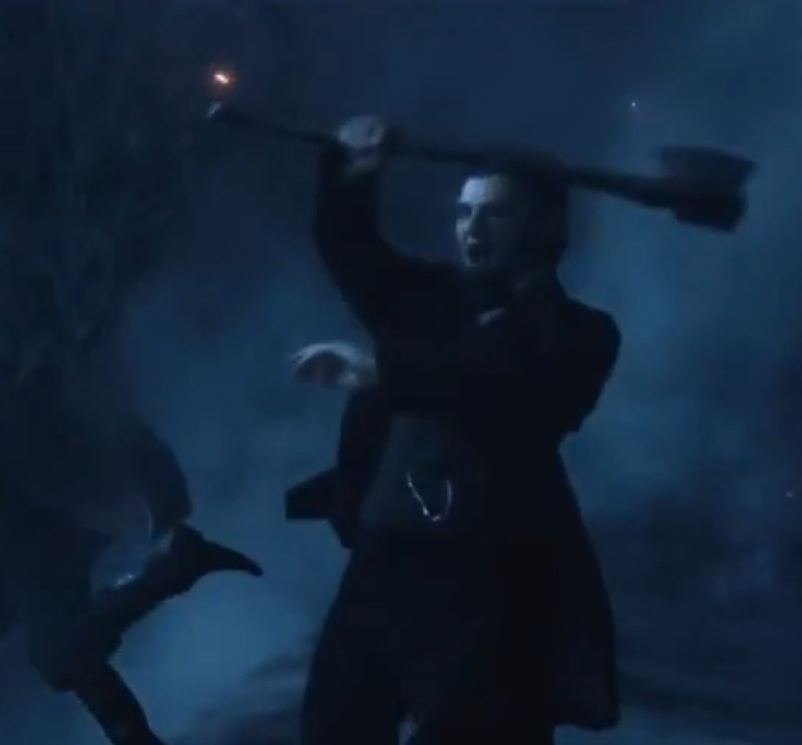
For anyone who hasn’t seen it yet (just click on the link and have a look) it shows actor Benjamin Walker made up as our 16th president doing his usual statesman-like schtick of standing tall and giving speeches. Intermixed are the typical Civil War scenes. But also tossed into the mix are these dark Gothic scenes and slow-motion action shots of vampires and Lincoln doing Matrix-like acrobatics as the Johnny Cash classic “When The Man Comes Around ” plays on the soundtrack. My favorite shots are of President Lincoln swinging that mighty axe and laying waste to the creatures of the night.

Take that Buffy!

When I first heard of the film and book, I didn’t think much. Actually both sounded kind of stupid, with the film sounding like that awful thankfully forgotten flick Young Einstein. But after seeing this trailer, it’s now a must-see summer film. It may wind up being a stinker, but it’s not likely to be forgotten! (Now if only we can sic Old Abe on those Twilight losers. :D)

Waldermann Rivera