It’s The Most Wonderful Time Of The Year…For Trailers!

pacific rim kirk

A fairly recent trend with movie studios these days during the holiday season is to build up excitement for their upcoming releases. This is being done with long-awaited trailers, in this year’s case, trailers for upcoming 2013 movies. It seems that sandwiched in between the big summer conventions with their super-exclusive trailers and clips and the Super Bowl, the best time for fans to first watch trailers is during the holiday season.

In rapid fire, studios are ramping up expectations and satisfying all those who couldn’t make it to the conventions and had to resort to watching bootleg copies filmed on someone’s phone. Forget the Super Bowl, who wants to sit through hours of sports and inane non-genre commercials just to glimpse a brief look at a summer film? It seems as if the holiday season has become the best time to whet fans’ appetites. During summer conventions, the films are far from finished and all that is available are teasers, but by the time the holidays are around, special effects shots are done and if there is something that may not set the world on fire based on reactions, there is still time to tweak the film or the marketing. Sure it’s nothing but Advertising 101 but it works.

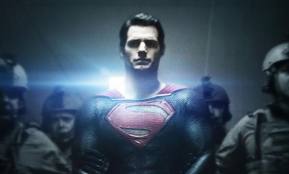
To date, this season has seen newly minted trailers for summer 2013 movies like After Earth, Man Of Steel, Pacific Rim, and Star Trek Into Darkness. One genre film that is coming out instead in the spring is the Tom Cruise vehicle Oblivion and that is one of the most interesting trailers. Evoking a ruined Earth motif and a lonely observer ala WALL-E, the images of nature reclaiming man-made structures are very arresting.

man of steelThe Man Of Steel trailer was a mixed bag, however. Like the teaser released in the summer, it comes off as very pretentious like a Terrence Malick movie but midway through it, the tempo picked up with exciting action shots of Superman. Still many are feeling skeptical being that its directed by Zack Snyder, who has a hit or miss track record. Ditto with After Earth, which stars Will Smith and is directed by M. Night Shyamalan. The director has hit a rough patch with his recent films and is in dire need of a comeback. Will After Earth do it for him? Or will it be The Happening of 2013?

Of course all this oohing and ahhing over trailers doesn’t mean the film will be great. Many of us are still smarting over being let down after all the excitement from seeing the Prometheus trailer that came out last year. At the same time, the trailer released last year around this time for The Avengers was just an average trailer. It wasn’t until spring that the definitive exciting trailer came out that set off a storm of anticipation for The Avengers.

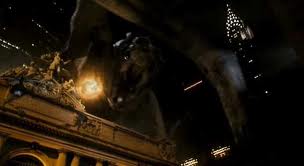
So which trailers are the favorites? That is hard to say, but the spots for Pacific Rim and Star Trek Into Darkness caught my attention. Pacific Rim had those cool giant robots and the entire thing seemed like a mashup of Cloverfield meeting the Transformers. But being that Michael Bay isn’t directing Pacific Rim adds many points to it. It turned out that the recent trailer for Star Trek Into Darkness wasn’t the teaser but the announcement for the teaser which came out today. The trailer was chock full of cool f/x shots, explosions and screaming, the kind of thing Star Trek is famous for, well not really. While Star Trek Into Darkness seems more like an action movie than one about exploration and not about the original spirit of Star Trek, the trailer does make it look exciting.

Now if only the movie studios would only give us a peek at The Wolverine, Kick-Ass 2 and Elysium.

Waldermann Rivera

Star Wars Ornaments Wish List

star wars orns

One popular gift item for the holidays with fans are Star Wars ornaments. Though there are produced by different companies the best ones are those made by Hallmark. They were first produced by Hallmark in 1996 a few years after the success of the Hallmark’s other sci-fifalcon brand the Star Trek ornaments. The first beautifully detailed ship ornament was of the Millennium Falcon and in that same year, Hallmark produced a set of mini-ornaments which consisted of a TIE fighter, an X-wing fighter and an AT-AT.

Since then, the company has released several ornaments each year and there is no sign of slowing down. Many of these ornaments have become highly sought after in the secondary market like the original R2-D2, while others are duds that would be lucky to fetch a buck on eBay (examples of those include Emperor Palpatine and Princess Leia in her slave outfit).

The pattern of these releases per year consists of a strikingly detailed ship, characters and dioramas. The first Star Wars (and Star Trek) ships featured lights but had to be inserted via a wire into a Christmas tree light socket. These days, batteries replaced the wires but for some reason while the Star Trek ships still have light features (except for the NX-01 and the 2012 Enterprise D) the Star Wars ships only have sound features. It’s too bad, because the lights as seen in the Star Trek ships really add an oomph factor and the Star Wars ships seem kind of pale in comparison.

100_4889

The character ornaments look great on trees, even the villains like Darth Vader, and they are much more colorful and eye catching when compared to the Star Trek character ornaments who are basically just humans. With Star Wars, Hallmark wisely utilized the many different aliens and droids in that universe and this could be why the ornaments are so popular. Even the human ornaments are nifty with the same characters being released wearing different outfits or accompanied by exotic companions like the Han Solo ornament with him riding on a tauntaun.

duelThe dioramas themselves are usually topnotch. Some include lights and sounds that capture specific moments from the films like Anakin Skywalker’s duel with Obi-Wan Kenobi in Episode III or when the Millennium Falcon leaves Mos Eisley (that diorama boasts John Williams’ iconic score) in Episode IV. Other dioramas were kind of frustrating, take 2011’s recreation of the Han Solo and Greedo confrontation in Episode IV. We still don’t know who fired first!

Hallmark also released ornaments based on the animated series Star Wars: The Clone Wars and even LEGO Star Wars figures. Undoubtedly with the new batch of films coming up in a few years, there will be ornaments based on those as well.

hp photosmart 720Beginning with 2007, Hallmark had branched out with special, limited edition Star Wars ornaments that were only on sale on premiere weekends. Many of these ornaments, the first being the Tusken Raider, are highly sought after collectibles. But Hallmark raised the ante recently with extra rare, limited ornaments that were only available in conventions. Many of these special ornaments were basically repaints of previously released ornaments such as the K-3PO/R3PO and R2-Q5/R2-A3 sets being C-3PO and R2-D2 painted in different colors. However, Hallmark also put out original ornaments in these conventions of the nefarious bounty hunters IG-88, Dengar, 4-LOM and Zuckuss, as well as Ben Kenobi and Ponda Baba (that alien whose arm got lopped off by Kenobi in the Cantina). All of these extra rare ornaments are hard to find and command a lot of money in the secondary markets.

The success and high value of these rare ornaments are a testament to the popularity of the Star Wars ornaments. Given the diverse nature of the Star Wars universe, there are many ornament ideas to be pursued. Hallmark should consider making these ornaments, as well as those based on the upcoming films:

Characters and Dioramas

  • Obi-Wan Kenobi riding on Boga, that agile dinosaur-like creature with the funky honks seen in Episode III.
  • A diorama featuring Han Solo, Luke Skywalker, Princess Leia and Chewbacca in the trash compactor, and have a feature where the chamber starts to compress!
  • A diorama featuring the Episode II arena battle with the huge beasts.
  • Mace Windu with his purple lightsaber.
  • Watto, who would look at home suspended on a tree branch.
  • The bug-like droidekas seen throughout the prequel films.
  • The MagnaGuards that accompany General Grievous, complete with their buzzing electrostaffs.
  • Admiral Ackbar the Mon Calamari militaryackbar leader who commanded the Rebels in Return Of the Jedi.
  • A diorama featuring Luke on Dagobah with Yoda and a force ghost of Ben Kenobi.
  • A diorama taking place in Jabba’s palace during Return Of The Jedi.

Ships

  • The Y-wing, A-wing and B-wing fighters seen in Episodes IV-VI. It would be really cool if the B-wing fighter’s wings would open and close.
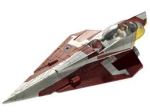
  • Obi-Wan Kenobi’s Jedi starfighter seen in Episode II.jedi fighter They can even have one with the portable hyper space engines.
  • The Mon Calamari cruisers seen in Return Of The Jedi.
  • The Medical Frigate seen in The Empire Strikes Back and Return Of The Jedi.
  • A speeder bike complete with a scout trooper. It would blend in nicely on a Christmas tree since they were shown in Endor’s forests.
  • A Bespin twin cloud car from The Empire Strikes Back.
  • Jabba the Hutt’s sail barge from Return Of The Jedi.
  • Anakin Skywalker’s pod racer from Episode I.

José Soto

2012 Doomsday Scenarios: Month Eleven

earth

Ever since the first atom bomb was detonated people became aware of our capacity to bring about our own extinction. One of the big fears spawning from the splitting of the atom was the likelihood of scientific accidents bringing about our downfall. Being that we’re so prone to making mistakes, it’s easy to worry that such destructive power has fallen on our clumsy hands.

Doomsday Scenario No. 2: Accidents Happen

The idea of a loaded gun given to a child is an apt metaphor of this doomsday scenario. Many people feel that we as a species are developing way too fast in terms of science and technology before we’re ready to truly understand the implications of new discoveries. By that concern, they point to our recent history with nuclear power.

Nuclear Fears

One of humanity’s deepest fears is that of an accidental nuclear weapons exchange. While it’s true the world powers that possess nuclear weapons have stringent safeguards there are the nagging doubt about their reliability. Back in the 1990s after the Cold War ended it became notoriously easy to acquire nuclear weapons from the former Soviet Union. The thought of such WMDs in the wrong hands is horrifying. But there is the possibility of failed safeguards. This was seen in the film and book Fail-Safe where U.S. bombers are mistakenly sent to bomb the Soviet Union. Despite all efforts, Moscow is destroyed and to avert World War III, the U.S. president arranges to restore the balance by having New York City nuked. A similar situation happened in the Stanley Kubrick film Dr. Strangelove but to a more comedic effect. Accidental nuclear war has also been the subjects of many songs like Nena’s “99 Luftballons” (“99 Red Balloons”) or Men At Work’s “It’s A Mistake”. But what is deeply chilling is that many times military personnel and governments almost used nuclear weapons by mistake. One such incident happened in the mid 1990s when a rocket test launched in Europe was mistaken by Russia to be a nuclear first strike against them and Russian leader Boris Yeltsin was urged by his military to launch a nuclear counter-attack.
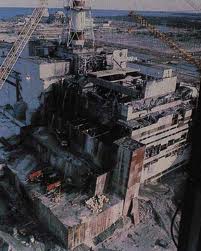
chernobylThen there are the problems with nuclear fission used as an energy source. For the most part, nuclear power plants are safe but the idea of a meltdown and the environmental impact is enough to keep most people leery about them. There was the Three Mile Island incident which thankfully ended well, but on the other hand we’ve had a nuclear meltdown in Chernobyl and most recently there was the Fukushima disaster in Japan. With Chernobyl that disaster left that city abandoned and uninhabitable to this day, while the impact of the Fukushima meltdown is still ongoing with an untold number of people having been exposed to deadly radiation.

Tomorrow’s Experiments

In the world of science fiction, wondrous discoveries and promising experiments often turn into worldwide disasters. In the film The Quiet Earth, a scientist working for a company worked on a global energy grid. What happens next is that the experiment makes all the people, except for the scientist and two other persons, disappear without a trace. At the end of The Quiet Earth, the scientist tries to undo the effect of his experiment but the result leaves him stranded in another reality by himself.

quiet earth

In Kurt Vonnegut’s book Cat’s Cradle, there is an artificial substance called ice-nine which is a type of water that is solid at room temperature. By the novel’s end, ice-nine is accidently released into the ocean which turns practically all the water in the world into solid ice and nearly all life on the planet ends a few days later.

Some scientific experiments and discoveries aren’t as world devastating as those found in The Quiet Earth and Cat’s Cradle, but they come close. In the book FlashForward, an experiment at CERN (European Organization For Nuclear Research) regarding Higgs boson particles unleashes a side effect wherein the entire world population briefly loses consciousness and experiences a few moments of the future. In the TV show based on the book, CERN isn’t responsible for the blackouts but rather a consortium of sinister scientists.

Then there are the dinosaurs of Jurassic Park. In the books and films, dinosaurs are brought back to life through cloning and chaos erupts. The humans are unable to control the dinosaurs in the upcoming Jurassic Park theme park, and this results with the unhindered dinosaurs driving out humans from the park. In the sequel book The Lost World and the film Jurassic Park III dinosaurs are multiplying and beginning to move past their island boundaries. This was dramatically shown at the end of Jurassic Park III when several pteranodons are shown flying out of their island. If dinosaurs were to invade other territories, they would decimate local flora and threaten humanity. Basically our world could turn into a monster film where humanity is at war with giant creatures.

Scientific WMDs

Sometimes the plot lines in these tales has it that the military is secretly testing new weapons or devices with unexpected results. The urban legend about the Philadelphia Experiment details how supposedly during World War II the U.S. Navy performed an experiment onboard the U.S.S. Eldridge to render it invisible but harmed the sailors onboard. A film based on the incident also called The Philadelphia Experiment took the premise a step further and the experiment threatened the Earth when it created a vortex.

The military is also responsible for the catastrophes that ravage the world in the movie The Core. It turns out that after testing a seismic weapon by the U.S. military, the Earth’s core stops rotating, which begins to collapse the protective electromagnetic field  surrounding the world. As the heroes in The Core journey to the Earth’s center to explode nukes that will restart the core’s rotation (!), electromagnetic storms raze the world and structures like the Golden Gate Bridge and the Roman Coliseum are destroyed.

the core 2

This fear about the military experimenting with secret weapons and technology is influenced by their secretive nature and the fact that so little is known about them. Take the H.A.A.R.P. (High Frequency Active Auroral Research Program) project for example. Reportedly, its purpose is to study the ionosphere for applications in advanced communications and surveillance. A lot of conspiracy theorists are convinced that H.A.A.R.P. is being used to create natural disasters like superstorms and earthquakes. Some even claim that it was used a week before the recent U.S. presidential election to create Superstorm Sandy so that the president had an opportunity to appear presidential and win the election. H.A.A.R.P. has also been used in fiction like The X-Files and in several Marvel comics.

Mini Holes and Goo

Some worry that uncontrolled or careless science experiments could lead to the decimation of food, water and oil supplies (in the case of water, this was presented in Cat’s Cradle). But two dominant concerns have arisen about consequential scientific research.

grey gooIn addition to Jurassic Park, author Michael Crichton also penned a book called Prey which was also about technology run amok. In Prey’s case, it was nanotechnology which worries many scientists. Nanobots are recognized as the next step in medical technology. Tiny self-multiplying robots that are invisible to the naked eye can be injected into patients to treat them for cancers and other ailments more effectively than with conventional methods. The same nanotechnology also has other applications but all of this is in the research phase.

One drawback with nanobots is that people may lose control over the self-replicating machines. This would result in out-of-control and rapid propagation. The nanobots will then consume all matter to self-multiply which results in the grey goo phenomenon. In that case unhindered, runaway nanobots will turn everything on Earth into shapeless masses. Grey goo has also covered in other novels like Wil McCarthy’s Bloom and Greg Bear’s The Forge Of God.

Another developing concern has to do with the Large Hadron Collider at CERN, which is the world’s largest particle accelerator. Many fear that the Collider can create mini black holes in the Earth as it collides protons together at near light speeds. Once the miniature black holes are created, they will grow and consume the Earth. However, this hasn’t happened and probably won’t. Scientists believe that any micro black holes will dissipate and actually these proton collisions take place naturally in our atmosphere and we’re still here.

 black hole 2

These micro black holes have plagued several science fiction stories and books like the novel Earth by David Brin is about an artificially created black hole that burrows itself in the planet’s interior which threatens the Earth. Other examples include Larry Niven’s The Hole Man and The Borderland Of Sol, Dan Simmons’ books Ilium and Olympos, and Martin Caidin’s Star Bright.

cern

It was also feared that the Collider would also create strangelets or strange matter. This subatomic matter is largely theoretical but if they were to be formed they would tear holes on our planet. The novel Impact by Douglas Preston has an alien machine that creates strangelets and the TV special End Day featured a scenario where a created strangelet destroyed the Earth.

Sci-Fi Heads Of State


Romney? Obama? Who’s your choice for president? Would you rather choose someone else? Well how about these presidents and heads of state that have appeared in science fiction? Love them or hate them, they were memorable leaders.

The Despotic

Science fiction is probably the best vehicle for showcasing villainous presidents. Look at it this way, few will get offended with these fictional tyrants that star in cautionary tales that take place in dystopian times.

Take President Erwin Rexall in the classic Frank Miller/David Gibbons mini-series Give Me Liberty. Though not the main character in the comic book, his presence in lieu of his harsh policies had an impact on Give Me Liberty’s heroine, Martha Washington. An exaggeration of Ronald Reagan, Rexall was a far-right, callous man who cared little for the average American. His successor, Howard Nissen was the complete opposite, a far left liberal who turned out to be a drunken incompetent. Eventually Rexall has his brain implanted into a robot’s body and continued his presidency after Nissen was assassinated.

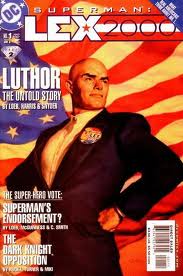
A more infamous president was Lex Luthor as seen in the pages of Superman. Holding the highest office in the land, allowed Luthor to be an effective thorn on Superman’s side. Adding insult was Luthor’s early popularity, though he didn’t do anything to prevent aliens from destroying Topeka, Kansas. Eventually, he fell from grace and power thanks to the efforts of several superheroes.

But more well-known despotic heads of state have been seen on film. The most recent one was Mr. Thompson in Atlas Shrugged, Part II. Played by Ray Wise, Thompson, although never referred to as the president, is the socialist head of state in the U.S. who implements unpopular reforms and mandates that strip away citizens’ rights. Another recent tyrant was President Snow (Donald Sutherland) in The Hunger Games. He wasn’t a prominent character in the book but appears in the film. Seemingly laid back, Snow actually has a sadistic demeanor.

One truly despicable despot was Greg Stillson in The Dead Zone. Based on the Stephen King book of the same name, the hero Johnny Smith discovers with his psychic powers that a local politician (played by Martin Sheen) will become a crazed president who unleashes a nuclear holocaust. The future scenes where he defies everyone’s pleas and launches nukes were quite chilling. The character also showed up in The Dead Zone TV series.

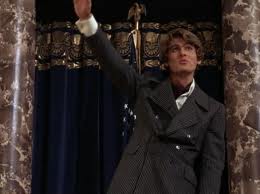
While the U.S. has had youthful presidents (keeping in mind that presidents in their forties like Kennedy or Clinton or Obama are considered young), there was Max Frost (Christopher Jones) in the film Wild In The Streets. A socially conscious and ambitious rock star, Frost manipulates politicians to pass a constitutional amendment that lowers the voting age and when a person can run for president. This allows the youthful rocker, whose in his twenties, to ride a wave into the White House where he becomes a dictator that banishes old people into re-education camps.

The Incompetents

Not all future presidents are dictators, many are just not up to snuff. There was President Chet Roosevelt (John Ritter) in the comedy Americathon where a bankrupt U.S. has to hold a telethon to raise cash. Then there was President Dwayne Elizando Mountain Dew Herbert Camacho in Idiocracy who leads an illiterate nation and is all about style but no substance. By the end of Idiocracy, it falls on the modern-day hero who winds up in that future, Joe Bauers a.k.a. Not Sure, to begin the re-education and salvation of American citizens by becoming president himself. But the most ill-suited president has to be Peter Sellers’ indecisive President Merkin Muffley in Dr. Strangelove.

Leaders On Television

There have been notable presidents or leaders in several sci-fi TV shows. For instance Lisa Simpson in The Simpsons was shown to be president sometime in the future in the episode “Back To The Future”. The most recent world leader was President Elias Martinez in The Event. Skillfully played by Blair Underwood, the president seemed unsure of how to handle the alien refugees the government was holding captive, but by the series’ end, President Martinez became more determined and decisive in protecting the U.S. and the world. The show Jack & Bobby took place in modern times but was framed by bookending commentaries by people in the future. One of the boys featured in the show grows up to become president years into the future. In the anthology show The Outer Limits, one episode “Trial By Fire” featured a newly inaugurated President Charles Halsey (Robert Foxworth), who unexpectedly has to deal with a first contact situation. An alien armada is on its way to Earth and Halsey has to decide if they are friendly or not. President Halsey is wracked with the knowledge that his decisions will severely impact life on the planet.

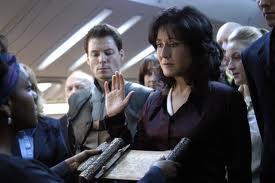
But the best known fictional presidents in sci-fi TV have to be Laura Roslin (Mary McDonnell) and Gaius Baltar (James Callis) seen in the remake of Battlestar Galactica. Roslin was the sole surviving member of the president’s cabinet following a surprise robotic Cylon attack on humanity. Although inexperienced, Roslin quickly grows into her role, becomes presidential and ultimately helps save humanity. Baltar on the other hand is more complex. Best seen as an enigmatic anti-hero, Baltar is responsible for the near extinction of humanity by the Cylons. There were broad hints that Baltar was insane but cunning and he aided the surviving humans. Eventually Baltar defeated Roslin in a presidential election and settled humanity on a habitable world. His presidency was unpopular especially after he surrenders humanity to an invading Cylon force.

Heroic Leaders

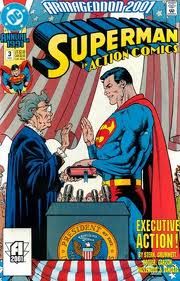
Not all presidents in sci-fi are evil or incompetent. Many were shown in a positive light and were even heroic. Roslin in Battlestar Galactica was heroic during her appearances in the show. Superman himself served as president of the United States in a fantasy “future” story in Action Comics Annual #3. Thanks to his diplomatic skills, Superman/Clark Kent has a successful presidency where he brings about world peace and lowers the deficit (thanks to some help from Aquaman, who dredges up sunken ships laden with treasure).

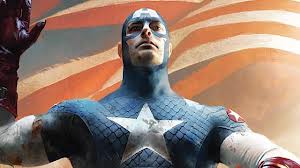
Another potential president was Steve Rogers. In the pages of Captain America # 250 he is approached to run for president of the U.S. but eventually declines. In the comic book What If Captain America Had Been Elected President? # 26, Rogers has a successful presidency, one of his major accomplishments being to make America energy independent. In the mini-series The Last Avengers Story, it’s stated that in the future Rogers becomes president of the U.S. but is apparently killed in his third term. Recently in The Ultimates # 16 the Steve Rogers in that universe is elected president of the U.S.

Other positive presidents seen in movies include Tom Beck (Morgan Freeman) in Deep Impact, who helps the U.S. and the world to recover from a comet strike, and the two Federation Presidents seen in Star Trek IV: The Voyage Home and Star Trek VI: The Undiscovered Country. It should be noted that Captain Jonathan Archer from Star Trek: Enterprise eventually becomes the first President of the Federation. But out of all these fictional sci-fi presidents probably the most heroic one  is President Thomas Whitmore from Independence Day. Patterned loosely on Bill Clinton, Whitmore is a young, beleaguered commander-in-chief who heroically leads the nation in fighting off an alien invasion. Although his military role in the final counterattack against the aliens is implausible it was heroic. Seriously, it is a stretch to believe that one of the few remaining world leaders will be allowed to fly a fighter jet to lead an attack on alien invaders. But he does give one heck of a rousing speech. So would any of these candidates earn your vote?

Lewis T. Grove

2012 Doomsday Scenarios: Month Ten

Among the many well-known apocalyptic worries, the idea of supernatural creatures rising up and destroying our world, while hardly unlikely, captivates many people.

Doomsday Scenario No. 3: Vampires, Zombies & Monsters, Oh My!

Supernatural monsters have been a mainstay in many cultures going back centuries. They were convenient scapegoats for things that went wrong and filled in the dark void of the shadows. These monsters either won so that a moral could be learned or were vanquished by the forces of good. Lately, stories have appeared where the monsters have triumphed and defeated humanity en masse. Certain monsters are more popular than others and fit into a doomsday scenario more easily than others. Of course, these supernatural monsters are impossible, right? Well science fiction has found ways to make them plausible.

Vampires In The Blood

The stylish and grotesque vampires have populated many blood curdling tales for centuries. As true creatures of the night, vampires arose from their coffins after sunset to prey on the living. The way to become a vampire isn’t to just die but to be bitten by one. That suggests that these creatures probably transmit a virus that transforms a living person into a vampire.

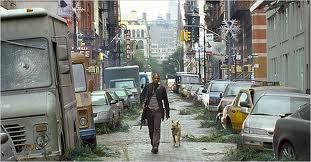
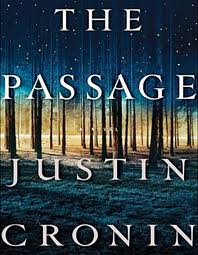
Richard Matheson’s classic novel I Am Legend has a vampiric virus decimating humanity and resurrecting them as vampires and taking over the world. The book and the films based on it (The Last Man On Earth, The Omega Man and most recently I Am Legend) presented us with an empty, decimated world with a sole human survivor and his desperate fight not just against countless vampires but to develop a cure.  There are other works about viruses that turns people into vampires and imperils the world. Two books that come to mind are The Strain by Guillermo Del Toro and Chuck Hogan and The Passage by Justin Cronin. The Passage is set in the near future where a virus quickly transforms most of humanity into vampire-like creatures who take over the world. The anthology novel Under The Fang features several short stories about humanity conquered by vampires.

As for films about vampires ruling the world, in addition to I Am Legend, there was Daybreakers, which took place a few years after a virus turned most of humanity into bloodsucking creatures. Daybreakers showed a world literally turned upside down as the vampire denizens populated major cities, but lived underground away from the sun and basically carried on with their lives. They just needed to farm the few remaining humans for nourishment. A variant of the vampire virus is the sci-fi film Lifeforce, which was based on the book The Space Vampires by Colin Wilson. This time vampire-like aliens were brought back to Earth by astronauts and it wasn’t blood that the aliens fed on. It was the titular lifeforce of people. As an added bonus, many of their victims also became vampiric and hunted humans for their lifeforce.

Zombie Apocalypse

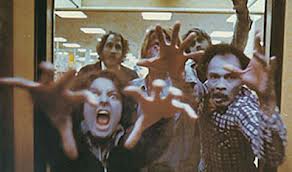
The undead flesh eaters are undeniably the most popular monsters to use for post-apocalyptic tales. Look no further than the hit AMC series The Walking Dead. It wasn’t always so, until the late 1960s zombies were relegated to stale horror yarns usually dealing with voodoo. Then George Romero came along and changed the sub-genre forever. His classic film Night Of The Living Dead gave us a world on the brink of a societal breakdown as undead corpses roamed the countryside and feasted on the living.

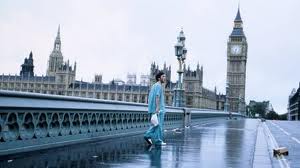
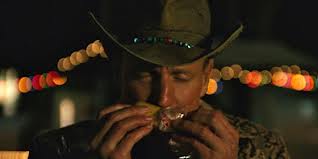
Romero directed sequels that were very popular but the zombie apocalypse genre didn’t reach maturation until around the millennium, which coincided nicely with all the jitters about the coming apocalypse. Video games like Resident Evil, comic books like The Walking Dead, books like World War Z and films like 28 Days Later (not technically about zombies but it follows the same route) reinvigorated and amped up the zombie genre. The zombie apocalypse is so prevalent in pop culture that even the CDC put out  a comic book detailing how they would deal with such an event. Zombies are perfect metaphors for the chaos and decay that will follow the fall of civilization as humans are displaced as the apex predators. Also these stories are useful for illustrating how we would behave during the downfall of society. Will we return to our savage ways? Will we use our pluck and ingenuity to survive? How much stress can we withstand before we break down completely? And how will we find that perfect Twinkie? (Note: see Zombieland for more on that last question.)

Monsters, Etc.

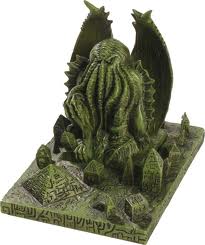
Humanity has always feared monsters as seen in various mythologies. This morbid fascination continued well into modern times with countless books, stories and movies about monsters both large and small terrorizing the world. An often used motif is that of an ancient, slumbering giant that is awoken by modern humans and then wrecks destruction across the world. Godzilla is an excellent example and best personifies the Japanese kaiju films. But Godzilla had predecessors that need to be mentioned. One of the earliest modern imprisoned monsters is the famous Cthulhu first written about in H.P. Lovecraft’s short story “The Call Of The Cthulhu”.  An ancient entity described as part human, part dragon and part octopus, the Cthulhu had a cult that wanted to unleash the giant monster onto our world. This entity has been alluded to in other works by Lovecraft.

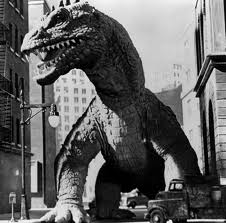
In film, the very first giant monster to be unleashed was the fictional rhedosaurus in The Beast From 20,000 Fathoms. Loosely based on Ray Bradbury’s short story “The Fog Horn”, the rhedosaurus was a dinosaur woken up by a nuclear blast and thus threatened the world not just with its destructive path but by its radioactive emissions. Destructive monsters have since plagued the silver screen with the Japanese kaiju films and American works like Q, Gremlins, John Carpenter’s In The Mouth Of Madness, Reign Of Fire, Cloverfield, The Cabin In the Woods and the upcoming Pacific Rim. In these films, the giants were mysterious and awakened inadvertently by humanity. Once unleashed they outmatched our military might and upended civilization as they destroyed cities and killed many people. Often entire cities and famous landscapes are decimated as seen in Cloverfield. And sometimes it was shown that the monsters won as the misshapen horrors from In The Mouth Of Madness  or the dragons in Reign Of Fire overran the world.