Dinosaurs On The Small Screen

When I saw the new series Terra Nova on Fox I couldn’t help wondering about how many dinosaur-based TV shows there have been. It turns out there aren’t many, which isn’t surprising for the obvious budgetary reason. Here’s a brief rundown of such shows but for brevity’s sake cartoons, documentaries and shows that only had an episode or two featuring the extinct reptiles won’t be included.
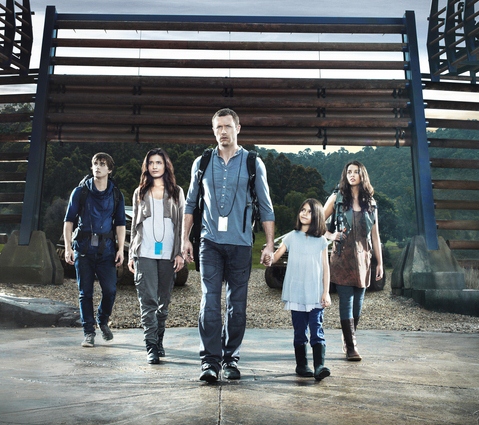
Terra Nova — Currently airing on Fox after numerous delays. The show follows the adventures of a 22nd century family who time travel 85 million years into an alternate past to escape a dying future. They are part of a human colony called Terra Nova and contend with predatory dinosaurs, dumb teenage drama and renegade humans.

Primeval–A BBC program that first aired in 2007 and was recently resurrected. Taking place in Britain, time portals called anomalies appear more and more often throughout the land and deposit confused and rampaging dinosaurs, prehistoric animals and even future animals. The Arc, a research and security facility, is set up with misfits and soldiers who deal with temporal incursions. It was recently announced that a spinoff taking place in Vancouver called Primeval: New World will go into production.

Prehistoric Park–This was a six-part series that aired in 2007 on ITV and Animal Planet was more of a mockumentary that starred Nigel Marvin who played himself. The premise is that a prehistoric wildlife preserve has been set up on an island. Think of it as a successful Jurassic Park. In the show, Nigel time travels to prehistoric periods and rescues animals about to perish and brings them to the present. More often than not he wound bringing unexpected animals.
Dinotopia–Based on the series of books, it was originally a four-hour mini-series that became a show and aired on ABC in 2002. The network pulled the plug after six episodes, which was a mercy killing. In this show, two brothers crash their plane in an uncharted continent where humans and dinosaurs (some are sentient and able to speak) live in harmony.

 Sir Arthur Conan Doyle’s The Lost World–This syndicated show ran for three seasons from 1999 to 2002. Loosely based on Doyle’s classic, it featured Professor Challenger and a group of people who are stranded on a South America plateau that is inhabited by dinosaurs, natives and people in latex makeup. It ended with an unresolved cliffhanger.

Dinosaurs–ABC aired this comedy, produced by Jim Henson Television, from 1991 to 1994. Coming off as a knock off of The Simpsons and The Flintstones, it was your standard nuclear family sitcom complete with the goofball dad, patient mom, wise children and a precocious little baby that kept screaming “Not the momma!” Only these were talking dinosaurs wearing clothes and complaining about humdrum problems. The series ended on a downer as a global catastrophe dooms the dinosaurs.

Land of the LostA personal favorite that first aired on NBC Saturday mornings from 1974 to 1976 and it set the standard. Rick, Will and Holly Marshall are out whitewater rafting and fall through a portal that transports them into an alternate dimension populated by stop-motion and puppet dinosaurs, hairy hominids called Pakuni and evil reptilian Sleestaks. Despite its juvenile trappings and budget the show really shone thanks to high-concept scripts penned by the likes of David Gerrold, Norman Spinrad, Larry Niven and D.C. Fontana. A remake aired in 1991 in syndication for two seasons but it had a lighter tone and wasn’t as memorable. And let’s not get into that Will Ferrell movie.

José Soto
Kennedy Space Center Visitor Complex

About an hour east of Orlando in Merritt Island, the Kennedy Space Center Visitor Complex cannot be called a theme park or a museum but it has elements of both. Like any healthy attraction, it’s constantly evolving and offering something new for visitors. And coming soon, the Complex will be the home for the just-retired Space Shuttle Atlantis.

Even though the shuttle isn’t ready for viewing yet that shouldn’t stop anyone whether they’re a space buff or not from visiting the Complex. There are plenty of displays, exhibits and fantastic presentations. It’s hard to see everything the Complex offers in a single day visit. This was not so in its past and it’s a testament to how the place has grown as a viable attraction.

The basic admission includes the Kennedy Space Center (KSC) Tour, IMAX presentations (many of which are in 3D), the nearby U.S. Astronaut Hall of Fame and the Complex’s grounds.

A popular attraction is the Shuttle Launch Experience, which simulates a shuttle launch for visitors. It’s a lot like the Mission: Space ride at Epcot only without the nausea, but it’s still a rough ride and according to many astronauts an authentic recreation of a shuttle liftoff. Next to the facility that houses the Shuttle Launch Experience is a well-detailed mock up of a shuttle called the Explorer. Visitors ascend a winding staircase to get into the craft’s hangar and further up for the cockpit.  And next to the Explorer are mock ups of the space shuttle’s external fuel tank and boosters, those and the shuttle make for memorable photo ops.

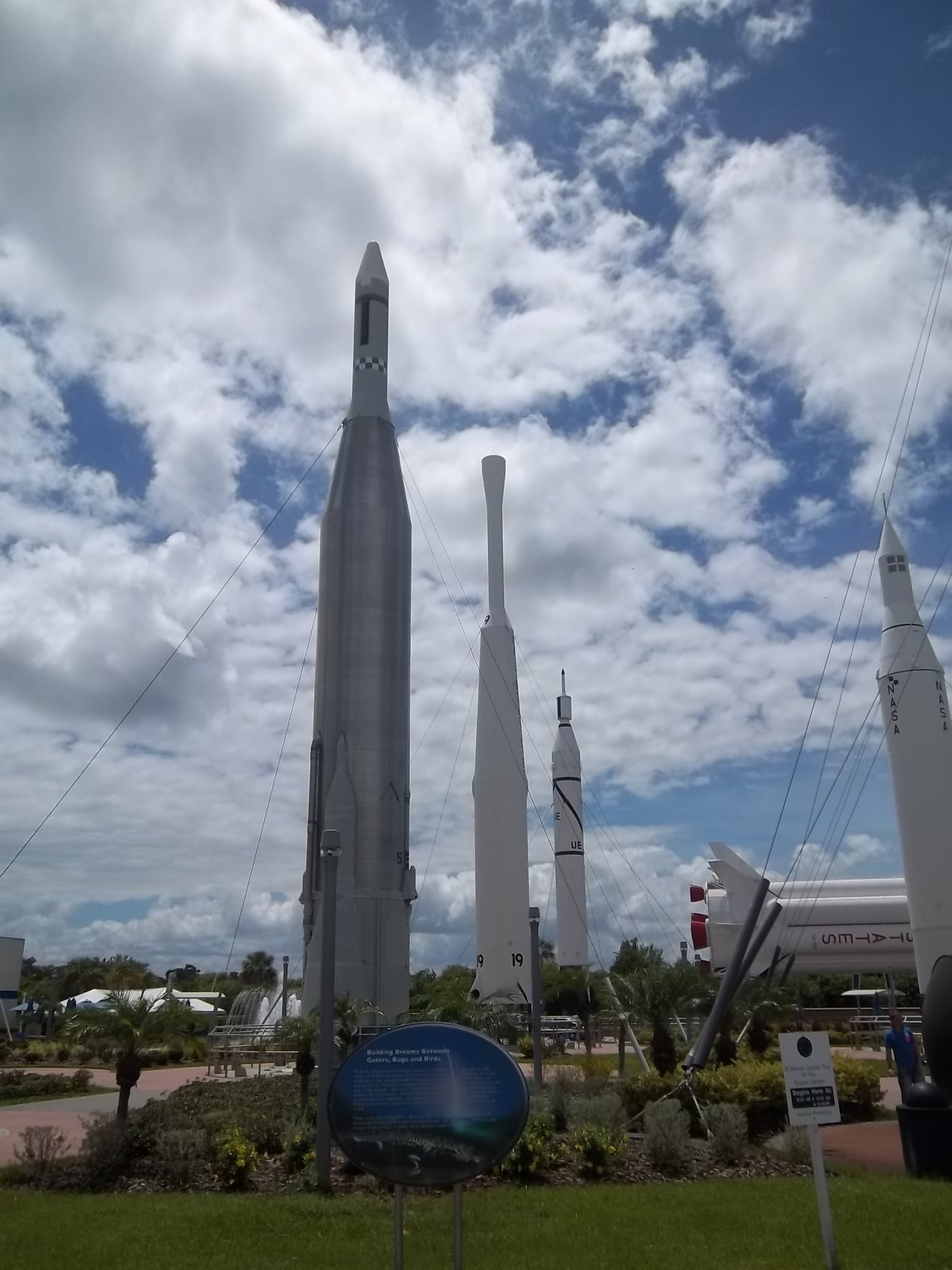
Other places to get photos include the Rocket Garden, an outdoor showcase of the rockets and capsules used during the ’60s. These include the Titan and Atlas rockets (plus a huge Saturn IB) and the Mercury, Gemini and Apollo capsules. In fact, visitors are allowed to climb into the claustrophobic. Nearby is the Early Space Exploration facility that features the actual capsules, artifacts and mission control consoles from the ’60s.

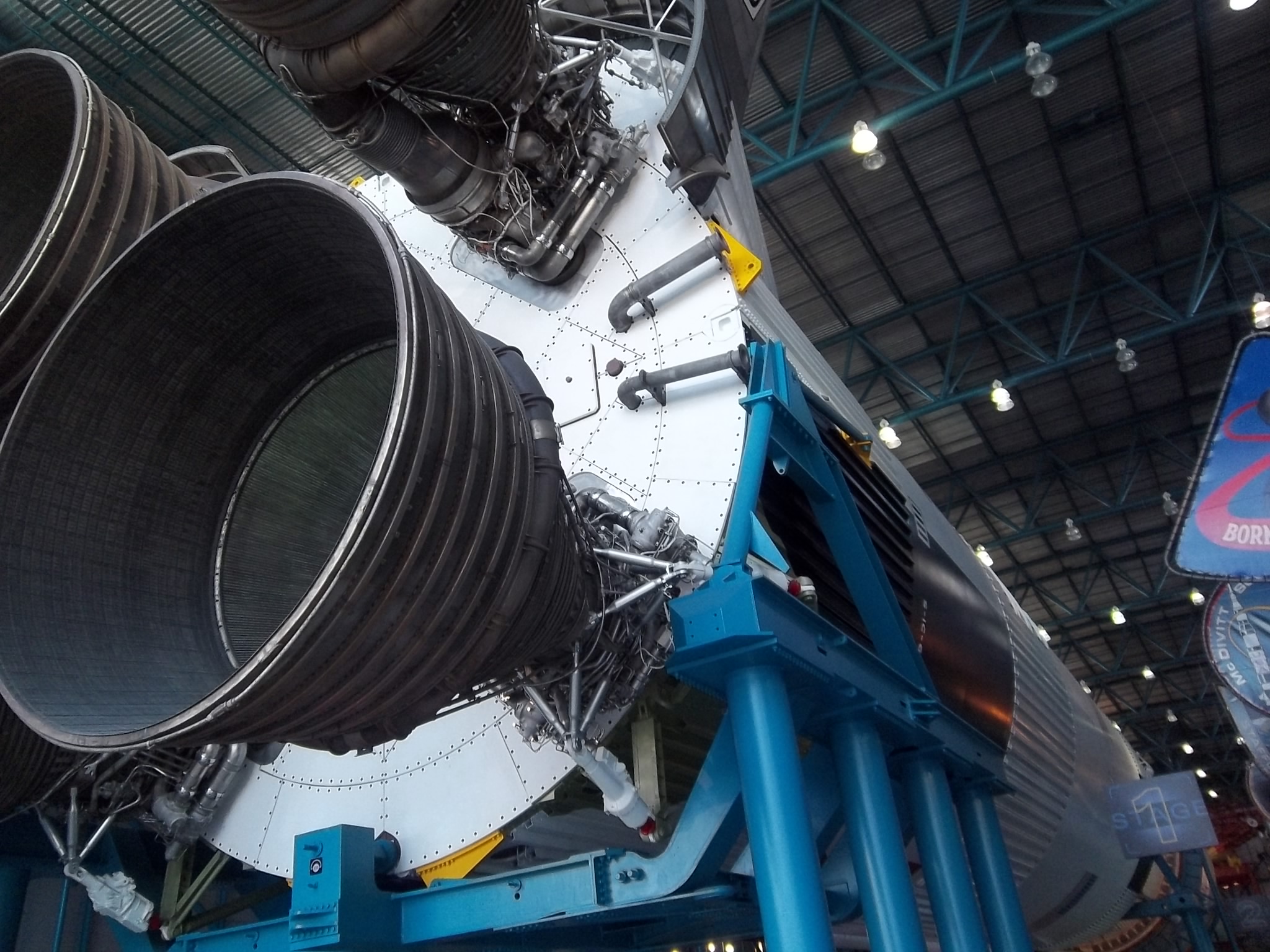
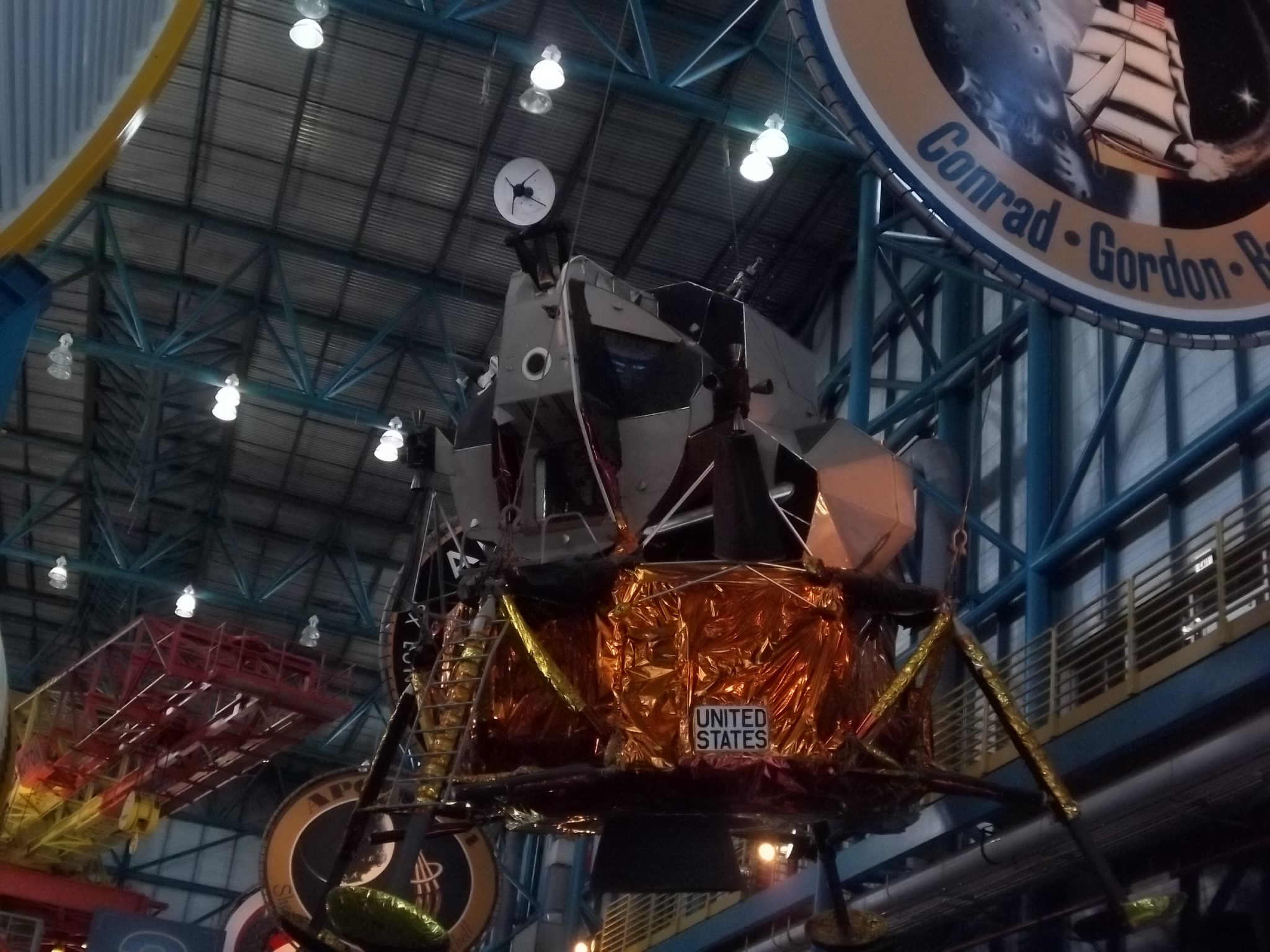
But the highlight of any visit is the KSC Tour. Although in-depth guided tours are available for additional fees, anyone can get a thorough visit with the KSC Tour. Buses at a terminal located off to the right of the Complex’s entrance plaza leave for the tour every fifteen minutes. A short ride will take visitors to the shuttles’ launch pads at the LC-39 Observation Gantry and even glimpse off in the distance the air force’s rocket launch pads. The next and final stop of the tour is a grand finale indeed. The Apollo/Saturn V Center boasts an overhead, mammoth 363-foot-long Saturn V rocket which rivals any giant dinosaur fossil display in a museum. There are also space suits, tools, a moon buggy and even a piece of moon rock that can be touched. Visitors can stay as long as they like in the Center before taking a bus back.

But the Complex isn’t just a place that looks at NASA’s past glories, there are many exhibits and attractions devoted to today’s space exploration. At the Astronaut Encounter Theater, visitors can meet and question guest astronauts. The Theater is also playing through December Star Trek Live, an engaging stage show featuring science facts and a time-travel themed storyline. Elsewhere, visitors can see up-close images from the Hubble Space Telescope or be part of Exploration Space: Explorers Wanted. An interactive, multimedia presentation on the possible future of space travel. There are even play areas in the Complex for children, a nature exhibit, an Astronaut Memorial, an art gallery and of course, souvenir shops.

To see everything at the Complex in one day is very difficult and not practical. So consider returning for a second visit. In fact, visitors who get their tickets validated when leaving can return for a second visit within a week. The admission prices are very favorable when compared to Orlando’s theme parks and the experience is much more educational and inspiring especially for future generations.

Article and Images by José Soto

Inheritors

In the Planet Of The Apes film series, humanity’s simian relatives have inherited the Earth in the far future. It’s a fascinating premise, that humankind currently the dominant life form will one day be supplanted. This goes back as early as with H.G. Wells’ classic The Time Machine, where that book’s narrator time travels to the distant future to find that humans no longer exist.

However with The Time Machine and the Apes films, the future rulers of the Earth are related to us. In the case of Wells’ story, humanity evolved into two distinct species the predatory Morlocks and the cattle-minded Eloi. But is this what will happen? Who is to say that our evolutionary branch will continue to dominate the world? For all we know, the eventual rulers will be based upon other animal species currently sharing the world with us. Or they could be something else. Let’s look at some candidates in a post-human world.

Rodents

There’s a good case to be made that some kind of rodent will dominate the world. They are a hardy species able to survive in just about in every environment. Rats are notoriously difficult to eradicate since they are very intelligent and durable. It’s easy to imagine a world where rodents become the dominant species. In Dougal Dixon’s book After Man: A Zoology Of The Future, a future Earth is presented where  rodent dog-like species called the falanx and bear-like bardelots are the top predators. Rodents have also filled other ecological niches in this future world. So it’s easy to imagine how a sentient rodent species could arise from this environment further along into the future.

Insects

This is harder to imagine but not impossible. What impedes insects from becoming dominant life forms is the environment. Earth’s gravity and atmosphere prevent insects from ever growing very large. Over 400 million years ago in the Devonian Era insects grew into monsters because of Earth’s higher oxygen content and temperatures. If such conditions were to be repeated and if there aren’t any competitors then it’s conceivable that insects could rule the land again and from there possibly lead to sentient insects. The potential for insect intelligence already exists with social insects like bees, wasps and ants. The latter are excellent candidates with their complex social hierarchies. Compared to bees and wasps, ants are very common and one species, the driver ant in EastAfrica, is a true terror capable of killing small animals. Phase IV was a movie released in 1974 that was about a newly evolved species of ants that developed a hive intelligence and began supplanting humanity. It may be far-fetched given humanity’s resilience and other competitors but given the right conditions then the opportunity is there for the insects.

Artificial Intelligence

Pretty cut and dried, the Singularity arrives in a few decades or so, Skynet comes online, etc. Humanity is enslaved or exterminated by sentient computers and robots. There is no Neo or John Connor to the rescue. Who knows what the computers do after we’re gone? Maybe they find Earth too confining or completely strip its resources and leave for the stars. Afterwards the microbes that survive will eventually yield to complex life millions of years later. It’s anyone’s guess as to what the new top life forms will be.

Marine Mammals

Dolphins and whales come to mind but despite arguments about the level of their intelligence one important factor impeding their capability for social and technological advancement is their inability to manipulate their environment. They lack appendages that allow them to handle objects. Perhaps if some cetacean evolves to return to land they can develop ambidextrous hands. But that could happen instead to the pinnipeds, namely seals. As with the insects, much depends on environmental factors. A flooded Earth will do.

Reptiles

There could be a second age of reptiles that leads to new kinds of dinosaurs. It’s happened before so it can happen again. Only this time the reptiles or neo dinosaurs evolve into a sentient species. There are several sci-fi stories that present advanced dinosaurs with technology. Harry Harrison’s alternate history book trilogy West of Eden is a good example. In Stephen Baxter’s Evolution, readers are introduced to sapient dinosaurs. Star Trek: Voyager had an episode in the third season called “Distant Origin” that featured a reptilian alien race that turned out to be dinosaurs that left Earth millions of years ago. Of course no such beings have been found in the fossil records…yet. Then again dinosaurs ruled the Earth for millions of years and they included bipedal forms with complex claws but never developed sentience as far as we know.

The Rest

Other candidates include birds. They had their chance when the dinosaurs died out but mammals beat them to the punch. As with cetaceans their lack of manipulating limbs could’ve hindered them.  Perhaps an evolutionary throwback that reintroduces hand-like claws might do the trick. Pigs are reputedly very intelligent as are elephants. But with elephants they are on the verge of extinction, seeing them taking over is difficult. Pigs are versatile creatures  but lack manipulating organs unless their flexible snouts evolve into trunks giving them a chance. The list goes on, many animal species can be candidates for evolving into a sentient, sapient race. Frankly, there are many variables that can’t be completely accounted for so we’ll just stick with our imagination for now.

Lewis T. Grove

Star Trek: The Exhibition at the Kennedy Space Center

The traveling exhibit Star Trek: The Exhibition is currently running through this summer at the Kennedy Space Center (KSC) as part of the Center’s Sci-Fi Summer. Showcasing the world of Star Trek, the Sci-Fi Summer program presents how the science fiction world of Trek helped to influence the development of our technology. It’s a great place to go if you are a Star Trek or science fiction fan not just because of the Trek-themed exhibits and attractions but because it melds that sci-fi aspect to NASA’s real life world. You get to see where we’ve been and how far we have to go.

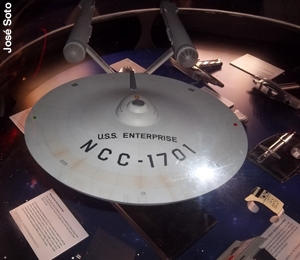
Star Trek: The Exhibition features a scale model of the Enterprise, and the actual props and costumes used in the Star Trek shows and films. At the KSC, the exhibit is broken up into two different buildings. One where IMAX films are shown (and is currently presenting Transformers: Dark of the Moon in 3D) has a room dedicated to the original Star Trek series, though props and costumes from the Kirk-era films can be seen. The highlight is a well-detailed replica of the original Enterprise bridge complete with dedication plaque, consoles and the captain’s chair that anyone can sit on for golden photo opportunities.

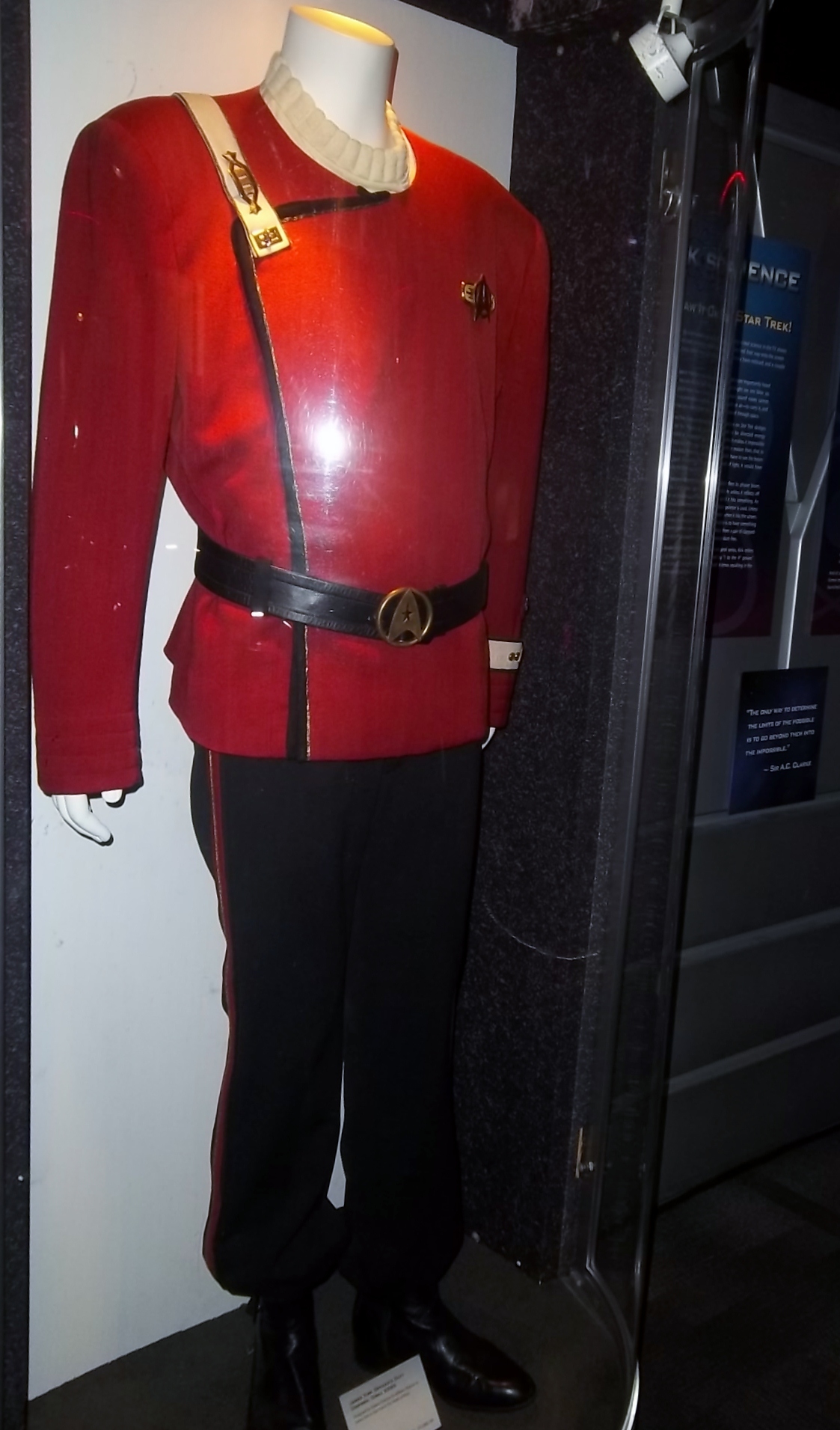
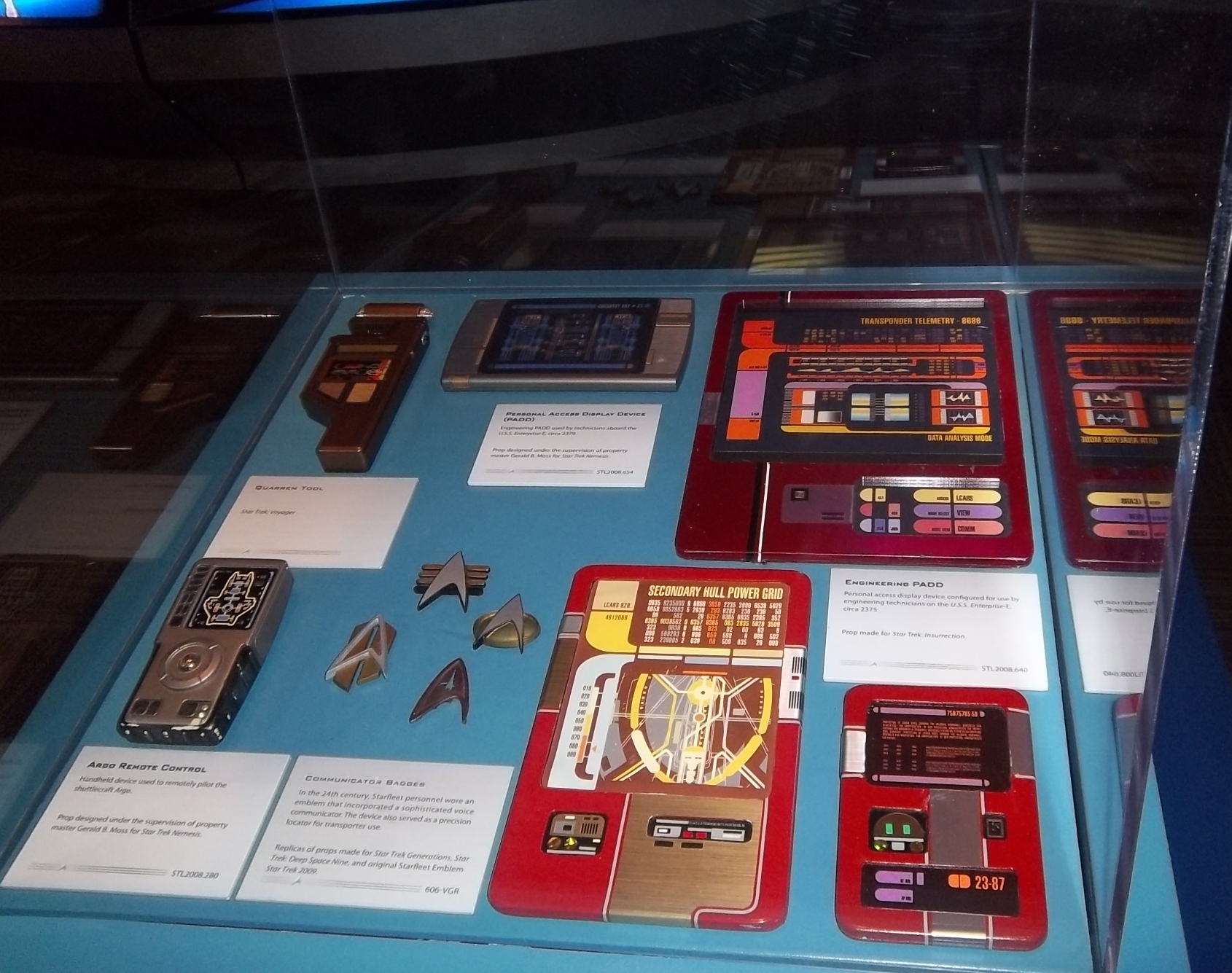
At another building near the tour bus terminal is a larger exhibit room dedicated to Star Trek: The Next Generation,  as well as Star Trek: Deep Space Nine and Star Trek: Voyager. This exhibit displays a mock-up of the Reman Scorpion fighter craft seen in Star Trek: Nemesis and partial recreations of the Enterprise D’s sickbay and engine room. There are models,  numerous props and costumes worn and used by the actors and a Klingon chair that you can sit on (there are also captain chairs from the Enterprise B and D but those are roped off). Additionally one side of the exhibit’s wall has a mural with a detailed timeline of NASA and Trek history. The opposing wall displays the costumes. A nice touch to this exhibit were two actors dressed as Vulcans from the far future who stayed in character and interacted with visitors. The uniforms they wore were the ones worn by 29th century Starfleet officers as seen in the Voyager episode “Relativity.”

The KSC has Trek costumes and factoids peppered throughout the facility with several famous delta shield symbol on the grounds that act as arrows to guide visitors to Trek-related exhibits and attractions. For example one path lead sto the rocket garden where a floor painting shows how large the Enterprise ships are in comparison to the horizontally displayed Saturn 1B rocket. It’s staggering to consider how large the Trek ships are when you walk the length of the rocket. There was so much to see at the KSC that one could easily spend an entire day on the grounds. Continue reading

NASA’s Next Chapter Awaits

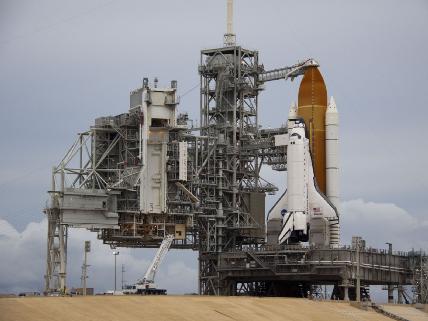
The space shuttle Atlantis lifted off today on its final shuttle mission closing a 30-year chapter in NASA’s manned space program. Looking around the news casts obsessed with Casey Anthony, the dismal jobs report, and other headlines it was hard to find substantial mention of Atlantis’ mission to the International Space Station (ISS).

This just underscores the sad state of America’s space program and it seems as if the shuttle fleet is being retired with a whimper. It’s almost as if NASA and the government want to downplay the fact that there are no concrete future plans.

After President Obama all but scuttled NASA’s manned space program, the agency has been left grasping at straws to remain relevant. Meanwhile Russia, China and other nations are pushing on with their space efforts. So why not us? Blame it on cost-cutting politicians, an apathetic public and NASA’s bureaucracy; there are plenty of reasons. But it could be traced to a lack of long-term planning.

Back in the 1960s, President Kennedy proclaimed his famous goal of landing a man on the moon before the decade ended. Then the U.S. was in a very public space race with a very competitive Soviet Union. One added impetus was that the Russians were winning. It fired the public’s imagination and will for America to forge ahead despite setbacks like the Apollo 1 tragedy. Once Armstrong and Aldrin landed on the moon, everyone celebrated and collectively went on the next thing. NASA’s budget was slashed and bit by bit the agency’s ambition withered; goals like sending astronauts to Mars by the 1980s went by the wayside. The most recent setback was with Obama effectively killing the agency’s plans to return to the moon in a few years.

Now with the shuttle fleet retired, current plans are to develop a new successor to the mammoth Saturn rockets, building spacecraft that can leave Earth’s lower orbit and vague plans to reach an asteroid by 2025 and orbit (not land on) Mars in the 2030s. Frankly that is too far away in time to capture the public’s imagination. For all the hand wringing by NASA, the fact is that the technology to send people to Mars and colonize our moon exists today, actually it has existed for years. What kept that from happening was the lack of will from everyone. Politicians didn’t want to invest their capital on projects that paid off way into the future, NASA seemed to be more interested in conducting tests in space that the average Joe didn’t care about, and the public complained about the costs and necessity of the space program. In truth, the budget for the space program is very small compared to other expenses. To do away with it completely won’t cure our financial woes.

NASA needs clear goals that regains the public’s interest, and more importantly the drive to push the envelope. It may take another nation pulling off a genuine feat to light America’s fire again. Perhaps commercial space craft development will do it (the company SpaceX has plans for a test run to the ISS this year). Or maybe the sight of American astronauts piggybacking on Russian space capsules might do something to boost our motivation. For now though, the next chapter in the U.S. manned space program is still on the launch pad.

J.L. Soto