Fondly remembered for their innovative comic books in the ’90s, Valiant returned to the comic book scene earlier this month with the release of X-O Manowar #1. The comic book about a Visogoth warrior who acquires an alien battlesuit and winds up in modern times quickly sold out its print run of 45,000 copies. The company has announced that there will be a second printing of X-O Manowar #1 for sale on June 20 featuring a new wraparound variant cover by Arturo Lozzi. But the comic book company isn’t resting on its laurels with X-O Manowar.
On June 6, Valiant will release a reboot of Harbinger (about people with psionic powers) followed by Bloodshot on July 11 and finally Archer & Armstrong (a semi-comical buddy book about a naive master assassin and an immortal being) on August 8. The company plans on concentrating their comeback with these four core titles but will eventually bring back its other heroes.
Fans may want to note that there are plans by Sony for a movie about Bloodshot. Given the runaway success of The Avengers and other recent superhero movies, it’s very likely that the movie’s development will be fast tracked. It helps that Bloodshot’s concept is compelling. In the original comic book released back in the ’90s, Bloodshot was originally a mobster called Angelo Mortalli who was in a sense reborn by having his mortally wounded body injected with nanites that gave him superpowers. These nanites, while giving him advanced healing, reflexes, and strength, have erased his memories, thus forcing him to re-discover himself.
In the reboot written by Duane Swierczynski and drawn by Manuel Garcia and Arturo Lozzi, Angelo’s origins are more nebulous as he and readers aren’t even sure of his real name. And the comic book has more of a military angle with Bloodshot partaking in dangerous, suicidal missions. The creators promise that the new Bloodshot will be action packed while evoking compelling military/spy mystery plots.
Bolstered by the success of X-O Manowar, Valiant hopes to complete its comeback with other titles. According to Valiant CEO Jason Kothari, “Valiant has never underestimated the resonance that its characters have with comic fans around the world. X-O Manowar #1 has already taken a lot of people by surprise, and with Harbinger #1, and Bloodshot #1 just around the corner, this is truly going to be a summer of Valiant.”
As the traditional TV network season dies down, many shows will conclude their seasons with memorable finales. Many sci-fi, fantasy and horror shows have had some of the most-talked about finales that included thrilling cliffhangers, WTF revelations and dramatic game-changing developments. WARNING: Major Spoiler Alerts Ahead.
10.“Lucifer Rising” Supernatural (Season Four); Sam and Dean Winchester are betrayed by their allies who want to bring about the coming apocalypse by unleashing Lucifer upon the Earth.
9. “How To Stop An Exploding Man”Heroes (Season One); the show fell apart after its terrific first season but many episodes from that season are still great including the season finale that featured several super-powered heroes confronting the power-stealing villain Sylar.
8. “Zero Hour”Star Trek: Enterprise (Season Three); the conclusion of the season-long Xindi arc finds Captain Archer and the Enterprise crew on a last-ditch, desperate gamble to prevent the alien Xindi from destroying Earth. Aside from all the action and ship battles, the episode had a surprise ending which unexpectedly stranded our heroes on an alternate Earth during World War II.
7.“Over There, Part 2”Fringe (Season Two); Olivia Dunham and Walter Bishop continue their mission in the parallel Earth to retrieve Peter Bishop. Viewers are treated to a fascinating look at another Earth with doppelgangers, advanced tech, quarantine zones and many alternate cultural Easter eggs, plus a nefarious plot to destroy our universe. The cliffhanger was pretty nifty too with Olivia trapped in the parallel universe while her sinister double takes her place.
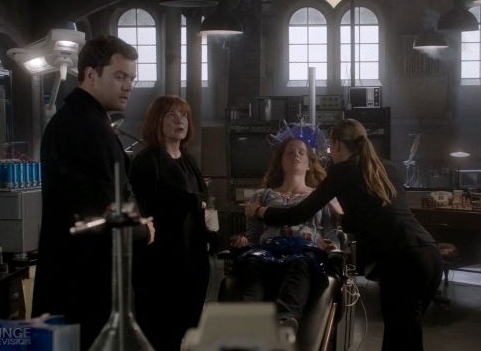
6.“Die Me, Dichotomy”Farscape (Season Two); the show’s main character, lost-in-space astronaut John Crichton, had a neural chip implanted in his brain by his enemy Scorpius in order to access Crichton’s hidden knowledge about wormholes. Throughout the episode, Crichton battles himself as the chip asserts control of his mind and makes him attack his friends and results in the death of his would-be lover Aeryn Sun. After a doctor finally removes the chip, Scorpius appears, takes the chip and leaves behind a helpless, broken Crichton on the operating table so he can live with the agony of what happened.
5.“Chrysalis” Babylon 5 (Season One); this season finale would prove to be the swan song for the show’s main character Jeffrey Sinclair (replaced off-screen in season two by John Sheridan) as ominous events unfold. Sinclair’s station security chief unsuccessfully attempts to stop a conspiracy to assassinate the Earth Alliance president. His efforts leave him shot and in critical condition. Meanwhile, the mysterious aliens called the Shadows emerge and attack an outpost of one of the major races, thus setting the stage for a deadly galactic war. Towards the end, Sinclair’s ally D’Lenn undergoes a physical transformation to fulfill a prophecy as Sinclair laments elsewhere that “nothing’s the same anymore.”
4.“Lay Down Your Burdens, Part II”Battlestar Galactica (Season Two); fleetwide presidential elections are held pitting President Roslyn against the enigmatic Baltar. An issue of the election and the series itself is whether or not the fugitive humans should abandon their quest to find Earth and settle down in a discovered habitable world. The episode jumps ahead more than a year later and shows how miserable the humans are living in their makeshift shanty towns. Things get much worse when their enemies, the robotic Cylons, arrive on the planet and the humans’ new leader Baltar surrenders the colony to the Cylons.
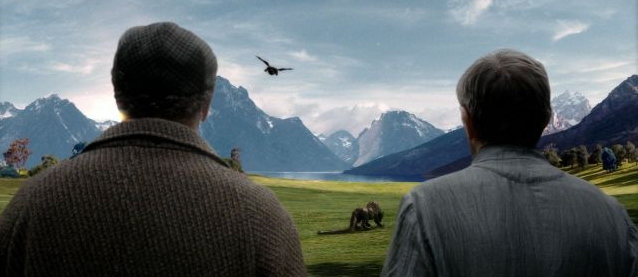
3.“Through The Looking Glass” LOST (Season Three); the final minutes are a true game changer for LOST. The castaways are trying to find their way off the mysterious island as flashbacks show a despondent Jack Shephard back in L.A. at the end of his road. For a while it was the standard format for the series, feature flashbacks on certain characters while advancing the present-day plotline. However, aside from the foretold death of a popular character, LOST stunned fans with the revelation that the episode’s flashback was actually a flash forward and that Jack was desperate to return to the island.
2.“Call To Arms”Star Trek: Deep Space Nine (Season Five); the peaceful Federation goes to war with the Dominion in this exciting season-ender. This development is a first for the Star Trek shows, which often preached peace above all. Viewers were treated to an effects-laden spectacular as hordes of Dominion ships attacked the Deep Space Nine space station. The episode ended with so many outstanding closers, each of which would’ve sufficed as any show’s final moments. For example, the episode could’ve just ended with Captain Sisko’s speech to his Bajoran colleagues that he will return, or with Dominion lackey Gul Dukat being “welcomed” to the station, or with Dukat’s discovery of Sisko’s baseball indicating that Sisko and company are coming back. The episode then topped itself with a final breathtaking scene of Sisko’s Defiant warship joining a vast Starfleet/Klingon armada ready to do battle.
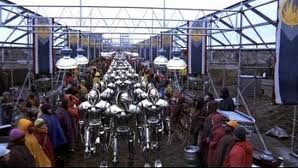
1.“The Best Of Both Worlds, Part 1”Star Trek: The Next Generation (Season Three); this was the first and best cliffhanger shown on Star Trek: The Next Generation. The cybernetic and invulnerable Borg race begin an invasion into Federation territory with the goal of reaching Earth. Despite their best efforts, the Enterprise and its crew are nearly powerless to stop the Borg, which leads to a crisis of confidence faced by Captain Picard. Meanwhile, First Officer Riker has to contend with an overly ambitious officer/Borg specialist who is out for his job. The tension runs way overboard as Picard is kidnapped by the Borg but the true jaw-dropping moment comes when the Enterprise crew attempt a rescue. They find that Picard has been horribly transformed into a Borg, who then coldly orders the Enterprise crew to surrender. Equally as chilling was Riker’s three-word response, which ends the episode…to be continued.
While the fate of two universes was in the balance in the final fourth season episode of Fringe, until very recently so was the show itself. Many Fringe fans breathed a relieved sigh when the show was given a final reprieve by Fox for a fifth and final season because now the show can properly finish its complex storyline. Yet by looking at the final episode “Brave New World, Part 2” one could tell that the show’s producers meant for this episode to also serve as a series finale if needed. Fortunately that wasn’t the case, but TPTB have to be careful not to fall into the trap that Babylon 5 did. In that show, the proper storyline came to a conclusion at the end of its fourth season only to be given a new season but felt tacked on and aimless.
As for the episode itself, it was one of the best of the series. Tightly plotted, suspenseful, and it featured all the elements of a classic Fringe episode. Meaning time-traveling Observers, reanimated corpses, weird and gross pseudo science, end-of-the-world theatrics and FBI agent Olivia Dunham (Anna Torv) doing a turn as one of the X-Men by emulating Jean Grey and Wolverine’s mutant tricks. This episode explained many of Fringe’s mysteries such as why was Olivia dosed with the fictional drug cortexiphan (which gave her psionic powers); what did the wounded Observer called September mean in previous episodes when he cryptically stated that Olivia Dunham had to die and most importantly what was the goal of the ultimate baddie.
The head villain was revealed in the penultimate episode of the fourth season to be Walter Bishop’s (John Noble) old partner William Bell (Leonard Nimoy) and he wanted to recreate the universe to his own design. William Bell had created a modern-day Noah’s Ark with new creatures and meant to use Olivia Dunham’s powers to fuel the collision between our universe and the parallel one that had been seen many times on Fringe. Naturally, it’s up to Olivia and her lover/partner Peter Bishop (Joshua Jackson) to stop this mad scheme.
What was surprising and oddly reasonable was his motive. Bell was dying of cancer and came to hate the unfairness of life. He reasoned that if we were created in God’s image then it was only natural that we try to be like God-hence all the scientific experiments and aberrations throughout the series. But what was surprising was that Walter Bishop came up with the scheme to destroy and remake the universe. Actually, Bishop concocted this back before the show when he was an evil mad scientist. This revelation also explains why the current Bishop is more benign and doesn’t have his full mental capacities.
There is a feeling of conclusion in the final minutes of the episode (Walter even finally calls his assistant by her proper name!), the Fringe Division of the U.S. government receives full funding and resources and Olivia and Peter are ready to live happily ever after. But luckily for us fans, a final nugget and indication of what is to come arrives in the form of the Observer, who delivers a warning. This is probably alluding to the future timeline seen in the recent episode “Letters Of Transit” where the Observers take over the world.
Thankfully, there are now a few more episodes left to answer this mystery and the other remaining ones. Thirteen episodes to be exact.
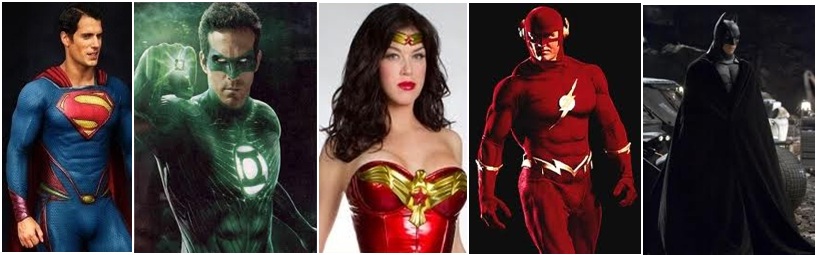
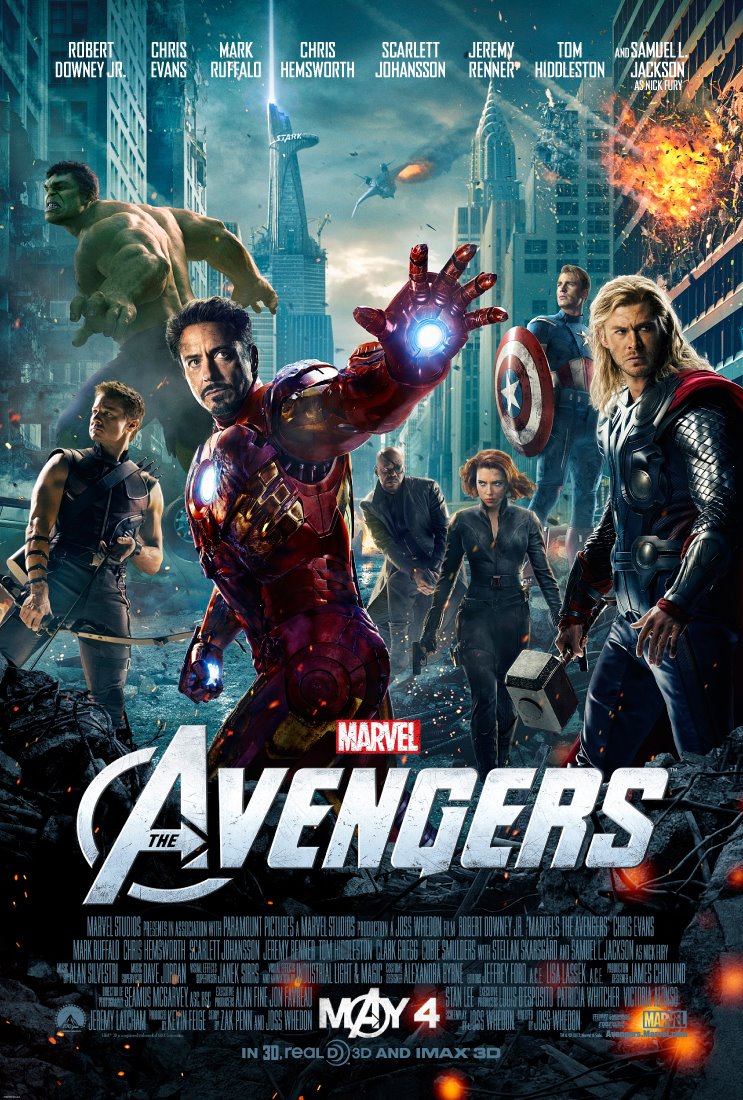
OK DC, Marvel has thrown down the gauntlet. Look at the result: The Avengers film looks to be one of this summer’s biggest blockbusters-maybe the biggest one. The buzz and hysteria surrounding this film is phenomenal. Toys based on the film are selling well and other merchandise is getting hard to find. Marvel Studios took a gamble and were patient. They carefully nurtured the film properties, which increased awareness for their characters. For The Avengers, Marvel Studios managed to corral the actors originating the super hero roles (with the exception of Edward Norton who didn’t reprise Bruce Banner/The Hulk) and bagged a director (Joss Whedon) who is an unabashed fan. Well it paid off in a super way-an opening weekend draw of over $200 million isn’t anything to sneeze at. So now the question remains: when will DC and Warner Brothers get their act together and put out a Justice League film? We’re not talking about some animated or motion capture film but an actual live-action film featuring Batman, Superman, Green Lantern, Wonder Woman, The Flash and DC Comics’ other great heroes.
Honestly how difficult is it to pull off? Marvel managed to do it, and DC’s characters has had more film and TV exposure so it would be easy to generate enthusiasm for such a film. And Marvel’s efforts are quite considerable if one takes into account how their properties have been scattered among many Hollywood studios. Warner Bros. has owned DC for some time so the logistics of gathering all their characters into one film should not be difficult. Of course, the ideal would be to bring aboard the most recent actors who’ve played the super heroes like Christian Bale or Ryan Reynolds, but it’s not really necessary as seen with Mark Ruffalo taking over the Bruce Banner/Hulk role in The Avengers and Superman and Batman have been recast throughout the years.
It isn’t as if The Avengers sprung up out of nowhere. The first inkling about a film starring Marvel Comics’ heroes came about at the end of the first Iron Man film in 2008 and later that year with The Incredible Hulk. In those films and others since then put out by Marvel Studios there have been many Easter eggs for fans that showed a shared universe. Captain America’s shield was in the background during a scene from Iron Man, the spy organization S.H.I.E.L.D. turned up, Hawkeye and Black Widow made cameos (Hawkeye in Thor and Black Widow in Iron Man 2) and even the Infinity Gauntlet was shown briefly in Thor. The point of all this was that for four years, Warner Bros./DC and everyone in the world knew Marvel Studios was building up to an Avengers film. Yet DC and Warner Bros. didn’t do anything to match that concept. Their releases didn’t give any indication of a shared universe (the last time this idea was explored were vague railroad PA announcements for a train headed to Gotham City in Superman Returns). It was so simple and would’ve excited fans.
That’s not to say that they haven’t tried to bring the Justice League to life. Putting aside the incredibly awful 1990s TV show pilot and a simplified version of the team appearing informally in Smallville, Warner Bros. was close to producing a Justice League film in 2008. A script was commissioned, George Miller was hired to direct it and he was casting roles, in other words, Justice League was in actual preproduction. But the Writers Guild strike of that year gave Warner Bros. a chance to pause and ultimately kill the project.
Reportedly, the studio wanted to emulate Marvel’s pattern of releasing solo super hero films that would culminate in a Justice League movie. But as of this writing, there is very little evidence that they are working toward such a film.
One worrying factor about building up to a Justice League film is the recent track record of DC movies. Aside from the recent Batman films, Superman Returns, Green Lantern, Constantine, Jonah Hex and Watchmen have been box office disappointments. The Dark Knight Rises is a guaranteed hit but this can’t be stated for next year’s Man Of Steel. Superman has proven to be a difficult character to translate to the big screen unless the right director is chosen and The Man Of Steel’s director, Zack Snyder has had a spotty record at the box office. So if the new Superman film doesn’t deliver it could mean another long drought before Superman returns to the silver screen and could delay a Justice League film.
Christopher Nolan, the director behind the successful Batman reboot, was rumored to be in line for directing a Justice League movie but there isn’t anything concrete stated about that notion. What is troubling for some fans is that Christopher Nolan as said in interviews that he wishes to keep the worlds of the individual heroes separate from each other. So, as with The Dark Knight, there probably won’t be any acknowledgement of Metropolis or Central City in The Dark Knight Rises. Ditto for Man Of Steel, which he is producing.
This mentality is shared by DC Entertainment as well. Diane Nelson, DC Entertainment President, said to IGN back in 2010, “We do have a very different attitude about how you build a content slate. And it isn’t necessarily about connecting those properties together to build a single thing. We think we’ve got great stories and characters that will lend themselves to great standalone experiences.”
Perhaps after looking at how much money The Avengers is making and the film’s popularity, DC and Warner Bros. may change their mind.
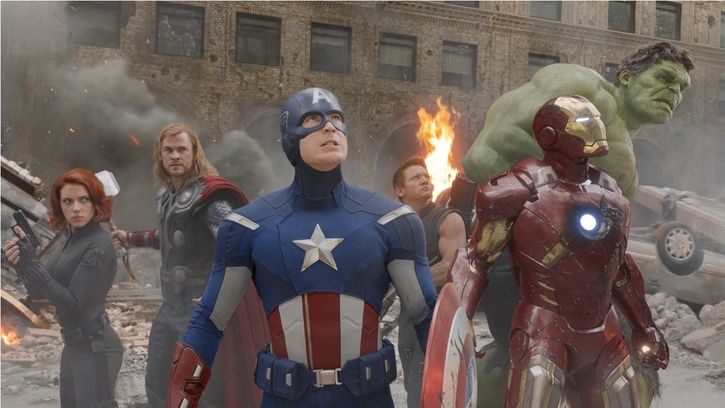
Wow. The new movie The Avengers literally left me breathless and spent after seeing it. Marvel Studios needs to take a well-deserved bow for their efforts throughout the years that culminated in this film. Many had doubts regarding the ability to pull this endeavor off but they are quickly dispelled with The Avengers. It so profusely feels like the climax that had been building up for many years.
Marvel Studios clearly made the right choice with Joss Whedon as the film’s director. He has the filmmaking talent and perhaps, more importantly, possesses a clear love and respect for the Marvel universe and it shows onscreen. But this film isn’t some slavish fanboy production. No, Joss Whedon and the crew had an understanding of how the Marvel universe works, how the Marvel characters behave and how to translate that to the screen and entertain even non-Marvel fans. It is difficult to imagine anyone else achieving what Whedon did and The Avengers will make him a deservedly A-list director. (On a side note, hopefully he will have the clout now to do a Firefly revival. Hey, we can only hope!)
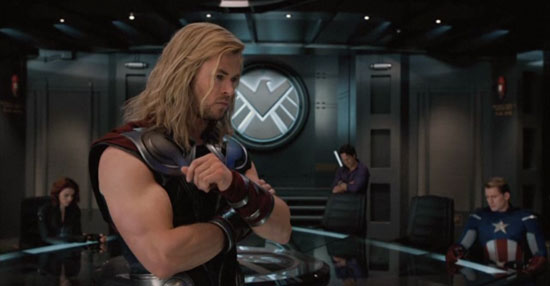
The Avengers jumps right into the action when demigod Thor’s (Chris Hemsworth) nemesis and brother Loki (Tom Hiddleston) arrives at an underground S.H.I.E.L.D. bunker and makes off with an otherworldly and powerful MacGuffin called the Tesseract (that’s the Cosmic Cube seen in many Marvel comics that grants unlimited power to wielders). After Loki escapes from the bunker, S.H.I.E.L.D. director Nick Fury (played by Samuel L. Jackson doing his usual tough-as-nails shtick) assembles a team of super heroes to help him retrieve the Tesseract and stop Loki’s plan to conquer the Earth.
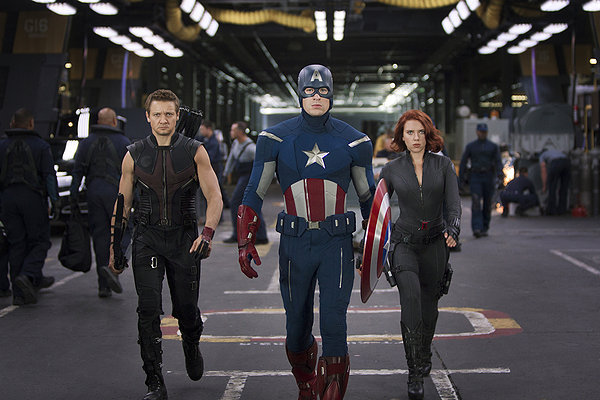
Then the fun begins as beloved characters like Tony Stark/Iron Man (Robert Downey, Jr.), Steve Rogers/Captain America (Chris Evans), Thor, Dr. Bruce Banner/Hulk (Mark Ruffalo, replacing Edward Norton and Eric Bana), Natasha Romanoff/Black Widow (Scarlett Johansson) and Clint Barton/Hawkeye (Jeremy Renner) meet for the first time. In the typical Marvel comics manner, they don’t get along with each other and even come to blows. But they learn to get along and even respect one another just in time to confront Loki and his alien army.
The Avengers is an action-packed bonanza with fantastic characters and that’s before the climatic final third of the film. Taking place in New York City, the beachhead for Loki’s alien invasion, the explosive, multi-tiered battles on the streets and in the skies are simply spectacular. There have been some complaints over how low-budget some previous Marvel Studios productions have been, but here no expense was spared. But unlike some empty, big-budget films, the action was very fluid and easy to follow, but more importantly the audience cared deeply about the heroes as they fought the alien army. Each character, even some minor ones, had their moment to shine. The Avengers could’ve easily been dominated by one or two characters like Iron Man due to the actor’s charisma but Joss Whedon knows how to give the actors just enough time to make their contributions before moving on the next character or plot point.
This film has set new standards for super hero films. One can only wonder how the filmmakers will top themselves (a clear, audience-rousing hint is given during the end credits; Marvel fans will rejoice) or how other studios’ films can compare to this one. Marvel Studios would be wise to retain Whedon for the inevitable sequel or at least use him for other productions. BTW, stick around for the very end, there’s another post-credit sequence. Without giving anything away, it isn’t anything earth-shattering, but rather a cinematic equivalent of having a cigarette or a relaxing drink after being so pumped out by the movie.

 Fondly remembered for their innovative comic books in the ’90s, Valiant returned to the comic book scene earlier this month with the release of X-O Manowar #1. The comic book about a Visogoth warrior who acquires an alien battlesuit and winds up in modern times quickly sold out its print run of 45,000 copies. The company has announced that there will be a second printing of X-O Manowar #1 for sale on June 20 featuring a new wraparound variant cover by Arturo Lozzi. But the comic book company isn’t resting on its laurels with X-O Manowar.
 drawn by Manuel Garcia and Arturo Lozzi, Angelo’s origins are more nebulous as he and readers aren’t even sure of his real name. And the comic book has more of a military angle with Bloodshot partaking in dangerous, suicidal missions. The creators promise that the new Bloodshot will be action packed while evoking compelling military/spy mystery plots.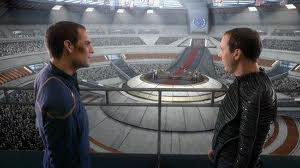








 Starloggers