The Flash Streaks Ahead Of DC’s TV Invasion

flash1Out of the four current TV shows based on a DC Comic, The Flash is the one that sticks closest to its comic book roots.

Airing on The CW network, The Flash stars Grant Gustin as the Flash or Barry Allen. He was introduced in a couple of episodes of Arrow in its second season, which set up his origin. The pilot episode of The Flash embellished the Flash’s origin and opened up Allen’s world. When he was young, his mother was killed by a mysterious figure in a vortex. Unfortunately, his father (played by the original Flash John Wesley Shipp) was sent to prison for her murder and Barry’s been looking for the killer ever since.

In the pilot (and the Arrow episode “Three Ghosts”), Barry was hit by lightning and fell onto chemicals at his lab in Central City when a nearby particle accelerator exploded. star labsThat accelerator was part of S.T.A.R. Labs headed by Harrison Wells (Tom Cavanagh) and the accident made him a pariah and a paraplegic. What’s revealed in the pilot and several episodes is that Wells is only pretending to be a paraplegic and that he has nefarious and deceitful intentions. After the lightning bolt knocks Barry into a coma, he later awakens in Wells’ lab and soon discovers he has superhuman speed. This was caused by the accelerator, the storm it created and the chemicals that splashed over him when he was struck. The accelerator also unleashed a type of radiation that randomly gave some people in Central City superhuman powers, turning them into supervillains of the week.
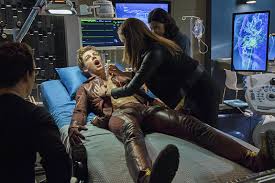
Now Barry, when not doing his job as a dorky crime scene investigator, spends his spare time at S.T.A.R. Labs where Wells and his assistants run tests on Barry and help him catch the new supervillains that have sprung up from the explosion.

strealAs a show, The Flash is generally entertaining. It’s not deep, and a bit too lightweight and clunky, but it captures the breezy spirit of the comic book with fast-moving stories and Barry’s superfast antics. They’re among the highlights of the show and are very inventive. In the episode “Plastique”, he used his powers to blur his face and reverberate his vocal chords to hide his identity and it was as much fun to watch as seeing him run across water.

One thing the show did right when compared to most comic-book-based shows is that it jumped right into the mythos of the superhero and showcased the Flash’s famous rogues gallery. Captain Cold (Wentworth Miller) has already made his appearance, as has nods to Gorilla Grodd and Professor Zoom. But the most interesting villain is Wells himself. The pilot revealed that he has knowledge of the future and seems to be using all means, including murder, to guide Barry into fulfilling his superhero destiny.

It would all be more palatable if the acting were better. Gustin is OK as Barry, but earlier on, he emoted allenPeter Parker too much, which wasn’t in line with his character. But he’s toned down the nerdy act in recent episodes. The other actors are fine, if not exceptional, except for Carlos Valdes, who plays Cisco Ramon, an overeager and annoying lab assistant. It seems like he is trying to emulate the quirky Felicity Smoak character from Arrow but he cannot pull it off and the result is that his scenes are irritating. Then there is the situation with the love of his life Iris West (Candice Patton). In the show, they have it that the two grew up together in the same home after Barry’s father went to jail. Essentially, Barry was a foster child in Iris’ home…so that means they’re really foster siblings. If that is so, then the unrequited attraction he has for her is uncomfortable to watch.

Putting that aside, The Flash is still young and finding its legs, but it’s better done than some of the other superhero shows. To date, the show is worth watching and hopefully will become much more captivating once the kinks are worked out.

Waldermann Rivera
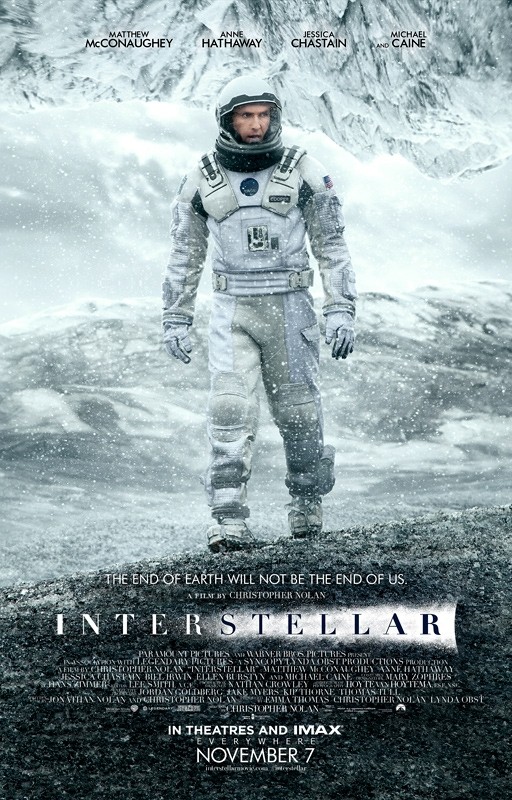
Interstellar & Its Emotional Core

interstellar poster

Interstellar may be director Christopher Nolan’s most ambitious work to date. Is it his best? Maybe, it truly depends on any viewer’s taste. Regardless of one’s viewpoint, Interstellar is probably Nolan’s most emotional film rivaling The Dark Knight.

One criticism of Christopher Nolan as a director is that sometimes his films feel emotionally distant even though he tries very hard to connect audiences with his characters. This time, Nolan is able to make that connection thanks in large part to Matthew McConaughy’s sincere performance. Playing Cooper, a former astronaut turned corn farmer, McConaughy’s work is gripping and deep and he is able to keep his scenes from being too kitschy. The emotions he displays strike a perfect note.


INTERSTELLARIn an unspecified future, the Earth is slowly dying. Various crops like wheat and okra have gone extinct as pervasive dust strangles the world. As crops die off, humanity spirals towards extinction with dust invading everything. Dreams are long gone, replaced by a practical need to grow more food and to just survive. As a widowed farmer, Cooper longs for the days when humanity strived for the stars and a sense of adventure.

Eventually he meets an old colleague, Prof. Brand (Michael Caine) and his daughter Amelia (Anne Hathaway). They are part of the remnants of NASA and a secret mission to return INTERSTELLARto the stars. Fifty years earlier, a wormhole appeared near Saturn and several manned missions were sent into the wormhole since the wormhole leads to other habitable worlds. Brand hopes that these worlds can be colonized in order to save humanity. Cooper is recruited to join Amelia and other astronauts to voyage through the wormhole and follow up on data provided by earlier explorers on three potential worlds for colonization.

In the run up to Cooper leaving Earth and his children, Interstellar is the typical well-plotted-though-a bit-distant Nolan film. Yes, there are the teary scenes from his daughter Murphy (Mackenzie Foy) and subtle disparaging remarks from his father-in-law (John Lithgow) about Cooper leaving his children behind without a guarantee of returning. These scenes do work but one has to wonder how Steven Spielberg (who was attached to the film originally) would’ve handled them. They probably would’ve had more emotional punch or they might’ve been overly sentimental.

INTERSTELLAR

Interstellar does pick up in leaps and bounds the moment Cooper and the crew of the spaceship Endurance first plunge into the wormhole. These moments are gasp inducing and afterwards a sense of danger and wonder is felt throughout the rest of the film. Nolan is also able to inject a feeling of moroseness and loss, especially when the effects of time dilation are noticed. Even more ominous are the moments when the Endurance crew explore two worlds. They seem genuinely alien and uninviting, and add a feeling of foreboding and lost time. Meanwhile, in the short time that he’s exploring, Cooper’s children have grown into adulthood and Murphy (now played by Jessica Chastain) has joined the project by assisting Prof. Brand as the old man struggles with a gravitational equation to allow humanity to leave Earth. As this is going on, the film engages the viewers even more and more.  Moments of high tension and eye-popping wonder fill the theater screen. The only drawbacks to Interstellar at this point are some pacing and narrative issues, as well as expository dialogue that flies by quickly. It dares audiences to keep up with  verbal examinations of quantum physics and other modern scientific concepts. The payoff though is huge.

black holeThat is because final part of Interstellar is unforgettable and daringly thought-provoking with mind-twisting moments. Nolan skillfully presents some far out concepts of physics and the nature of time and other dimensions that calls to mind Kubrick’s work in 2001: A Space Odyssey. But Nolan departs from Kubrick in that while he is as analytical as Kubrick, the core of this film isn’t stark nor cold. Rather, Interstellar embraces human emotion as it rails against the cold, harsh nature of science and physics. Not only that, the film goes beyond and explores some ethical and philosophical concepts about species survival, love and the human connection. As a sci-fi epic, Interstellar is a sweeping, magnificent, though flawed, endeavor that pushes boundaries.

José Soto

Avengers: Age Of Ultron Teaser Trailer!

Never mind watching next week’s episode of Agents Of S.H.I.E.L.D.! Marvel has decided to release this teaser for next year’s Avengers: Age Of Ultron today. Whoa…this just looks super awesome!

Seriously, what’s not to like? We have the Hulk battling Iron Man in his Hulkbuster armor, lots of explosions and mayhem, and best of all Ultron! It seems like Joss Whedon made yet another brilliant casting decision by choosing James Spader to play the iconic Avengers villain. Ultron looks incredibly badass and intimidating in the same vein as the Terminator. Hopefully he’ll be on screen just as memorable as Loki or Magneto and become of the great Marvel movie villains. Obviously, there isn’t any way to say that this film will be better than its predecessor The Avengers, but it looks like another winner for Marvel Studios.

Our hats off to Marvel, after making the rest of us who didn’t attend this summer’s Comic Con sweat and agonize over the concealed footage shown at that convention, they’ve given all of us a nice treat. So enjoy this official Avengers: Age Of Ultron trailer!


Update: …And here’s the extended trailer featuring more footage, it’s still creepy with that Pinocchio music.

The Terminator: The 30-Year-Old Sci-Fi Masterpiece

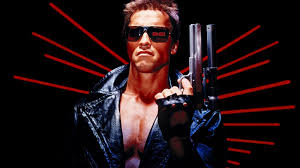
poster 2Thirty years ago, howling winds among the blackened ruins of Los Angeles in the year 2029 AD and a flying machine of death and destruction began James Cameron’s 1984 classic science fiction action thriller The Terminator. This film was a landmark for the director as well as its star Arnold Schwarzenegger and began one of cinema’s best known sci-fi franchises. It has many great qualities that many films have since tried to emulate. Such as its pulse pounding pacing and action, as well as the many interesting themes it explores (i.e.: the conflict between man and machine and the idea of fate and whether it can be altered).

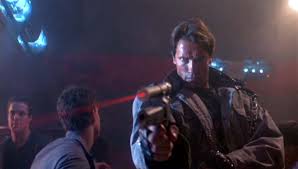
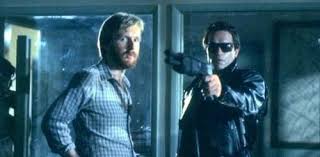
The story involving a ruthless killer cyborg laser scopeplayed by Schwarzenegger coming from the future to kill a waitress called Sarah Connor (played very well by Linda Hamilton), the mother of the future human resistance leader John Connor, examines the idea of humanity losing control of the technology it created. All of this is done through the lens of classic ’80s high-powered action and gun battles.  One of the memorable things about The Terminator is how uncompromising it is. The brutal nature of the terminator is on full display as he coldly executes his targets and relentlessly pursues Sarah. This is also explained quite well by her protector Kyle Reese (another excellent performance by Michael Bien), a soldier sent back from the future to protect her. He tells her quite bluntly that the machine will not ever stop until she is dead.

sarah and kyle

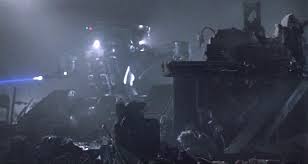
Any discussion of The Terminator would not be complete without mentioning the fantastic future war sequences that start the film and are seen in flashbacks throughout. It showed a scary post-apocalyptic landscape of a city destroyed by nuclear fire, and massive hunter-killer machines trying to wipe out any humans that appear as if they were rats. This is all seen through the eyes of Kyle Reese, and when he is shown getting back to a human hideout, the hunter killersense of misery and despair among the surviving humans only heightens the tension. It makes his mission to protect Sarah and ensure that humankind has a fighting chance all the more important and desperate. It also demonstrates the terrifying nature of terminators as one infiltrates the hideout and mercilessly slaughters anyone nearby. This is paralleled by the present-day terminator walking into a police station and killing everyone he sees in an effort to get at Sarah. Speaking of Sarah, the film well presented the theme of a once-timid character who finds her inner resolve and becomes a completely changed person. By the end of the film, Sarah Connor is just as determined and full of fight as the machine that is stalking her.

cameron and arnoldAll of these qualities are why the movie is still admired and seen 30 years after its release. The Terminator stands out among many of its decade’s other action films. It propelled James Cameron and the cast to stardom and led to him directing other favorites like Aliens, The Abyss, Titanic and Avatar. It cemented Schwarzenegger as an international star and created a fascinating universe that was further developed in three sequels, books, comic books and a TV show that expanded on the world of the super computer Skynet bent on humanity’s destruction. This world will be revisited in next year’s Terminator: Genisys.  Hopefully, it will be as action packed and exciting as the classic 1984 original that is still the best of the series and will endure for years to come as a sci-fi masterpiece.

C.S. Link


Reasons Why The Marvel Superheroes Are Still Successful

marvel 75

The 20th century needed a new group of heroes that reflected then-modern sensibilities. During the Golden Age of comic books, superheroes belonging to DC Comics (then named National Periodical Publications) such as Superman, Batman, and Wonder Woman fulfilled this need with their wild superhuman exploits that captured the imagination. By the post-war era in America, DC’s superheroes were pretty much the standard: the Establishment.

By attempting to have the most likeable characters, DC’s superheroes had no character or emotional flaws, and the stories gravitated towards plot-driven, farcical adventures rather than character-driven stories.

In the wake of DC’s success, other comic book companies were founded and tried to emulate DC. Out of the many companies, only Timely Comics had staying power and here we are celebrating the 75th anniversary of that company that will later become Marvel Comics.

The Flawed, Science Heroes: Comics changed forever with the start of the so-called Marvel Age. The birth of the Marvel Universe took place in the early 1960s. This was a period that people were in awe with all of the wonders of science and space exploration. The Space Race and the Cold War were on the minds of the people. The Zeitgeist was the fear of the imminent Red Invasion and the Promise of Science- where will it take us?

perez marvelThe core of the first generation of Marvel superheroes were essentially Science Heroes. With the exception of Dr. Strange, the rest of the Marvel Universe was largely a world of weird science and science fiction. Spider-Man, Fantastic Four, Captain America, Giant-Man, the Wasp and the Hulk were Radioactive Heroes. Peter Parker was bitten by a radioactive spider. The astronauts from Reed Richard’s group were exposed to cosmic rays during their maiden voyage into outer space. In an unfortunate accident, Dr. Bruce Banner was hit with the full blast of Gamma Rays. Tony Stark built an electronic-laden armor with tons gadgets and abilities. Captain America was a patriotic hero that survived World War II by being frozen due to his exposure of Vita-Rays; part of the catalyst that transformed Steve Rogers from a skinny kid to an athletically proportioned hero. Giant Man and the Wasp benefitted from Hank Pym’s size magnification and reduction experiments, along with side studies in insect communication and gene splicing.

Great concepts- ahead of its time- but what made the Marvel Universe different, however, was not only the science aspect, but rather the fact that these Marvel heroes were emotionally flawed, imperfect, and fallible. Tragedy strikes as often as victories. Moral dilemmas were as large as the threat.

Spider-Man wins the battle with the big bad villain, but he can’t get enough money for his rent and he blew a date with either Gwen Stacy or Mary Jane Watson. Captain America is back in the modern world, but he feels lost like a fish out of water. marvel heroesThe X-Men have astounding abilities, but they are persecuted and feared by society, who view mutants as aberrations, and treat them as outcasts. The Fantastic Four’s Thing has great power, but he also has this great fear that his blind girlfriend Alicia won’t accept him if she ever regained her sight and found him ugly. But the Thing- AKA Ben Grimm, is very human despite his rough exterior, with a heart that endeared him to readers. Dr. Strange was a callous, money-loving jerk; a celebrity physician until a terrible traffic accident ended his career. This gave him pause to reflect and improve on his past behavior as he was now invested to learn the mystic arts to save the world from an ancient evil. And the list goes on and on with the great flaws that these characters have, but that is what made these characters appealing. That in particular was something that comic book readers became very attuned to, and why they identified with them. Continue reading →