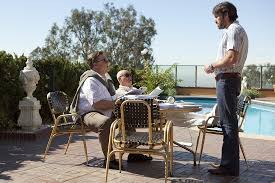
One thing not really being talked about in the movie trades and news regarding the movie Argo winning the Oscar for Best Picture is Argo’s sci-fi angle. It’s the first time this has happened with a Best Picture winner.
For the unaware reader, the movie is about the CIA’s efforts during the Iran Hostage Crisis to rescue six Americans hiding in a Canadian embassy in Tehran. A crucial sub-plot in Argo has to do with Ben Affleck’s character of CIA operative Tony Mendez coming up with the off-the-wall idea of entering Iran to rescue the American hostages by posing as a film producer. This scheme involves him supposedly producing a fake “science fantasy adventure” movie called Argo and he wants to film the project in Iran because of its exotic location. Unbelievably this scheme works as Mendez is given permission by Iran to enter the hostile country for location scouting.
Actually Argo the fake movie was based on a never-made sci-fi movie called Lord Of Light (based on a book of the same name). Lord Of Light went far enough into pre-production that legendary comic book artist Jack Kirby was commissioned to draw some concept art for the film project.
The whole thing with the fictitious movie is just a gimmick while Argo is devoted to the efforts to smuggle out the Americans. The movie cannot be considered sci-fi at all, yet it has a sliver of a sci-fi connection. This is the closest that the disrespected genre (in Hollywood’s eyes) has come to date for being part of a movie that is a Best Picture winner. Not much, but it’s a first step.
Perhaps one day a genuine sci-fi movie will earn that Best Picture honor on Oscar night.
Traditionally, genre films have been snubbed by the Oscars, that is a given. But in recent years, such films have snuck into the list of nominees. A few years back Avatar, Inception, District 9 and the film versions of The Lord Of The Rings received Best Picture nominations. Most know that the fantasy epic The Lord Of The Rings: The Return Of The King actually won for Best Picture in 2003.
While that is all well and good, there are numerous worthwhile sci-fi, fantasy, animated and horror films that were ignored by the Academy of Motion Picture Arts and Sciences at least when it comes to the most valued prize, the Best Picture pick. The following are notable genre classics throughout the decades that should’ve at least received a nomination for Best Picture.
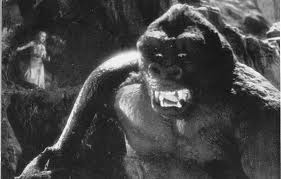
1930s-1940s:Frankenstein (1931) is still revered today as a genuine horror and sci-fi masterpiece with Boris Karloff’s iconic performance as the Creature. King Kong (1933) was a groundbreaking film that influenced many generations of filmmakers to this day with its unforgettable, dreamlike scenes that transported viewers into a lost world filled with a giant gorilla and dangerous dinosaurs.
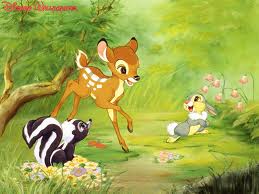
Although Walt Disney received a special Oscar for Snow White And The Seven Dwarves (1937), the film failed to be nominated for Best Picture. What was nominated instead of the groundbreaking first full-length animated film? Such well-regarded classics like Test Pilot and Alexander’s Ragtime Band–note the sarcasm. Disney’s followup animated masterpieces Pinocchio (1940) and Bambi (1942) were also ignored by the Academy when it came to announcing the Best Picture nominations.
But the Academy wasn’t too dense, in this time period a few fantasy films received Best Picture nominations starting with Lost Horizon (1937), The Wizard Of Oz (1939) and It’s A Wonderful Life (1946).
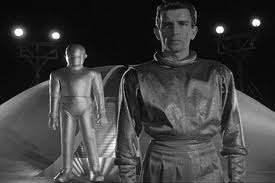
1950s-1960s: Many nominated films in these two decades were either musicals or dramas. Unlike the previous decades there weren’t any genre films recognized with the exceptions of Walt Disney’s Mary Poppins, Doctor Doolittle (both of which are really musicals) and Stanley Kubrick’s Dr. Strangelove Or: How I Learned To Stop Worrying And Love The Bomb. Horror and animated films were for the virtually absent among the list of Oscar nominees. Sci-fi films in this time period began to grow out their zero-budget, infantile trappings. There was an explosion of sci-fi films in the 1950s, many of them worthy of recognition by the Academy like The Day The Earth Stood Still (1951),War Of The Worlds (1953), Forbidden Planet (1956) and The Incredible Shrinking Man (1957). But the Academy members failed to see the merit of these films, which are still fondly revered.
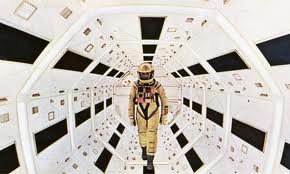
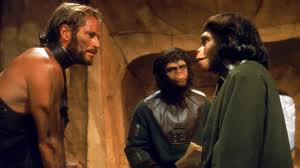
Kubrick’s next film after Dr. Strangelove is considered by most people as the greatest sci-fi film ever made. Yet 2001: A Space Odyssey (1968) was largely ignored by the Oscars. The other important sci-fi masterpiece that came out in the same year Planet Of The Apes was also snubbed by the Oscars except for a special makeup Oscar. By the way, does anyone know what won that year for Best Picture? Oliver! Another musical snoozefest and films that were nominated included Rachel, Rachel and The Lion In Winter. Are any of these films venerated by film lovers today? Thought not. Continue reading →
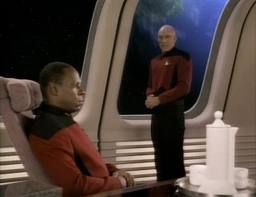
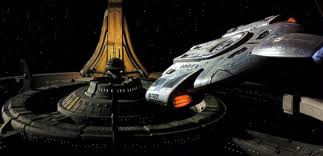
This past January marked the twentieth anniversary of perhaps the most underrated Star Trek show Star Trek: Deep Space Nine. It differed from the other Trek shows in that it took place on a space station (the titular Deep Space Nine or DS9) near a wormhole and the characters often had to deal with the political and social ramifications of galactic events and alien first contact. In so many ways, Star Trek: Deep Space Nine is arguably the best Trek show and certainly the best spinoff of the original Star Trek. Many episodes were exciting, thought provoking and best exemplified the spirit of Star Trek. Being that it’s the show’s 20th anniversary, here’s a top 20 list of their very best episodes.
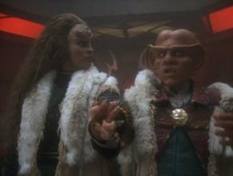
20. “The House Of Quark” A white lie about killing a Klingon warrior to boost business leads resident DS9 bar owner Quark (Armin Shimmerman) to unwillingly marrying the Klingon’s headstrong widow (Mary Kay Adams). Later Quark must fight another Klingon for her honor in this humorous social clash of Klingons and Ferengi cultures.
19. “Homefront/Paradise Lost” This two-part episode is an eerie predictor of the besieged, mistrustful mentality that hit the U.S. after 9/11. A Changeling terrorist attack on Earth leads to worldwide paranoia that Changelings are everywhere and infiltrating the Federation. Ultimately this brings about an attempted coup by rogue Starfleet officers.
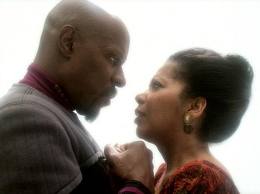
18. “What You Leave Behind” The final episode of Star Trek: Deep Space Nine brings the show to a proper conclusion as the Dominion War finishes in an epic throwdown involving an armed uprising on the Cardassian home planet, the major space powers in a pyrotechnic space battle and Captain Benjamin Sisko (Avery Brooks) has a final confrontation with his arch nemesis Dukat (Marc Alaimo) and ultimately discovers his destiny.
17. “The Jem’Hadar” What a way to introduce an enemy race! Sisko, his son Jake (Cirroc Lofton), Quark and his nephew Nog (Aron Eisenberg) are captured while camping on a planet in the Gamma Quadrant by the Dominion’s belligerent military force, the Jem’Hadar. Ruthless, deadly and formidable, the reptilian-like soldiers proved their extreme fanaticism by destroying a Galaxy-class starship fairly easily.
16. “Past Tense, Part I and II” Sisko, Dr. Julian Bashir (Alexander Siddig) and Jadzia Dax (Terry Farrell) are accidently transported to San Francisco in the 2020s and become involved in a calamitous social movement called the Bell Riots. When the leader of the movement is killed, Sisko must assume his identity in order to preserve the timeline, while trying to keep himself and hostages safe.
15. “Favor The Bold” The first few episodes of DS9’s sixth season had the Federation on the defensive in the Dominion War with the Dominion occupying the station. Tired of defeat, Sisko devises a bold battle plan to take back DS9 and gathers his forces. Meanwhile tensions boil over in DS9 as First Officer Kira Nerys (Nana Visitor) confronts the Changeling Security Chief Odo (René Auberjonois) over his divided loyalties.
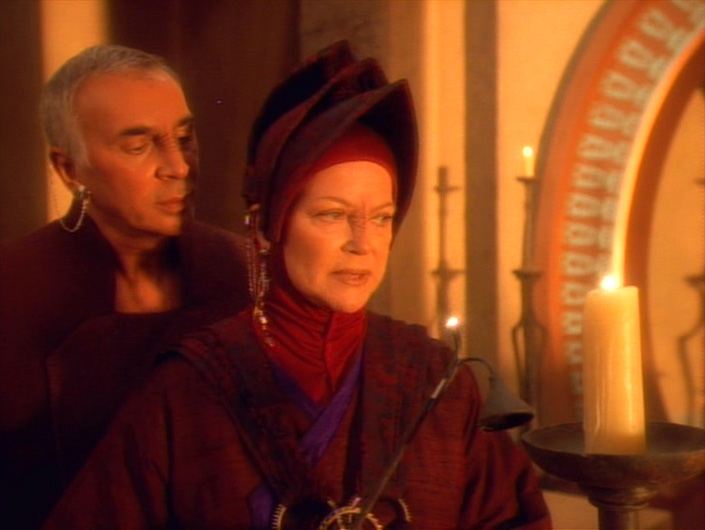
14. The Circle Trilogy (“The Homecoming”, “The Circle”, “The Siege”) Bajoran politics start off the second season with Star Trek’s first three parter. A legendary Bajoran freedom fighter (Richard Beymer) is found in a Cardassian prison by Kira, who frees him. This causes a chain of events that culminates in a plot by an anti-Federation, reactionary political group to overthrow the Bajoran government. Guest stars Frank Langella and Louise Fletcher played exceptional villains.
13. ” The Quickening” Dr. Bashir learns a lesson in the limits of his medical skills when he and Dax struggle to help a planetary population infected by the Dominion with a deadly and incurable disease. An allegory to the AIDS epidemic, the scenes of Bashir’s tireless efforts to ease the suffering and cure people were powerful and touching.
12. “Crossover” Kira and Bashir return to the infamous Mirror Universe last seen in the original Star Trek episode “Mirror, Mirror”. This time humanity has been conquered by the Klingons and Cardassians and the duo get to see a radically different DS9 with once familiar characters like Quark and Garak (Andrew J. Robinson) now complete strangers. Plus, it gave the actors plenty of opportunities to chew the scenery with their over-the-top performances of their doppelgangers.
11. “The Way Of The Warrior” Worf (Michael Dorn) from Star Trek: The Next Generation joins the station crew in this fourth-season opener that sees the impact that the shape-shifting Founders have had with their infiltration of the Alpha Quadrant. The Klingons and the Federation break ties with each other and become adversaries. The climatic space battles between the station and a Klingon fleet and the intense fighting inside DS9 were an adrenaline rush of excitement!
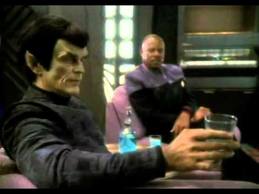
10. “In The Pale Moonlight” One of the most controversial episodes of Star Trek: Deep Space Nine has Ben Sisko desperate over the state of the war against the Dominion, committing very questionable and treasonous actions to influence the Romulans to join the war on the Federation’s side. These nebulous actions by a Star Trek lead hero best illustrate the murkiness of DS9’s main characters.
9. “In The Cards” This very funny episode showcases Jake and Nog as they go through many headaches and make complicated deals just to obtain a rare Willie Mays baseball card for Jake’s father. Highlights include the mad Dr. Giger (Brian Markinson) and his alleged immortality machine. Meanwhile on an ominous note, on the eve of war, negotiations fail between the Federation and the Dominion.
8. Emissary” The pilot episode introduces the cast of characters and the Cardassian-built space station orbiting the ravaged planet of Bajor. Intrigue and self-discovery abound as the intricacies of Bajoran society and the characters’ quirks are revealed, especially Sisko’s tortured soul. Still mourning over his dead wife and on the verge of leaving Starfleet, Sisko faces a moment of truth after discovering a nearby stable wormhole and the non-corporeal aliens inhabiting it.
7. “In Purgatory’s Shadow”/”By Inferno’s Light” Major changes happen in this two parter when the Cardassians, led by Dukat, unexpectedly join the Dominion. One of the show’s biggest shocks came when it was revealed that one of the major characters was actually a Changeling during several previous episodes and out to decimate the Alpha Quadrant powers.
6. “Far Beyond The Stars” Sisko finds himself in an alternate reality where he is a struggling science fiction writer in 1950s New York and must contend with racism as he tries to get his story published about a space station commandeered by a black officer. It was unforgettable and refreshing to see the show’s actors, many without makeup, portraying distinctly different characters, some good and some bad. Brooks deserves many kudos for captivating performance as Ben Sisko and writer Benny Russell.
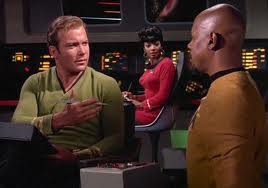
5. “Trials And Tribble-ations” In this tribute to the original Star Trek, the crew of the Defiant (the Starfleet ship posted to DS9) time travel back to Captain Kirk’s (William Shatner) era and wind up part of the classic Star Trek episode “The Trouble With The Tribbles”. The scenes where the DS9 characters interact with the original Enterprise crewmembers are still jaw-dropping and fun to watch. Some highlights include seeing the original Enterprise, Worf’s abrupt non-explanation about the classic era’s Klingons and when Sisko got to meet Kirk, one of his heroes.
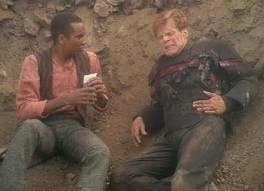
4. “…Nor The Battle To The Strong” Jake and Dr. Bashir are stranded on a Federation outpost under attack by Klingons. This episode focuses on Jake (one of the few by DS9 to do so) and his impressions of war as he is recruited to be a medic and meets several characters who react differently to battle situations. He sees up close how filthy and demoralizing war is and is strongly shaken by its brutality and its senseless nature. This episode was one of the grittiest ever shown on Star Trek and the realistic elements such as the Starfleet officer who wounds himself and Jake’s scared reactions added much to the story.
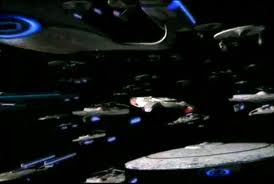
3. “Call To Arms” The fifth season of Star Trek: Deep Space Nine closes with this exciting episode that is about the eve of war between the Federation/Klingons and the Dominion. Tensions boil over and negotiations break down leading to open warfare between the two powers. The episode’s writers skillfully set up many cliffhangers for the coming season and had astonishing multiple endings that could’ve each ended the season effectively. Still, that final shot that has the Defiant joining a massive Starfleet/Klingon armada makes one cheer.
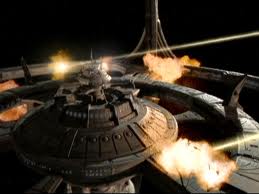
2. “Sacrifice Of Angels” This epic conclusion to the storyline about the Dominion occupation of DS9 rivals any big-screen sci-fi spectacular with its amazing special effects. Outnumbered and outgunned on board the Defiant, Sisko leads an armada of Starfleet ships against combined Dominion and Cardassian battle ships. It’s a race against time to break through the formidable fleet to reach DS9 before the mined wormhole can be opened to send through Dominion reinforcements. Meanwhile, Kira, Quark, Jake and other Federation loyalists on the station try to stay one step ahead of Dominion forces as they try to sabotage the enemy. After seeing the good guys losing ground in the episodes leading up to “Sacrifice Of Angels” it was a cathartic to see them finally confronting the enemy.
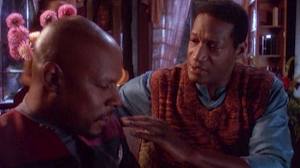
1. “The Visitor” One of the best time travel stories shown on any Star Trek series is ultimately about the bond between a father and his son. Sisko and Jake are on board the Defiant when a freak accident apparently disintegrates the captain. During his mourning Jake discovers that his father is actually alive but trapped in a timeless limbo. Life and time goes on while Sisko never ages and helplessly watches as Jake grows older, marries and then gives up his marriage and writing career to help him. The performances by Avery Brooks and Tony Todd (who plays Jake as an adult) will touch a soft spot in any viewer’s heart. The ending of “The Visitor” will be sure to leave a lump in one’s throat. More importantly, the episode illustrates how feelings and relationship trump any obstacle. These themes are why Star Trek: Deep Space Nine stood apart from the other Star Trek shows.
Other memorable episodes that just missed the list include in no order: “Explorers”, “The Siege of AR-558”, “Waltz”, “A Time To Stand”, “For The Uniform”, “The Magnificent Ferengi”, “Our Man Bashir”, “Inquisition”, “The Die Is Cast” and “Duet”.
Ever since the announcement of new standalone Star Wars films there has been much speculation as to what characters will see their own movie. Aside from which characters these films would cover, there have been musings as to when these Star Wars standalone films take place. In between the trilogies? After Return Of The Jedi?
Yoda will have one made, and hopefully it will focus on his younger days hundreds of years before the two trilogies, perhaps similar to the Knights Of The Old Republic series of comic books and games. Seeing him in his youthful prime, perhaps like Luke Skywalker was in A New Hope and The Empire Strikes Back should be a treat and fun to watch. Imagine him not being so wise or powerful, it would be a new way of presenting Yoda before he became a Jedi Master.
It was announced that Han Solo will also be getting his own Star Wars standalone movie. It will probably focus on his younger days and maybe show how he got his ship the Millennium Falcon from Lando Calrissian. Perhaps the movie will show how he met up with Chewbacca, as well as his early run ins with Jabba the Hutt and the Empire. This sounds like an interesting film and could be based on the series of novels that focused on this time period. Those include A.C. Crispin’s Han Solo trilogy (The Paradise Snare, The Hutt Gambit and Rebel Dawn) and the first Han Solo books written in the late ’70s/early ’80s by Brian Daley (Han Solo At Stars’ End, Han Solo’s Revenge and Han Solo And The Lost Legacy).
Boba Fett will also be starring in a Star Wars standalone film, for all we know Joe Johnston will get his wish and be picked as the director. I think it should take place after Return Of the Jedi and show how he survived falling into the sarlaac pit. This would alleviate many upset fans that were unhappy to see their favorite bounty hunter so carelessly killed off. One possibility is it could flashback to his early days after Attack Of The Clones and show how he became such a feared bounty hunter.
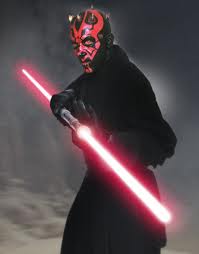
I am hoping that Darth Maul gets his own film as well and it could show he became such a ferocious fighter and sith lord. Maybe the story of the novel Shadow Hunter where he takes down the Black Sun crime syndicate could be used. His early interactions with Darth Sidious would be interesting to see.
The droids R2-D2 and C3PO could have their own film as well, as there is a precedence with the Droids animated series. Seeing how they managed to survive from Revenge Of The Sith to A New Hope could have them going across the galaxy and interacting with all sorts of characters from this era could be neat.
Finally, another no brainer is a Star Wars standalone film for fan favorite Jar Jar Binks–just kidding! 🙂
When we were kids, the future was presented to us by magazines like Popular Science and the long-gone Omni and pulp magazines was one that had us using jet packs to go to work, beaming to a planet, and using family VTOL rec vehicles. Other notions included colonies on Mars, cities in the sky and tricorders as seen on Star Trek. These developments back then were forecast for today, but as we all know that future missed its mark and was ultimately proven to be unattainable as of 2013. Except for the tricorder, which is a lot like smartphones. The new comic book limited series by IDW The High Ways takes place in the late 21st century and the future it represents seems like an attainable one.
Written and drawn by John Byrne, The High Ways has a future that seems as if its midway between our world and that of Star Trek. Space travel is much more common than it is now. Humanity has begun to travel regularly within our solar system, but faster-than-light travel is still a distant dream.
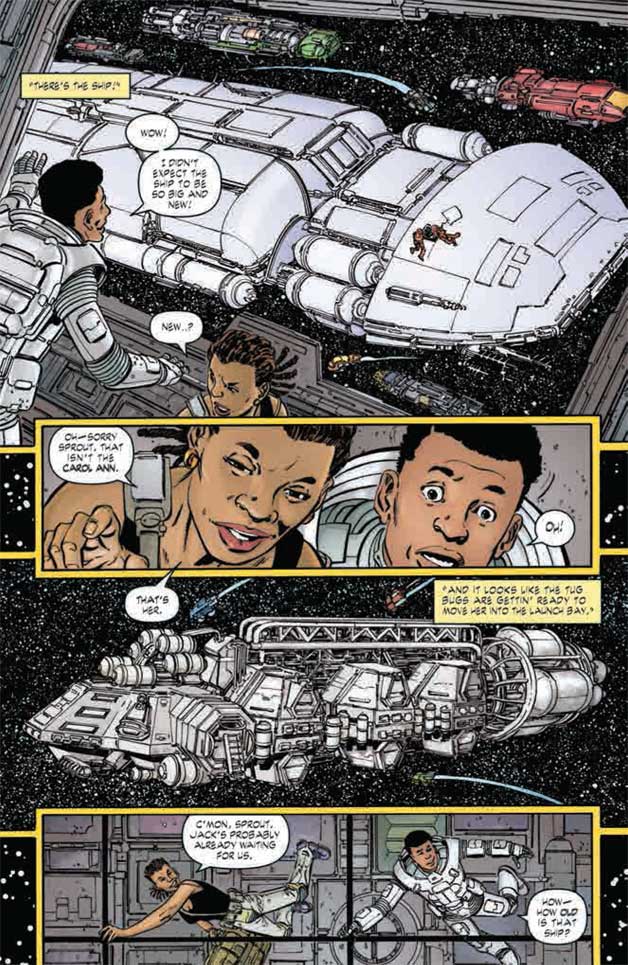
The limited series features Eddie Wallace, your typical young rookie navigator who is out seeking adventure in space. He can’t wait to go out into space and we first meet him in this vast space station inspired by the spoke-like wonder seen in 2001: A Space Odyssey. Naturally, what he expects and what he encounters are two very different things. Byrne’s skill as a detailed artist are put to good use in this comic book. There is hardware everywhere and it’s not aesthetically appealing like in Star Trek. In The High Ways, things have a lived-in look as seen in Star Wars and Alien, but not as advanced. Workers have to virtually live within their spacesuits. There isn’t any artificial gravity in the Wallace’s assigned freighter, the Carol Ann. The ship isn’t sleek at all, if anything, the Carol Ann is downright bulky and cobbled-together looking, even the Serenity on Firefly looks more appealing. From looking at Wallace’s expression when he first sees the ship that even he isn’t impressed.
At the station, Wallace meets his partner, Marilyn Jones, an attractive though slightly older and more experienced worker. She takes a liking to him in the way a big sister is fond of her little brother who is just out experiencing the world for the first time. The other main character is the Jack Cagney, the captain of the Carol Ann, who is short and craggy, looking much like movie legend James Cagney. According to Jones the captain only loved two things in his life and one of them is his ship and is only willing to take two people along with him on the Carol Ann on an assignment to Mars.
As they set out on the Carol Ann, their assignment is changed and they are diverted to a station orbiting Europa, Jupiter’s moon. There is where the mystery begins. For starters, the personnel at the station didn’t seem to know that the Carol Ann was assigned to the station. After meeting a normal, motley crew at that station, Wallace notices something isn’t quite right. The station crew seems oblivious to this ominous feeling that is plaguing Wallace. What is revealed in the final panel is downright creepy and actually gave me the creeps. I can’t wait to read what happens next.
The High Ways had very endearing characters and is a fun read at the same time it gives us readers a believable and attainable future setting; I recommend it to everyone who loves science fiction. Byrne is in his element with this story and he’s at his best when he writes and draws science fiction tales.