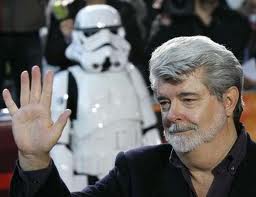
It’s been all over the news lately that with the release of Lucasfilm’s Red Tails George Lucas plans on retiring from blockbuster, i.e. popular films. Lucas cites the hard time he had trying to get Red Tails financed by studios (before he wound up paying for most of the film himself) and hints at the bitter reaction from many fans over his Star Wars prequels. In a New York Times Magazine interview he states, “I’m retiring, I’m moving away from the business, from the company, from all this kind of stuff.”
But looking at this and other interviews, one can spot a loophole or two. He does not rule out a fifth Indiana Jones film, although the older Harrison Ford gets and the longer it takes for Lucas to approve a script the less likely that becomes. Then there is the Star Wars live-action series that he is still trying to get off the ground. That looks more likely since advancements in special effects will soon make it financially feasible for Lucas to produce film-quality episodes of his galaxy-spanning saga.
Actually, his so-called retirement isn’t exactly news. Back when Star Wars Episode III: Revenge of the Sith was released, Lucas said then that he wanted to move away from blockbuster films. And even further back when Return of the Jedi came out, he claimed back then he wanted to focus on small, experimental projects. For many fans still bitter about Jar Jar Binks and Indy surviving a nuke blast in a fridge that’s great news. Don’t let the door hit you on the way out George, they may be thinking. But to others this is sad news and cements the fact that there won’t be any future Star Wars films.
Then again, look at his earliest efforts, THX-1138 and American Graffiti. Many forget today that both films were quirky, experimental pieces of filmmaking but are rightfully considered classics today. That’s especially true with THX-1138 since even today the film is seen as an avant-garde film. Whereas American Graffit is seen as a more conventional film it actually helped introduce the storytelling narrative of the main characters going off on their individual tangents without a set plot. That is because this technique has been copied so many times since. So Lucas probably just wants to go back to his roots and make quieter, low-budget films. That’s fine, since he did a superb job in directing them and at this point in his career, being that he is set financially, he can now afford to do whatever he wants.
Oh by the way, don’t forget that along with THX-1138 his other early genre effort was a little-known film at that time about some kid running around in spaceships with aliens. Yes that was Star Wars, but it was considered to be a huge risk for 20th Century Fox and experimental. So don’t write George Lucas off just yet.
It’s pretty obvious that the world of digital comics is expanding at a phenomenal rate. As tablets and smartphones become more commonplace it won’t be too long before the number of readers of digital comics could eclipse that of regular paper comics.
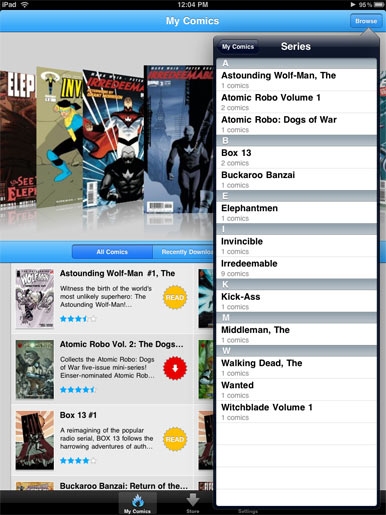
Companies like DC and Marvel sell digital downloads and even offer free downloads to sample their comics. And it’s very easy to download comics. Just download an app with Comixology, iVerse Media’s Comics + or even from comic book companies themselves. In fact, Marvel, DC, IDW, Dark Horse and others also offer free apps.
After downloading the apps, just sign up for a free account. Readers are taken to the sites’ main menu where they can buy comic books. There are literally thousands of titles to choose from, no more running around to different comic book stores to find that elusive issue that is sold out everywhere. A simple search button will yield instant results. At this point the sites don’t have complete collections but the library is growing so it won’t be inconceivable to have a complete collection of Fantastic Four digitally.
Once they’re downloaded, the comics go into the cloud so they can’t be lost even if you’re device is damaged. Anyone can go into a friend’s laptop or desktop and view their own comics. While comics can be read on traditional computers, reading them on mobile devices is the way to go becausenow the digital comics are as portable as regular paper comics. What’s more is that images can be enlarged to better appreciate the art and a simple swiping of fingers allows page turning to be easier than regular comics. Plus readers don’t have to worry about being careful with reading mint comics and the online comics don’t have any ads to skip over.
Before buying comics, readers are given a preview of a couple of pages to sample the comic. This can be a disadvantage to regular paper comics where a reader can conceivably skim through the entire issue before deciding to buy the comic. But many times, companies offer several-page previews or even an entire first issue which gives one a better idea of what they’re going to buy.
These free downloads are an excellent way to preview comics or characters. DC jumped at this opportunity by offering downloads of popular characters and calling them for example Flash 101, which offers origins and first appearances of characters, complete with cover galleries. It’s a great introduction for new readers and DC should use this concept more with their lesser known characters. One can only wonder why Marvel isn’t doing this.
DC certainly has the edge when it comes to digital comics. It seems as if they wholeheartedly embraced the concept especially when they launched The New 52 earlier this year when they relaunched their titles on paper and digital on the same day. These digital comics revived DC’s sales, in fact, for September 2011 they were the only company to have reported a sales increase of 1000% that is simply incredible.
However, not all is perfect with digital comics. To really compete, digital comics must offer more for the same price. For example a paper comic is $2.99 or $3.99 and that is supposedly due to production and print costs. Then why are online comics the same price? Sure if one is patient, individual issues usually drop in price weeks later, but why should the costs be the same on the first day of issue? If companies are to charge the same price then incentives should be offered. This could include creator commentaries, scripts, galleries and sketches. The comics should have a toggle button pencil inks and even one to remove the word balloons so readers can really appreciate the artwork.
Companies need to take advantage of the interactive features that are possible with online comics. One thing that can be done is to include live, real-time reader comments and updates. This means that a reader can finish a book then be able to comment on the issue which will show up immediately in that book’s commentary section.
While currently downloaded comics offer suggested links to similar titles, the comics should offer a link to a superhero homepage, that is that homepage would explain who is the character, show maps and galleries and databases on characters and story arcs. In DC’s case, offer a link to their 101 introductions or include it with the initial download of a particular comic. Annuals should be annotated with sound f/x which could be an incentive to buy them.
Perhaps the Justice League annual, the deluxe edition, can have voice actors, CG effects, sound effects, original music composed and conducted for the annual; the penci/inlk/color/word ballon toggle, interviews with the editor, writer, artists, dropdown reader commentary (the letters page), link to the Hall of Justice where you can get a converged version of the 101s, like Superman 101 will present not only comics, but TV shows, animation, gaming, trailers, and movie versions. Also polls asking for opinions of a particular issue, character, or villain, etc.
Also, DC Universe online should converge with the New 52. And of course, any new mass media creation should be cross compatible with other media, meant to tie unto an integrated universe.
They could have started with the Green Lantern movie and linked him with the future formation of the Justice League. DCUO could have merged the Ryan Reynolds GL into the game. That’s the big picture examples of how digital comics can further evolve.
Check out this video from the annual big idea conference TED, which stands for Technology, Enternatinent, Developers:
Here they show what an ebook can do. DC & Marvel really should exploit the best that tech has to offer to show that a superhero story can envelope a convergence of media.
There is still room to grow with digital comics. Perhaps some of these suggestions could be utilized to fully realize digital comics’ potential. In the end this could be what saves comics.
As this imagining continues about who Lucas would cast in the Star Wars movies if they were filmed chronologically, there is one important thing to consider. Most likely the films would’ve been completely different to the point that characters would change or even be written out altogether. There isn’t any way to accurately factor in how different the films would be. This is pure speculation under the premise that if the storyline remained exactly the same then so would the characters for the most part. As stated previously, there isn’t any way to know if Lucas would’ve gone for these picks or if the actors would accept the offers.
The Original Trilogy: Star WarsEpisodes IV-VI
Luke Skywalker: Supposedly, Ryan Phillippe was a thisclose runner-up to play Anakin. So he was in Lucas’ mind. He has the acting ability to add more pathos and angst to Luke as he grows from a simple farm boy to a seasoned warrior throughout the trilogy. Then again Lucas may have hired Hayden Christensen and who knows how that would have turned out. But one actor to consider seriously is Shawn Ashmore, who appeared as Bobby Drake/Iceman in the X-Men films. True he might’ve been a bit young but Luke was supposed to be an innocent farm boy with big dreams.
Han Solo: Thomas Jane has the good looks with a rakish demeanor, plus he’s a talented, underrated actor that could easily play a swasbuckling, rogue spice smuggler who redeems himself and wins a princess’ heart. Of course, a fan-favorite alternative would be Firefly’s Nathan Fillion, his character of Malcolm Reynolds has many of Han’s qualities but Jane looks a bit tougher, the kind of scrappy guy you want on your side during a fight. Also another Firefly alumni that could’ve portrayed a deadlier version of Han is Adam Baldwin.
Leia Organa: Selma Blair has the looks and scrappiness to play the princess-in-distress who can take care of herself in a blaster fight. Perhaps audiences would’ve been spared that goofy hairdo in Episode IV, then again remember those outlandish outfits that Padme wore in Episode I. A viable and spunky alternative is Kelly Macdonald who, like Ewan MacGregor, appeared in the cult classic Trainspotting, so Lucas would’ve still hired someone from that film. Or Morena Baccarin, yet another Firefly alumni, could’ve played a more sultry and exotic Princess Leia.
Obi-Wan “Ben” Kenobi: It’s likely that Perry King or any other actor who originated the role back in the ’70s and ’80s would have been able to reprise it with the new trilogy. With that stated here’s a curveball of an acting pick: Sean Connery. The man was a legend by 1999. He has that regal yet tough demeanor with a compassionate undercurrent to pull off the role of an old Obi-Wan. This role might’ve prolonged his acting career by a few more years since it wouldn’t have led to him retiring after feeling disgruntled with Hollywood.
Darth Vader: Kurt Russell, who might’ve been picked to play Anakin in the early films, could’ve been persuaded to don a full suit with face-concealing helmet and play Vader. Maybe Ron Pearlman could’ve worn the suit? Otherwise, some unknown, muscular and tall performer would fill in the role. James Earl Jones would’ve done the voice as in the real world. If he wasn’t available then Lucas could’ve gone with Avery Brooks who also has a rich, booming and distinctive voice.
Lando Calrissian: Solid acting ability is just one reason why Blair Underwood is a lock for this role. It calls for someone that is a charming, good-looking, former con man who is forced to turn against Han before joining the rebels in the end. The guy just looks like a hero! Another outside possibility is Terrence Howard who has many of Underwood’s qualities to play Lando.
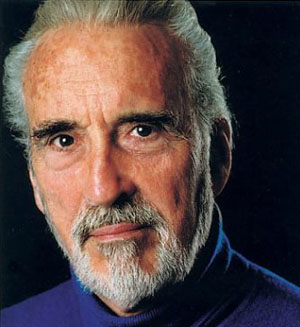
Grand Moff Tarkin: Christopher Lee should’ve been able to play this role nicely. As seen most recently with Lord of the Rings: The Two Towers, Lee showed audiences why he makes a great villain with experience going back to the old Hammer films. Then again Lucas may have tapped Terrance Stamp for the role. He did appear as Chancellor Valorum in ThePhantom Menace and could play cold, icy villain with his eyes closed.
Boba Fett: If Scott Glenn was cast as Jango then there’s no reason why he couldn’t play his offspring in the final films. That is if Boba had an expanded role in the final films. Otherwise, being that the character had a limited role, spoke a handful of lines and didn’t even remove his helmet, it’s probable that an unknown actor would’ve been cast instead.
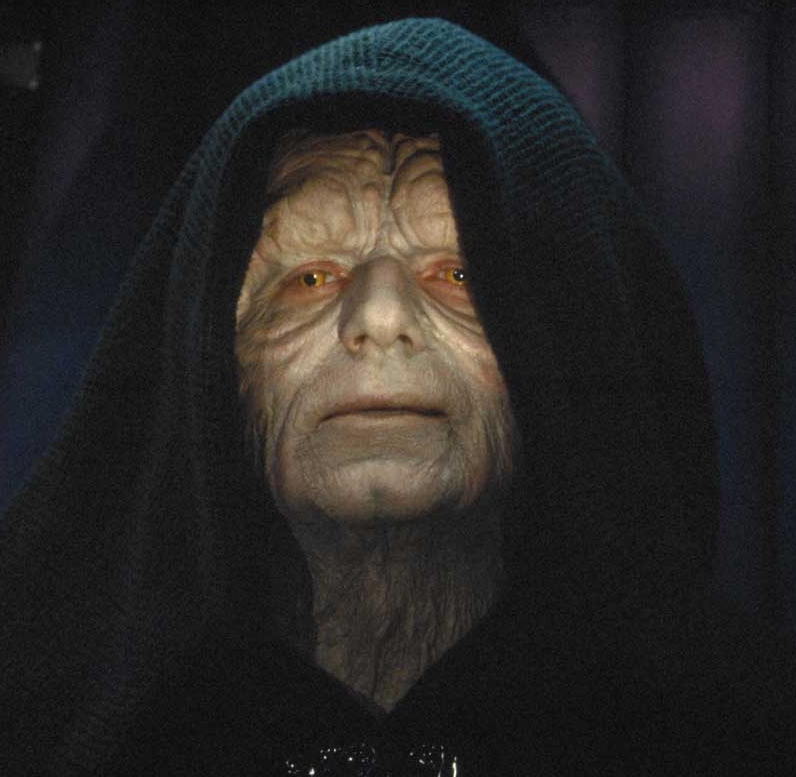
Palpatine: Ian McDiarmid would reprise his role as the Emperor for the final two films. The makeup might be different. That of course depends on whether or not he originated the role with the Prequel Trilogy. Whoever else was chosen to play Palpatine could’ve continued playing him or John Noble, now seen on Fringe, could’ve done the part. That man can do twisted, calculating nemesis. Look no further than his role as Walternate in Fringe or Denethor in Lord of the Rings: The Return of the King.
Chewbacca: If that character made his debut in Episode III and Peter Mayhew played him then hopefully he would still play the Wookie in the later films. It’s hard to imagine someone else doing the part, maybe Brad Garrett? He is pretty tall, but he wouldn’t have any lines so who knows if he would’ve accepted. Perhaps Chewbacca would be played by some unknown actor. Then again Chewbacca and the Wookies may not have appeared in Episode III, meaning that he would be a CG creation. In that case only Andy Serkis or Doug Jones would be able to project their acting ability through the mo-cap process.
Wicket: Lucas probably would have the Ewoks rendered in CG and made them into a completely different race. Maybe a more formidable and believable a force to defeat the Empire’s stormtroopers. Otherwise Warwick Davis would play Wicket as he did in real life.
Yoda, C-3P0, and R2-D2: They would’ve been played by the performers who originally played them. Meaning Frank Oz, Anthony Daniels, and Kenny Baker, respectively. That’s because since all three characters appeared in the early films and in real life were performed in the ’70s and ’80s by these three men then logically they would continue doing the roles. One thing to note is that Yoda would have been a lot less active in the prequels due to f/x limitations. Hence, no crowd-pleasing lightsaber duels in the prequels. But Yoda may have survived long enough in the final film to confront Palpatine with a spectacular duel as he did in the final scenes of Episode III.
As for Jabba the Hutt, Admiral Ackbar, and Nien Numb, well they most likely would be CG creations instead of puppets or actors in heavy makeup. It would be interesting to see how they would’ve appeared in that case.
And just to goof around, let’s have Patrick Stewart bridge the worlds of Star Trek and Star Wars and make a cameo appearance in Episode V as Lando’s aide Lobot!
While many are complaining about yet more changes to the Star Wars films with the new blu rays, everyone should consider that the saga has always been in a state of flux. This thought leads to a nagging question. What if George Lucas had filmed the saga chronologically? That is Episode I was the first Star Wars movie to be filmed back in the mid ’70s while Episode VI would’ve been released in 2005. Aside from the f/x and the storyline being different, so would the casting. This rings especially true in the last three films because it’s hard to imagine Mark Hamill, Harrison Ford and Carrie Fisher portraying their iconic roles in middle age.
So with that thought let’s imagine who Lucas would’ve cast in the Prequel Trilogy, which would’ve spanned from the releases dates of 1977, 1980 and 1983. Note that there isn’t any way to predict with absolute certainty who Lucas would’ve cast or if his picks would’ve even accepted the roles. It’s easy to imagine that Lucas might’ve gone for an unknown actor or someone out of left field to play any of these roles. This isn’t a criticism of Lucas or the actors just pure speculation based on who auditioned for roles and was available at the time.
The Prequel Trilogy: Star WarsEpisodes I-III
Qui-Gon Jinn: As the seasoned, wise and worldly Jedi Master, Nicol Williamson would’ve filled that role quite well. Just look at his performance as Merlin in Excalibur, the actor would’ve been perfect for Qui-Gon. One reason for this pick is that Lucas wanted to use primarily unknown performers but he did use seasoned, established actors in his films like Alec Guiness and Peter Cushing. If he decided to cast a star then an excellent choice for Qui-Gon would be Sean Connery. Despite his advancing years, Connery was still a tough, rugged leading man with many of the qualities needed for Qui-Gon.
Obi-Wan Kenobi: One of the main contenders for Han Solo was Perry King. In fact, he played Han in the Star Warsradio plays. So with his handsome good looks and acting chops, King would be a solid choice to play the heroic, noble Jedi who’s forced to fight his apprentice by Episode III. Plus he probably would’ve reprised Obi-Wan years later in Episode IV.
Padme Amidala: A difficult part to cast along with Anakin. The reason being that Lucas might’ve decided to have Anakin in the first film be an older character, which would throw off the entire casting process. If that happened then Carrie Fisher could perform her as she did with Princess Leia and that in turn means the actor to play Anakin in Episode I would have to be older . But if Lucas decided to have Padme younger then he would need to pick someone else like Terri Nunn, now known as the lead singer of Berlin. She was 16 at the time of casting and originally read for the role of Leia. Alternatives would include Rosanna Arquette, Melanie Griffith and even Eve Plumb. Seriously.
Anakin Skywalker: Kurt Russell was in the running for the role of Han Solo. He could’ve easily played a rash Anakin in Episodes II and III with his boyish good looks and hint of menace in his eyes. Just look at his portrayal of Snake Plissken. In Episode I, a young Anakin might’ve gone to some unknown child actor. Or Lucas could’ve picked Noah Hathaway who was about the same age as Jake Lloyd was when he was cast as Anakin. Or the filmmaker might’ve decided to introduce Anakin as a slightly older child, maybe even a teenager. This of course would probably mean that the actor chosen would continue to play the role in the sequels and thus no Kurt Russell. Choices include Ike Eisenmann, or Lance Kerwin.
Jar Jar Binks: Robin Williams would’ve been perfect for the role. Imagine a young, spirited Williams in his comedic prime running away with this role under heavy makeup. His performance might’ve been the one to catapult him into stardom rather than Mork from Ork. The character might’ve really caught on back then and had a larger roles in the sequels.
Mace Windu: Billy Dee Williams was considered for the role of Han Solo and as Mace, Williams would’ve added a heavy dose of charisma. This would’ve complemented the overall character of the Jedis and added to their regal nature. Heck, if you see him wearing his cape as Lando Calrissian, the guy looks like a Jedi of sorts.
Palpatine: Ian McDiarmid hopefully would’ve been cast back in ’76 and played the scheming politician and Sith Lord. The makeup might’ve been different in the final films given his age but nothing else would be different.
Nute Gunray: This was a largely forgettable villain but Peter Cushing would’ve added a chilling demeanor and turned him into a true menace. Albeit he would’ve played a human without makeup. However given his ill health by the early 80s his involvement in the next two films might’ve been limited.
Count Dooku: To portray this dashing, elegant and calculating fallen Jedi an actor needed to have all those qualities. Christopher Lee had it and so would Ricardo Montalban. Although would he then reprise his iconic role of Khan in Star Trek II: The Wrath of Khan a couple of years later? If not him, then Maximilian Schell would’ve been a viable alternative.
Jango Fett: Scott Glenn has that mean, ornery look of a mercenary and the character might’ve had more of a Western motif. Clues of this can be found in the original Attack of the Clones when Jango dispatches a hapless Jedi with a quick draw during the climatic arena battle. Plus, Glenn’s casting would mean that Boba’s role in the future films would’ve been more substantial.
Darth Maul: The role was limited requiring only someone with tremendous physical prowess. A young Jackie Chan , Chuck Norris or some other martial artist could’ve portrayed this acrobatic Sith apprentice.
General Grievous: Due to the limited CG technology in the early ’80s, the character would be presented as a more humanoid being, perhaps the actor’s face would’ve being visible. In any regard, Christopher Lloyd has shown in the past with Who Framed Roger Rabbit? and Star Trek III: The Search For Spock, that he can make a convincing villain and would have done the same in Episode III.
Boss Nass: Brian Blessed would have played this role and be in makeup rather than some CG rendering as with Episode I.
José Soto
Coming Soon: Part II with the Original Trilogy Re-Cast!
DC Comics unveiled this Wednesday their reimagined universe with Justice League #1, (written by Geoff Johns and drawn by Jim Lee and Scott Williams). This isn’t an ordinary reboot per se.
Variant cover to Justice League #1 by David Finch
Rather it’s the next evolution for comic books. As every comic book fan knows, on August 31, 2011 DC simultaneously released print copies of Justice League #1 and digital downloads of the same issue. While comic book shops received their copies on Tuesday, they weren’t allowed to put them up on shelves until their stores opened the next day. With the digital downloads, however, they were ready for consumers at 12 am midnight on Wednesday.
That already is one plus side for downloads and in theory this means that everyone, anywhere with Internet connections can get a copy of their favorite comic book. If you lived in big cities like New York that have many comic book stores it’s fairly easy to find any kind of comic book. But if you live in small towns, often you’d have to travel many miles scouring the landscape for a new release and hoping that the small store you find still has a copy of the release. That is if they even carried it in the first place.
Upcoming Detective Comics #1, Cover by Tony S. Daniel
This could spell trouble for comic book stores. But if they’re smart they can re-tool their business model and possibly gear their stores more to sell merchandise based on the comic books. That’s just one idea. Either way, they need to adapt or go the way of travel agencies and record stores that were decimated by travel websites and iTunes. But for fans and publishers, digital downloads are the way to go. But it’s not without its drawbacks.
First of all, it’s one hundred percent web dependant. If your Internet connection is poor or the signal is cut off you can’t read the comic book. See, if I was living in the Legion of Superhero’s perfect 30th century world where technology was very advanced this wouldn’t be much of a problem. But today, it is still easier for me to walk five feet over to my bookshelf and pick up a print copy than to turn on a computer or tablet or smartphone and search for the same comic book in digital form. Also, there’s no interactivity with the Justice League download. The word balloons and art are static, but on a plus side, there are no ads and the images are hi-res. In fact, the final four pages consist of costume sketches by Lee and Johns.
Being that it’s a protected download, you cannot copy it and send or sell it to a third party. If your friend wants a copy, he or she can’t just borrow a print copy and give it back to you; it has to be bought. For publishers this is a godsend since I think this may help boost sales.
Speaking of that, I believe that the downloads will wind up selling five times more than print copies. Eventually we may see sales totaling about 500,000 per issue versus today’s dismal 20,000-30,000 figure. Of course, I doubt it will equal or top the World War II figures of millions of copies per issue and that’s because there is so much media for comic books to compete with.
Upcoming Action Comics #1, Cover by Rags Morales
A good ripple effect from downloads is that poor-selling titles may have a longer life. Ordinarily, a comic book with low sales would be canceled for economic reasons. But if it switched to being solely a digital download then production costs will be low enough to keep it going. While fans of that title won’t be able to own a print copy, they can at least follow the title on-line.
As downloads and new apps and technologies emerge and come of age, it will be easier for new generations already accustomed to the new technologies to buy downloads and actually prefer it over running down to the store to buy a print copy. This is truly a game changer not only for DC but the comic book industry at large. Now for the perfect connectivity, what’s the name of that 30th century Internet service provider?
 It’s been all over the news lately that with the release of Lucasfilm’s Red Tails George Lucas plans on retiring from blockbuster, i.e. popular films. Lucas cites the hard time he had trying to get Red Tails financed by studios (before he wound up paying for most of the film himself) and hints at the bitter reaction from many fans over his Star Wars prequels. In a New York Times Magazine interview he states, “I’m retiring, I’m moving away from the business, from the company, from all this kind of stuff.”
 THX-1138 his other early genre effort was a little-known film at that time about some kid running around in spaceships with aliens. Yes that was Star Wars, but it was considered to be a huge risk for 20th Century Fox and experimental. So don’t write George Lucas off just yet.